

AI CERTs
6 months ago
AI workforce skill mapping systems reshape corporate reskilling
Sudden leaps in generative AI are reshaping corporate talent planning. Consequently, boards now demand concrete strategies for rapid reskilling. Executives are turning to AI workforce skill mapping systems for precise insights. These platforms promise live inventories of abilities, gaps, and growth paths. However, hype can obscure practical steps and hidden risks. This article delivers a pragmatic roadmap for leaders considering enterprise deployments. Readers will gain market context, technical building blocks, governance advice, and success metrics. Moreover, each section flows into an actionable checklist supporting data-driven decision making. We also spotlight certifications that strengthen workforce credibility in an AI-first economy. Prepare to translate buzzwords into measurable business value. Meanwhile, real-world statistics ground every recommendation. Therefore, technology buyers can avoid pilot fatigue and accelerate scaled results.
AI Workforce Skill Mapping
World Economic Forum data signals an urgent skills crisis. By 2030, 59 percent of workers need significant training. In contrast, many budgets remain locked in external hiring. Consequently, AI workforce skill mapping systems emerge as cost savers and growth accelerators. They combine skills graphs, machine learning, and internal marketplaces. Furthermore, platforms like Workday, SAP, and Eightfold infer abilities from live project artifacts. This automated visibility transforms static job descriptions into dynamic skill signals. Subsequently, leaders can redeploy talent weeks faster than traditional requisition cycles.
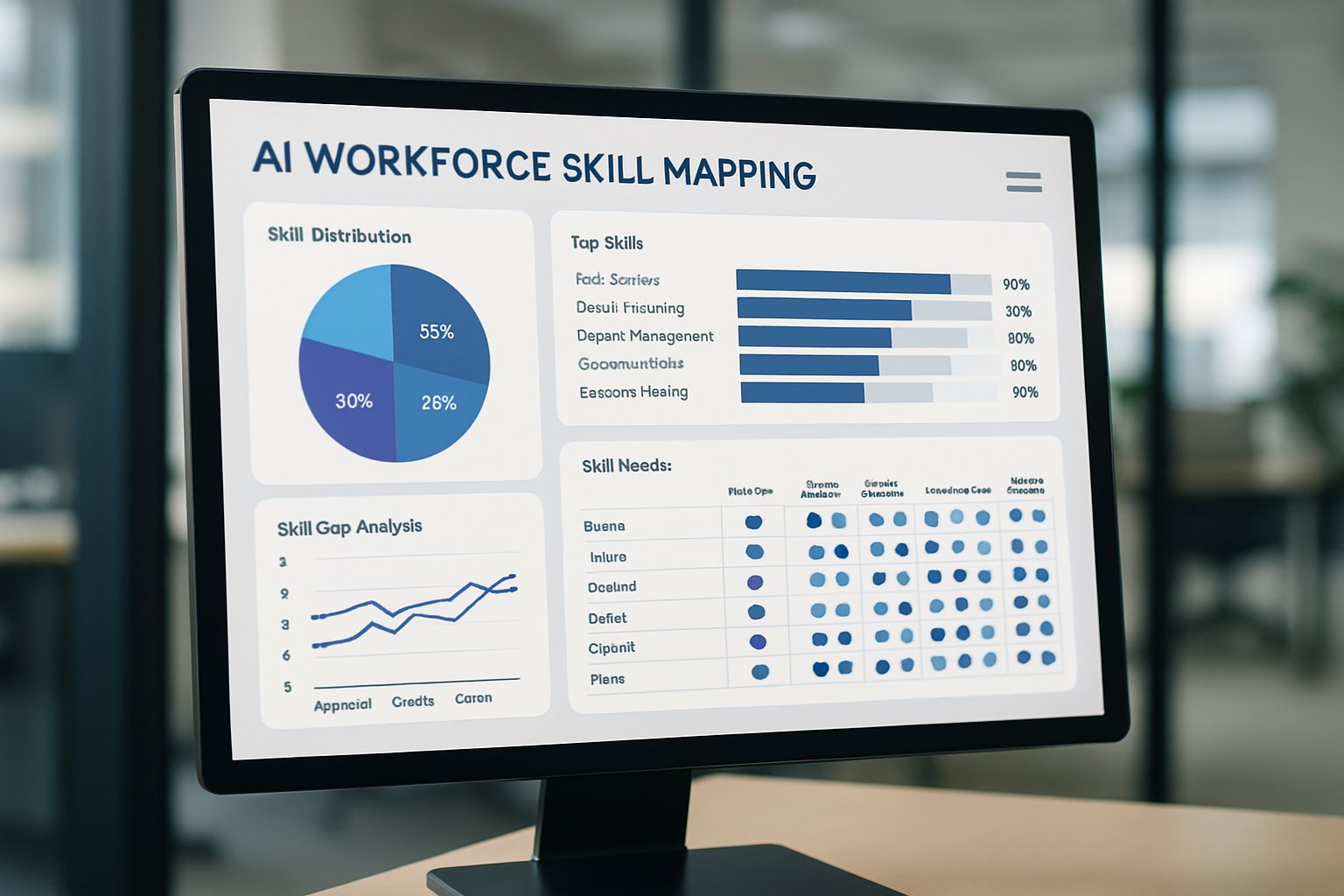
The shift from titles to skills offers measurable agility and retention gains. However, strategy must rest on solid market drivers, not vendor rhetoric. The following snapshot grounds the conversation in verifiable trends.
Global Market Drivers Snapshot
Recent reports outline four macro forces behind the adoption wave.
- WEF projects 170 million new roles and 92 million displaced by 2030.
- Cisco consortium says 92 percent of ICT jobs will transform significantly.
- Udemy notes finance AI course consumption jumped 75 percent in one quarter.
- Learning software revenue may reach 8.2 billion dollars by 2029.
Collectively, these numbers spotlight rising demand for scalable reskilling architectures. Therefore, platform capabilities must evolve accordingly. AI workforce skill mapping systems underpin each illustrated statistic.
Next, we examine why a skills-first mindset delivers strategic advantage.
Skills-First Strategy Rationale
Traditional frameworks hinge on hierarchical roles and slow annual planning cycles. Moreover, they overlook adjacent capabilities that support lateral moves. AI workforce skill mapping systems surface hidden synergies between tasks and people. Consequently, mobility improves while hiring costs drop. Secondary benefits include richer succession pipelines and personalized learning journeys. Additionally, talent intelligence metrics help leaders model future scenarios faster. For example, Workday used live skill inference to realign 20,400 employees within months. Furthermore, future-skills analytics can pinpoint emerging gaps before they disrupt execution. These outcomes validate a pivot toward granular, data-driven workforce planning. However, delivering them requires robust technological foundations. We now explore the tools enabling those foundations.
Key Platform Innovations Emerging
Most modern suites embed skills graphs as core data models. In contrast, earlier systems relied on static competence dictionaries. Furthermore, natural language processing extracts capabilities from emails, code repositories, and tickets. Subsequently, profiles stay current without manual surveys. Another breakthrough involves retrieval-augmented generation for personalized learning content. Consequently, future-skills analytics dashboards update instantly when employees finish micro courses. Internal talent marketplaces then match people to gigs in minutes. Moreover, talent intelligence algorithms surface adjacent roles, boosting retention. Vendors differentiate through openness, explainability, and privacy controls. Professionals may validate expertise with the AI Supply Chain™ certification. Such credentials strengthen trust during platform rollouts.
Key technical capabilities include:
- Open skills taxonomies with API access.
- Bias detection and audit dashboards.
- Learning ecosystem integrations via LTI.
- Employee consent and profile editing rights.
Collectively, these advances turn raw data into actionable pathways. However, implementation discipline decides ultimate ROI. The next section distills a proven playbook.
Implementation Playbook Essentials
Successful programs begin with clear business outcomes. Therefore, leaders set baseline metrics like internal mobility and time-to-fill. AI workforce skill mapping systems require high quality data integrations. Connect HRIS, ATS, learning platforms, and project management tools early. Subsequently, run a three-month pilot in a critical function. Moreover, include human reviewers to validate inferred skills and matches. Talent intelligence dashboards should expose model confidence scores for transparency. Future-skills analytics then guides tailored content and gig recommendations. Governance boards must oversee bias audits, privacy compliance, and appeals mechanisms. Finally, compare pilot metrics against baseline and iterate before scaling enterprise-wide.
Structured pilots de-risk investments while building stakeholder trust. Nevertheless, governance remains critical throughout scaling. Our next section explores those governance requirements.
Governance Ethics And Trust
Algorithmic decisions must withstand legal and public scrutiny. Therefore, organizations adopt clear data minimization and consent policies. AI workforce skill mapping systems can collect sensitive behavioral information. Consequently, privacy impact assessments should precede every new data connector. Moreover, regular bias testing using demographic parity metrics reduces discrimination risk. In contrast, black-box models undermine employee confidence. Establish explainability dashboards showing why each match appears. Additionally, human reviewers should approve high-stakes promotions or layoffs. Publishing annual fairness reports promotes accountability with regulators and staff. These measures foster trust vital for sustained adoption.
Strong governance protects both brand and workforce dignity. Next, we quantify success using rigorous metrics.
Measuring Impact And Metrics
Quantifying ROI helps secure continued investment. Suggested metrics include:
- Internal mobility rate change.
- Time-to-fill internal roles.
- Training completion to application ratio.
- Employee retention in critical skills.
- Skill coverage versus strategic demand.
Furthermore, integrate dashboards with finance systems to track cost savings. Future-skills analytics can also forecast workforce readiness for new product launches. Moreover, talent intelligence insights reveal emerging gaps before they hurt revenue. AI workforce skill mapping systems should refresh these metrics weekly for agility. Consequently, executives receive near real-time decision support.
Consistent measurement converts abstract skill data into financial narratives. Finally, leaders must look ahead to emerging trends.
Future Outlook And Actions
Analysts predict deeper integration between skills graphs and workflow automation. Meanwhile, smaller vendors will differentiate through domain specific ontologies. AI workforce skill mapping systems will increasingly embed conversational agents for career coaching. Consequently, employee adoption may grow as interfaces feel intuitive. Additionally, regulatory scrutiny will tighten, mandating transparent bias reporting. Boards should act now to pilot, audit, and scale responsibly. Professionals can future-proof careers by earning advanced credentials like the earlier linked certification. Moreover, cross-functional task forces should align HR, IT, and compliance roadmaps. AI workforce skill mapping systems coupled with talent intelligence create resilient, adaptable organizations. Therefore, proactive leaders seize competitive advantage today.
Responsiveness, governance, and measurement underpin successful reskilling programs. These pillars close the loop from strategy to execution.
Conclusion
Corporate success now hinges on skill velocity, not static headcount. AI workforce skill mapping systems translate velocity into actionable blueprints. They integrate skills analytics and learning ecosystems for holistic insight. However, technology alone fails without clear goals, clean data, and ethical governance. Therefore, start with a focused pilot, embed human oversight, and measure relentlessly. Professionals should deepen expertise through recognized certifications for career resilience. Act decisively, and your organization will thrive amid relentless change. Consequently, an agile, engaged workforce becomes your strongest competitive moat.
Disclaimer: Some content may be AI-generated or assisted and is provided ‘as is’ for informational purposes only, without warranties of accuracy or completeness, and does not imply endorsement or affiliation.


