

AI CERTs
2 hours ago
AI Test Challenges Authentication Integrity on Van Eyck Art
Until last week, two serene panels of Saint Francis enjoyed near universal admiration as Jan van Eyck originals. However, a fresh machine-learning study by Swiss start-up Art Recognition delivered stinging verdicts. The high-resolution system assigned 91 percent and 86 percent negative probabilities to the Philadelphia and Turin pictures. Consequently, the results have shaken curators, collectors, and insurers. Authentication Integrity now dominates conversations across conservation labs and auction houses. Moreover, the episode underscores wider tensions between connoisseurship and algorithmic certainty. Industry professionals must examine the technology, its limits, and its market impact.
AI Claims Shock Market
On 7 February 2026, Art Recognition unveiled its findings through The Guardian. Additionally, Tilburg University researchers collaborated on the analysis. The algorithm scrutinised micron-level Brushstrokes across thousands of image patches. It then compared those patterns against a training set of roughly twenty confirmed Van Eyck Masterworks. Consequently, the Philadelphia panel received a 91 percent negative score, while Turin’s version scored 86 percent negative. Both museums declined comment at press time. The controversial scores question Authentication Integrity across global collections.
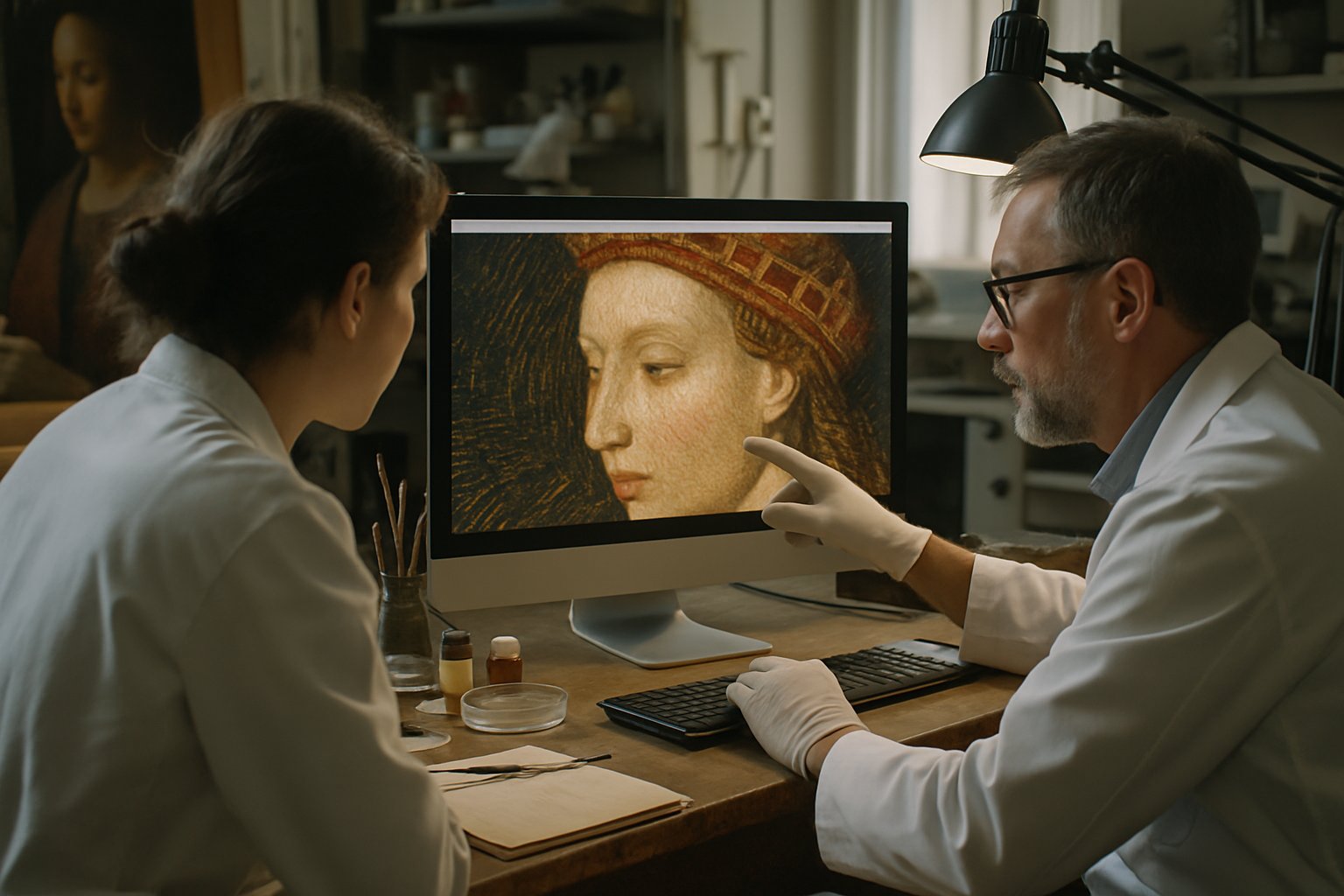
Art market observers reacted swiftly. In contrast, the same tool returned an 89 percent positive reading for the National Gallery’s Arnolfini Portrait. Therefore, investors asked whether valuations of the disputed panels should be revised. Auction houses watch the situation closely, fearing broader ripple effects on Netherlandish Masterworks.
These headline numbers upended price expectations and curatorial narratives. Nevertheless, the technical community demanded methodological transparency. The next debate centred on how the model actually works.
Brushstroke AI Model Explained
Art Recognition’s pipeline begins with ultra-high-resolution gigapixel photographs. Subsequently, algorithms segment individual Brushstrokes, capturing edge curvature, pressure profiles, and pigment texture. Moreover, convolutional layers classify each stroke against a reference corpus of accepted works.
Proponents argue that such granularity adds a new quantitative layer to Art Forensics. However, critics note that Van Eyck left only about twenty secure paintings, meaning tiny datasets. Consequently, overfitting threatens Authentication Integrity when the system extrapolates from limited examples.
The company declined to publish its full architecture or training weights. In contrast, peer review remains standard in scientific disciplines. Without open methods, independent analysts cannot replicate scores or assess statistical noise. Such disclosure would elevate Authentication Integrity within computational art history.
Transparent code would bolster professional confidence in AI connoisseurship. Meanwhile, scholars voiced several red flags that merit close attention.
Scholars Raise Red Flags
Ghent University professor Maximiliaan Martens warned that Van Eyck Brushstrokes are barely visible even under microscopes. Moreover, centuries of varnish, retouching, and wood movement distort surface signals. Therefore, he questions whether the algorithm recognises the artist or the restorer.
Historian Till-Holger Borchert acknowledged the results might support earlier theories of studio participation. Nevertheless, he cautioned against binary claims that erode nuanced workshop realities. Noah Charney added that Art Recognition had proven accurate in prior Rubens and Van Gogh disputes, yet every Old Master case differs.
Expert voices reveal a field wrestling with probability, not absolutes. Consequently, data limitations emerged as the focal technical concern guiding further dialogue.
Dataset Limitations Still Matter
Machine-learning models thrive on thousands of labeled examples. However, Old Master authentication supplies only dozens, sometimes fewer. Art Recognition reportedly trained on under twenty Van Eyck Masterworks, an order of magnitude below best practice. Consequently, statistical confidence intervals widen. That scarcity threatens Authentication Integrity because a single mislabelled image can skew outcomes.
Condition variance compounds the issue. Meanwhile, cracked varnish and infrared reflections introduce artifacts that models may treat as authorial cues. Furthermore, workshop assistants often copied compositions, producing convincing but mechanically different Brushstrokes.
Key reliability hurdles include:
- Small positive corpus for each painter
- Unknown restoration histories altering surface data
- Closed commercial algorithms blocking peer validation and undermining Authentication Integrity
- Inconsistent imaging standards across institutions
These constraints explain many expert reservations. However, technology also offers genuine advantages that stakeholders should not dismiss.
Prospects For Art Forensics
Despite controversy, AI delivers measurable benefits when deployed responsibly. Additionally, it screens large digital archives rapidly, flagging suspicious works for deeper review. Consequently, scarce conservation budgets stretch further.
Moreover, probabilistic scoring adds objectivity, complementing human eye judgments. Analysts liken the approach to medical imaging triage. In contrast, traditional connoisseurship lacks quantitative baselines, complicating Authentication Integrity discussions.
Early success stories include identifying eBay forgeries masquerading as Baroque Masterworks. Furthermore, Art Recognition claims to have uncovered forty such listings in 2024. Balanced deployment therefore enhances Art Forensics without replacing scholars. The next hurdle involves governance and shared standards.
Toward Open Shared Standards
Industry leaders propose a voluntary disclosure code. Consequently, firms would publish model architectures, training datasets, and confidence intervals. Museums could then replicate findings before adjusting labels or insurance values.
Professional guidance may arrive through collaborative bodies. For example, the International Council of Museums is drafting a protocol that emphasises Authentication Integrity through cross-disciplinary oversight.
Practitioners can deepen their expertise through the AI Researcher™ certification. Moreover, such programs integrate Art Forensics modules covering spectral imaging and Brushstrokes analytics.
Standards and training foster transparency and skill growth. Subsequently, financial and legal consequences become easier to manage.
Financial And Legal Stakes
Market analysts estimate that downgrading each Saint Francis could shave millions from insurance valuations. Moreover, exhibitions planned around Van Eyck Masterworks may face renegotiated loan agreements.
Legal exposure also rises. Consequently, museums must document due-diligence steps when accepting or deaccessioning disputed works. Boards increasingly request Authentication Integrity audits before major acquisitions.
Insurers observe parallel developments. Meanwhile, some underwriters already adjust premiums based on AI risk assessments. Collectors therefore demand clearer disclosures from authentication vendors.
Financial implications reinforce the need for rigorous science and open collaboration. The field now anticipates next statements from the Philadelphia and Turin museums.
The Van Eyck episode offers a cautionary yet hopeful case study. Moreover, it shows how AI can sharpen inquiries while exposing gaps in data and transparency. Nevertheless, preserving Authentication Integrity requires open methods, peer review, and cross-disciplinary standards. Art Forensics, connoisseurship, and probabilistic modelling must operate in concert, not conflict. Professionals can strengthen their analytical toolkit through targeted training and certifications. Consequently, the debate will evolve from sensational headlines to accountable science. Engage with emerging guidelines, share datasets, and champion responsible technology. Your informed participation will shape how future Masterworks are judged.


