

AI CERTs
3 months ago
AI Search Visibility Playbook: Future Optic Strategy Explained
Generative search is upending traditional traffic models. Publishers now chase citations inside AI answers, not only blue links. Future plc has responded with its proprietary system, Future Optic. Consequently, the company claims higher authority across several large language models. The AI Search Visibility Playbook outlined here dissects that strategy for technical marketers. Additionally, we explore metrics, infrastructure, and monetization implications shaping next-generation discovery. Marketers seeking resilient growth tactics should study these emerging patterns closely. Moreover, declining click-through rates on AI Overviews intensify the urgency. Therefore, understanding how retrieval systems select and cite content becomes critical. This introduction sets the stage for a deeper, data-backed exploration. Subsequently, each section provides actionable guidance grounded in verified industry statistics.
Why Visibility Now Matters
AI Overviews appear on roughly half of Future’s tracked keywords, management says. Meanwhile, traditional Google Search delivers only 27% of the publisher’s sessions. In contrast, LLM Crawling surfaces citations even when users never click a link.
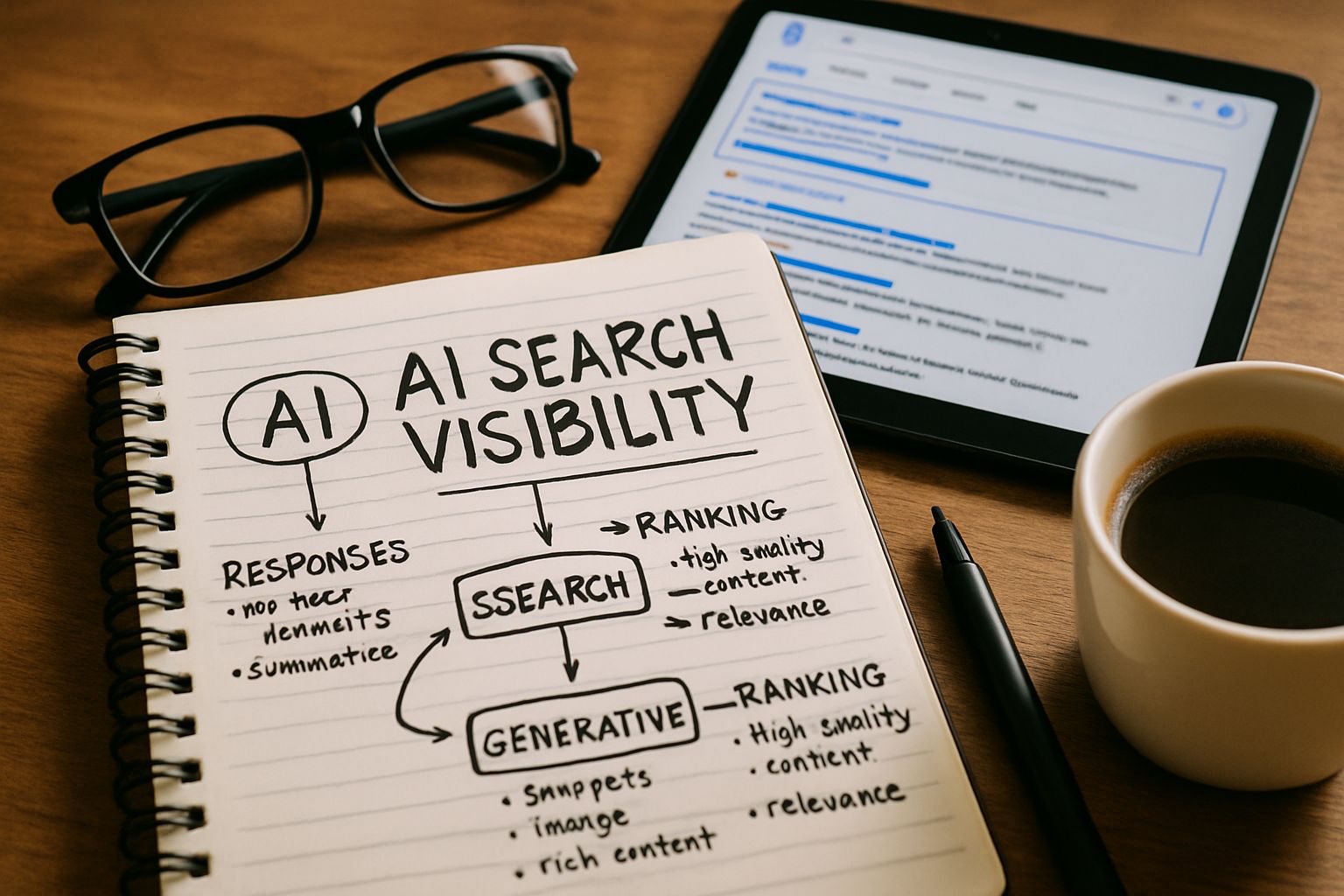
- Samsung pilot delivered 4,754 LLM citations and 23-33% mention uplift, Future reports.
- FY25 revenue hit £739m, yet the firm highlights AI authority, not pageviews.
- Independent studies record click-through drops to single-digit percentages when AI summaries appear.
These figures illustrate urgent stakes. Consequently, Future formalized its AI Search Visibility Playbook to safeguard influence. Next, we examine how Optic operationalizes that goal.
Future Optic In Focus
Future Optic, also marketed as “AI Audience”, monitors citations across ChatGPT, Gemini, Perplexity, and Copilot. Furthermore, the tool packages editorial and sponsored content into machine-readable modules. Simon Collis says Optic narrows keywords to subverticals like “music making” for sharper signals. Consequently, Samsung’s campaign used the approach and triggered measurable citation lifts. The AI Search Visibility Playbook appears central to Optic’s pitch for advertiser budgets. Moreover, the AI Search Visibility Playbook underpins each configuration decision inside the platform. Answer Engine Optimization (AEO) metrics feature prominently in sales collateral, according to investor slides. Nevertheless, the company keeps its LLM Crawling methodology proprietary. Optic promises scalable authority for brands. Therefore, understanding its underlying components matters for every publisher. The following section breaks down those components explicitly.
Core Playbook Key Components
Every successful rollout begins with measurement. Future built a standardized prompt set that probes model answers weekly. Additionally, it tracks three visibility tiers: context inclusion, explicit citation, and downstream clicks. The AI Search Visibility Playbook next prescribes answer-first content blocks with clear schema. Answer Engine Optimization (AEO) guidelines advise concise paragraphs and persistent canonical URLs. Moreover, LLM Crawling gains reliability when publishers supply chunked embeddings via vector databases like Pinecone. Consequently, Optic marries editorial polish with retrieval-ready metadata. These components create a closed feedback loop. Subsequently, publishers can optimize campaigns with data rather than intuition. Practical AEO tactics illustrate this loop in action.
AEO Tactics For Publishers
Answer Engine Optimization (AEO) starts with an audit covering headings, FAQ schema, and snippet length. Furthermore, teams should draft canonical answers within 50 words to feed retrieval systems. Future’s editors embed clarifying sentences every 200 words, reinforcing chunk boundaries for LLM Crawling. In contrast, legacy SEO often buried the answer near article bottoms. The AI Search Visibility Playbook advises pushing key facts above fold and labeling them plainly. Additionally, AEO metrics success depends on closed-loop prompt testing across engines. These tactics stabilize citations across volatile model updates. Therefore, infrastructure decisions become the next concern. We now explore that layer.
LLM Crawling Infrastructure Guide
LLM Crawling relies on vector databases storing embeddings with metadata filters. Moreover, Retrieval-Augmented Generation fetches those embeddings before the model crafts an answer. Future likely maintains an internal index, though management has not disclosed its vendor stack. Professionals can deepen skills through the AI+ Cloud Architect™ certification. The AI Search Visibility Playbook specifies automated re-indexing schedules to preserve freshness. Consequently, publishers avoid stale references that degrade authority scores. Sound infrastructure amplifies every other tactic. Subsequently, we consider the associated risks. The next section addresses those caveats.
Risks And Key Caveats
Model volatility tops the risk list. Independent research shows citation patterns can flip within weeks. Nevertheless, the AI Search Visibility Playbook mitigates volatility through constant prompt regression tests. Opacity presents another challenge because providers rarely reveal retrieval weighting algorithms. Answer Engine Optimization (AEO) transparency guidelines urge clear sponsorship disclosures inside branded content. Furthermore, visibility gains may vanish if platforms change API access terms. Consequently, publishers must diversify surfaces and measurement providers. These caveats demand vigilant oversight and flexible roadmaps. Nevertheless, pragmatic next steps can still drive momentum. Our final section outlines them.
Actionable Next Steps Ahead
First, benchmark current citation share across major engines using a fixed prompt suite. Then, implement the AI Search Visibility Playbook incrementally, starting with high-value subvertical keywords. Additionally, align AEO metrics with advertiser objectives during campaign planning. Moreover, schedule re-indexing jobs weekly to maintain freshness signals. Professionals should cultivate in-house RAG proficiency to avoid vendor lock-in. Finally, pursue transparent sponsorship labels to maintain user trust.
In summary, Future’s experiment proves that authority inside AI answers can be productized. The AI Search Visibility Playbook, when paired with disciplined infrastructure and testing, safeguards discoverability. Therefore, leaders should pilot similar frameworks, measure rigorously, and iterate fast. Consider strengthening technical expertise through the earlier mentioned AI+ Cloud Architect™ certification. Take action today and future-proof your brand’s share of voice across emerging AI surfaces. Consequently, you will diversify traffic sources beyond volatile search results. Nevertheless, remain agile, because platforms will continue refining retrieval pipelines.


