

AI CERTS
2 hours ago
AI Revolutionizes CERN Physics Higgs Work
Graph neural networks, transformers, and diffusion models penetrated nearly every analysis workflow. Moreover, GPU-powered triggers began operating live inside detectors. Industry leaders call this convergence a watershed for scientific computing. Throughout this report we examine how CERN Physics teams exploit AI to sharpen Higgs-boson insights. Additionally, we outline real business lessons for data-driven enterprises beyond academia. Therefore, the discussion carries relevance far outside Switzerland’s borders.
AI Boosts Higgs Measurements
CMS stunned the May 2025 community by tightening limits on scalar decays into charm quarks. Using graph neural networks for charm tagging and transformer classifiers for event selection, analysts lifted sensitivity by 35 percent. Consequently, the elusive charm-Yukawa coupling now stands far closer to Standard Model expectations. The incoming director-general Mark Thomson declared the gains “very, very, very big” for the field.
Graph Networks Lead Gains
Meanwhile, ATLAS replicated many techniques for its scalar-pair searches, again recording marked improvements. In contrast with earlier cut-based approaches, deep classifiers sift subtle multi-jet topologies with remarkable efficiency. CERN Physics practitioners credit better feature representations for that leap. Moreover, they are preparing to attack the critical Self-coupling parameter with upcoming Run-3 datasets.
These AI-driven analyses clearly accelerate precision goals. However, further model transparency remains necessary before discovery claims emerge. Consequently, simulation advances are drawing equal attention.
Generative Simulation Speed Breakthroughs
Detector simulation absorbs vast computing budgets across the Worldwide LHC Grid. Therefore, collaborations train diffusion and flow models to mimic Geant4 calorimeter showers in milliseconds. Subsequently, CMS researchers released CaloDiT, a transformer-backbone diffusion surrogate delivering four orders-of-magnitude speedups. Boson energy responses produced by the network matched Geant4 within two percent across key layers.
Additionally, the community launched the CaloChallenge to benchmark fidelity objectively. Consequently, independent teams compare pixel-level distributions, not just integral observables. CERN Physics experts insist that public leaderboards enhance trust and reproducibility. However, domain shifts between Monte Carlo and real detector noise still threaten subtle scalar signatures.
- 45 PB of filtered data produced weekly, demanding efficient generators.
- Up to 1.5 exabytes stored across the grid, straining archival budgets.
- Speedups of 10,000× reported for diffusion calorimeter surrogates.
Fast surrogates cut CPU costs dramatically. Nevertheless, rigorous validation safeguards scientific credibility. Real-time event selection faces similarly strict requirements.
Real-Time GPU Trigger Systems
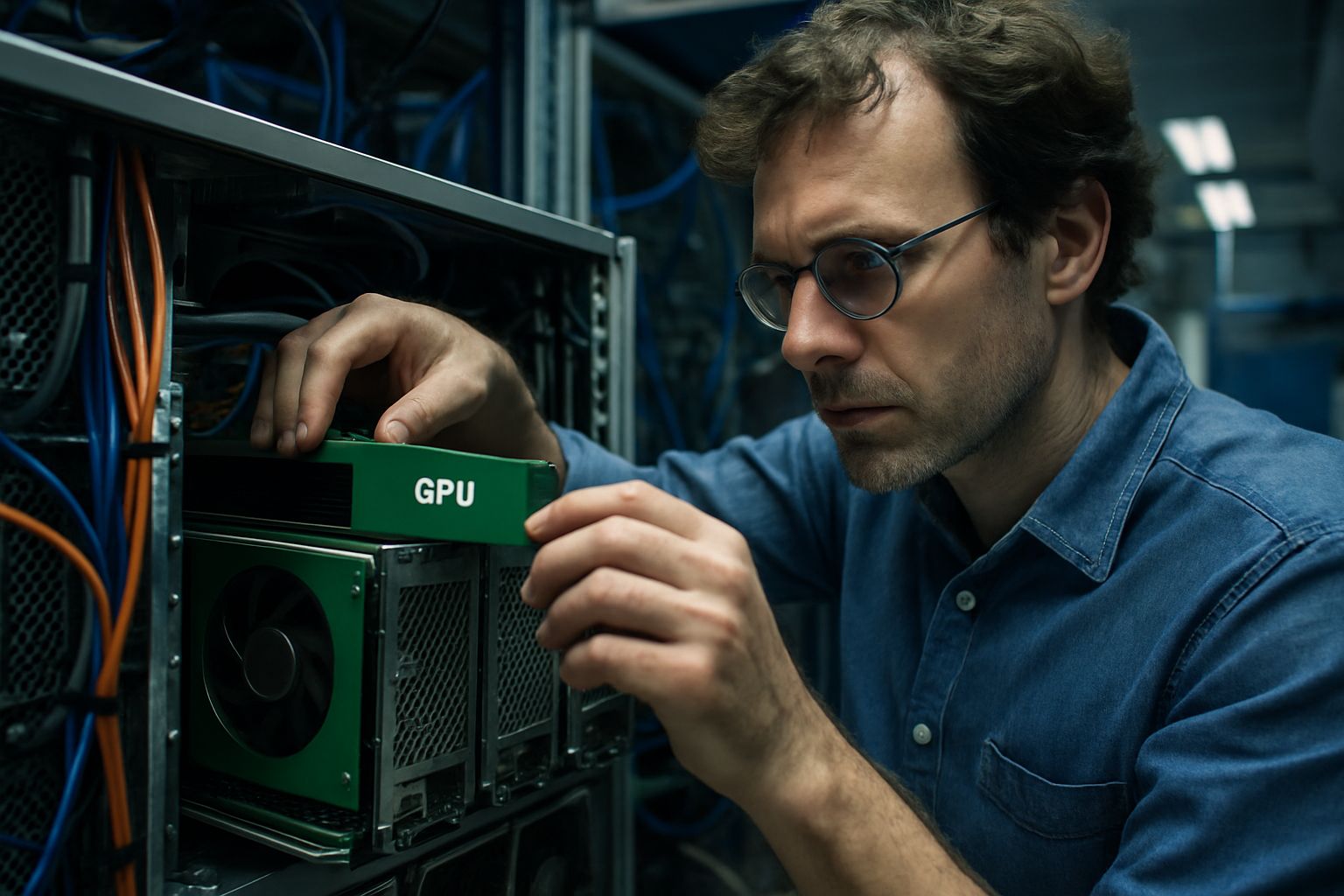
LHCb’s Allen project showcases inference at 40 Tbit/s using 500 NVIDIA Tensor Core GPUs. Meanwhile, ATLAS and CMS prototype comparable accelerators for high-luminosity upgrades. Consequently, detectors can retain rare Boson decays that hardware filters once dropped. CERN Physics teams report latency below one millisecond, meeting stringent control-room standards.
Additionally, software frameworks now schedule kernels across heterogeneous clusters seamlessly. In contrast, earlier triggers used custom ASICs with limited flexibility. Self-coupling measurements will benefit because double-boson events can be flagged immediately. Moreover, GPU resources scale easier through commercial procurement partnerships with NVIDIA and Google.
These triggers extend physics reach into once-forbidden luminosity regimes. Moreover, they illustrate AI’s hardware integration success. Yet, benefits come alongside interpretability and governance challenges.
Benefits And Remaining Challenges
AI adds measurable value across discovery, efficiency, and cost metrics. For example, charm limits improved 35 percent without extra collider runtime. Furthermore, early Boson anomaly searches gain power from unsupervised representation learning. Consequently, experimental timelines compress by years, saving substantial funding.
Validation And Governance Needs
Nevertheless, black-box decisions trouble many reviewers. Explainable AI tools, saliency maps, and physics-informed layers now occupy active research channels. Additionally, simulation bias might mislead Self-coupling estimates if training data lack realism. CERN Physics working groups therefore mandate blinded analyses, cross checks, and duplicated pipelines.
Benefits clearly outweigh current limitations. However, strict oversight must accompany every deployment. Future research programs already reflect that nuanced view.
Future Higgs Research Roadmap
Run-3 and the High-Luminosity LHC promise data volumes an order larger than before. Therefore, CMS and ATLAS plan deeper transformers, federated training, and continual calibration loops. CERN Physics strategists also prioritise open data releases to spur external algorithm innovation. Higgs Self-coupling extraction remains the marquee target, requiring exquisite control of double-Boson backgrounds.
Additionally, collaborations envisage hybrid quantum-classical pipelines for combinatorial tracking problems. Subsequently, the experiments will integrate trusted causal inference frameworks for anomaly detection. Professionals can deepen skills via the AI Healthcare Specialization certification. Consequently, cross-sector lessons accelerate detector, medical, and industrial research simultaneously.
Roadmaps demonstrate sustained AI investment across science and industry. Moreover, transparent governance features prominently in every milestone. Such momentum suggests continued dominance for data-centric collider innovation.
Ultimately, CERN Physics successes with AI highlight a broader digital transformation underway in basic science. Consequently, policymakers now view algorithmic infrastructure as strategic as cryogenic magnets. CERN Physics results already influence industrial automation and medical imaging. Moreover, the interdisciplinary talent pipeline keeps expanding. Stakeholders seeking to join that momentum can pursue the earlier linked certification and collaborate on open datasets. Therefore, expect CERN Physics to stay at the frontier of discovery and computing alike.


