

AI CERTS
2 hours ago
AI power plants: Reviving Idle Sites for Hyperscale Compute
This feature explains why the strategy exploded, who benefits, and what risks loom. Moreover, it offers data driven case studies, expert quotes, and policy insights for decision makers. Professionals seeking strategic guidance will also discover certification resources to sharpen commercial skills. In contrast, communities near retired smokestacks confront potential pollution returns if peaker units restart. Meanwhile, utilities defend the revivals as essential for grid stability while renewable projects lag. Therefore, the following sections dissect the economic engine behind AI power plants and map emerging solutions.
Demand Transforms Old Sites
IEA predicts data centers will use more than double electricity by 2030. Furthermore, AI power plants promise faster scaling for clusters that require hundreds of megawatts continuously. Hyperscalers crave sites with existing high-capacity lines, according to multiple 2025 project announcements. Developers therefore target decommissioned coal, gas, or nuclear parcels offering instant substation access. Reuters found 60% of retiring peakers in PJM postponed closure after AI demand spiked. Additionally, Microsoft’s deal to restart Three Mile Island exemplifies how AI power plants reshape legacy narratives. These moves illustrate a powerful feedback loop between compute growth and energy infrastructure.
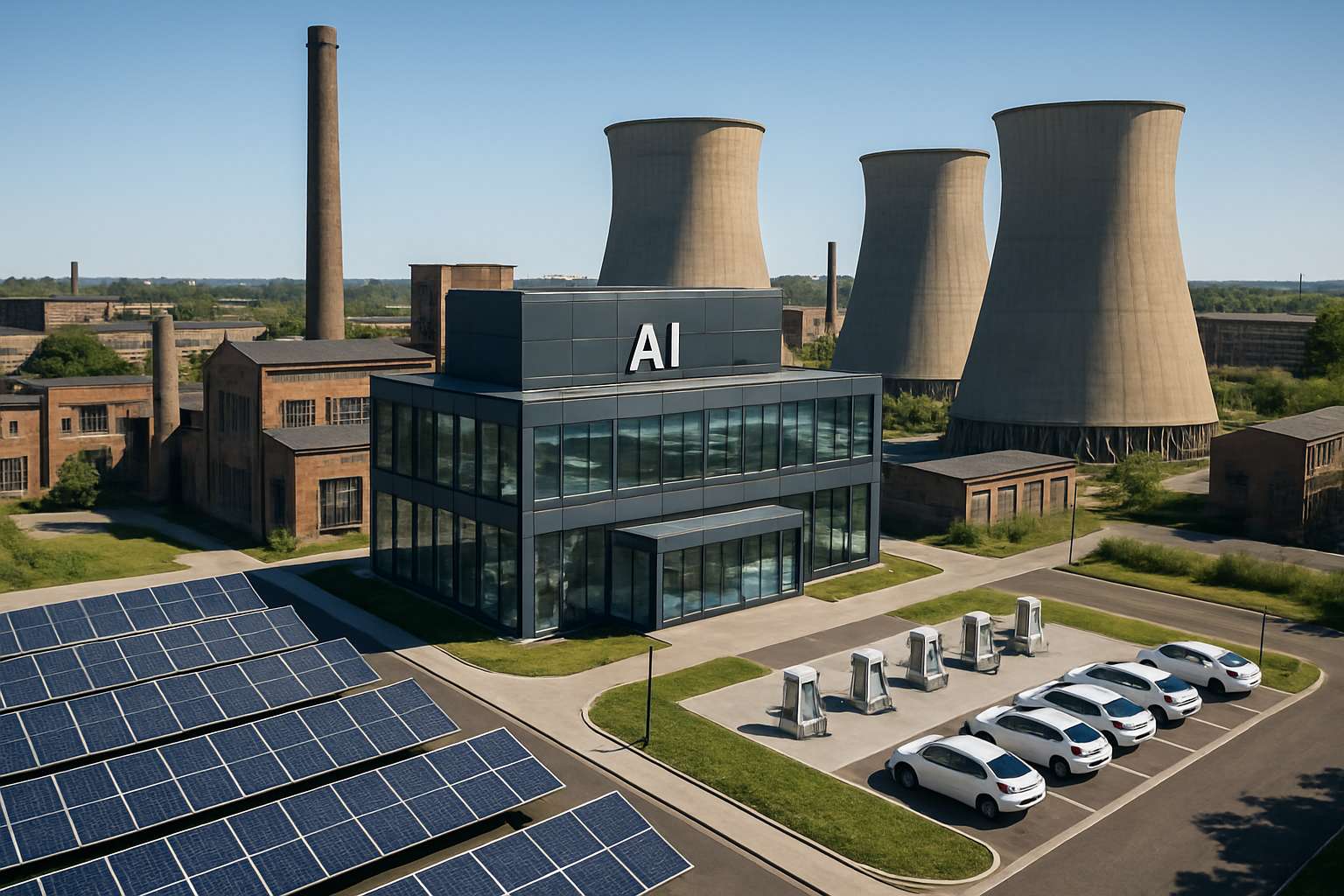
The demand surge has turned idle land into prized assets overnight. However, rapid conversions create new challenges explored in the next section.
Speed Drives Site Choice
Time-to-market dominates corporate site selection math. Consequently, brownfield parcels slash interconnection delays that plague greenfield proposals. Aligned Data Centers said Conesville’s existing switchyard cut years from its Ohio timeline. Moreover, OpCore’s French project leverages a 700 MW authorization already secured by EDF.
- Existing grid transformers reduce capital outlay for utilities and developers.
- Industrial zoning simplifies noise, water, and sustainability permitting.
- Large parcels support scalable data centers without community relocation.
- Local grants convert stranded energy assets into new tax revenue.
In contrast, greenfield queues can stretch beyond five years, stalling machine learning roadmaps. Therefore, AI power plants become strategic shortcuts despite remediation uncertainties.
Speed delivers clear commercial value for operators and investors. Nevertheless, environmental justice groups warn that haste can magnify legacy harms, discussed below.
Environmental Justice Key Concerns
Legacy peaker sites often sit near historically redlined neighborhoods. Subsequently, new thermal loads could trigger additional fossil dispatch and local pollution spikes. Reuters quoted UCLA researcher Lara Cushing linking old siting patterns to health disparities. Additionally, postponed retirements of oil or gas units prolong particulate emissions. IEA notes that dirty backup generation erodes sustainability gains touted by corporate buyers. AI power plants risk reputational damage if community impacts remain unresolved.
- Peaker runtime increases during summer demand peaks.
- Remediation costs may burden taxpayers if deals collapse.
- Carbon accounting debates obscure actual lifecycle emissions.
Consequently, transparent engagement and enforceable emission caps become prerequisite for social license. The justice debate forces firms to quantify externalities rigorously. Next, we examine clean supply contracts aiming to defuse opposition.
New Zero Carbon Deals
Several hyperscalers pursue nuclear or renewable PPAs to offset carbon concerns. Microsoft’s 835 MW Three Mile Island agreement showcases this tactic. Furthermore, Constellation argues nuclear offers reliable energy without combustion pollutants. Similar contracts appear across Europe, where data centers tie wind assets to revived corridors. Nevertheless, critics say location-based accounting still counts local combustion from standby turbines. AI power plants embracing nuclear partnerships must therefore guarantee around-the-clock clean delivery.
Zero-carbon contracts mitigate headline emissions significantly. However, economic dimensions drive whether such deals scale universally.
Economics And Policy Balance
Capital markets favor reuse because connection speed accelerates revenue recognition. Moreover, utilities monetize stranded assets, improving balance sheets without new rate cases. State leaders, meanwhile, tout job creation aligned with sustainability goals. Yet, grid planners struggle to model sudden 300-700 MW loads at single nodes. Consequently, capacity prices in PJM spiked over 800% during some 2025 auctions. AI power plants can therefore distort regional energy economics if planning lags. Policymakers debate incentives for on-site batteries and long-duration storage to smooth draws. In contrast, environmental agencies push stricter pollution limits on revived stacks.
Aligning incentives remains a multifaceted negotiation. The final section outlines practical actions for all parties.
Action Items For Stakeholders
Developers should commission full environmental studies before announcing AI power plants. Additionally, utilities must publish transparent interconnection timelines and upgrade budgets. Community groups can request binding emission caps tied to load growth milestones. Investors, therefore, should model remediation liabilities alongside compute demand forecasts. Regulators may expedite permits if projects pair grid support with renewable procurement. Professionals can enhance expertise through the AI Sales™ certification. These actions reduce conflict and accelerate sustainable deployments. Consequently, coordinated planning can unlock the full promise of AI power plants.
AI power plants illuminate the growing convergence of compute ambition and legacy infrastructure opportunity. Moreover, speed advantages entice developers, while environmental stakes demand vigilant oversight. Utilities and regulators must coordinate capacity planning to prevent localized pollution rebounds. In contrast, nuclear or renewable PPAs demonstrate viable pathways toward genuine sustainability gains. Consequently, stakeholders who prioritize transparent metrics will capture economic value and public trust. Professionals seeking deeper commercial insight should pursue the AI Sales™ certification. Seize the momentum today and lead these transformative deployments toward inclusive technological progress.


