

AI CERTS
3 hours ago
AI Government Budget 2026: MeitY Funding, IndiaAI Progress
Consequently, every rupee allocated signals policy intent, investor confidence, and research momentum. Industry leaders therefore scrutinised the ₹1,000 crore line item earmarked for FY27. Meanwhile, startups assessed whether the compute marketplace’s subsidised GPUs will remain affordable in India. In contrast, policymakers highlighted the wider ₹21,632 crore MeitY envelope supporting digital priorities.
Furthermore, analysts compared the reduced annual outlay with previous projections to gauge continuity. This article unpacks the numbers, opportunities, and concerns surrounding the latest AI Government funding cycle. Moreover, it outlines how compute, datasets, and semiconductor incentives intersect within India’s evolving innovation strategy.
IndiaAI Mission Funding Snapshot
Firstly, the Cabinet cleared IndiaAI Mission in March 2024 with a five-year corpus of ₹10,371.92 crore. Accordingly, MeitY divided spending across compute, datasets, skilling, startups, and governance pillars. Secretary S. Krishnan previously noted that almost 45% supports the national compute portal.
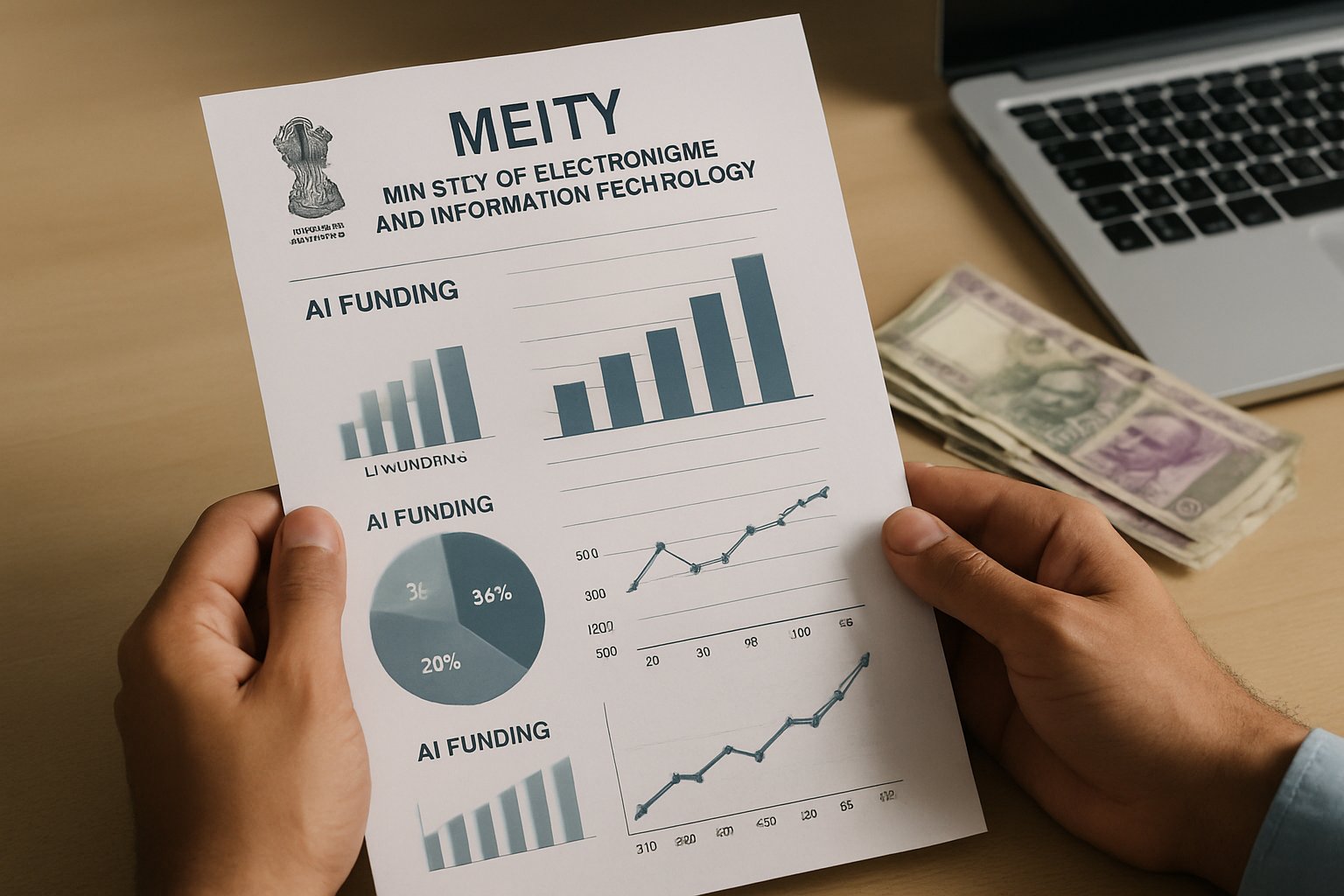
- March 2024: Mission outlay approved at ₹10,371.92 crore.
- July 2024: Initial ₹551.75 crore released to kick-start deployment.
- FY26 BE: ₹2,000 crore projected, later revised to ₹800 crore.
- FY27 BE: ₹1,000 crore allocated within ministry demand.
- GPUs online: Over 38,000 units operational by December 2025.
Collectively, these figures reveal a downward annual trajectory despite continuing infrastructure rollout. Nevertheless, the multi-year envelope remains intact, preserving strategic continuity for the AI Government roadmap. Therefore, officials emphasise that periodic reviews will recalibrate grants as the AI Government platform scales. Funding trends show promise but signal caution. However, sharper scrutiny awaits when Parliament debates the broader Union Budget details.
Union Budget 2026 Insights
Union Budget 2026-27 tabled on 1 February delivered ₹21,632 crore to MeitY for India’s digital future. Moreover, revenue expenditure accounted for ₹21,234.15 crore, while capital spending sat at ₹398.81 crore. Consequently, capital intensity remains modest, aligning with service-heavy digital programmes rather than physical factories.
Industry commentary fixated on the ₹1,000 crore IndiaAI line because it halved from last year’s BE. In contrast, revised estimates for FY26 had already fallen to ₹800 crore, softening the perceived blow. Therefore, some analysts viewed the fresh allocation as baseline rather than cut.
Budget documents also referenced allied Semiconductor incentives and design linked subsidies, reinforcing a holistic technology stack strategy. Additionally, Finance Ministry officials argued that separate Semiconductor grants complement compute spending, not compete with it.
- Total allocation: ₹21,632 crore, up marginally year on year.
- IndiaAI Mission: ₹1,000 crore, pending parliamentary approval.
These numbers will anchor forthcoming ministry demand debates. Furthermore, they influence vendor forecasts tied to AI Government procurement cycles. Budget 2026 signals incremental support rather than aggressive expansion. Consequently, stakeholders now monitor programme execution metrics more closely.
Compute Portal Rollout Progress
Meanwhile, the national compute portal has become the mission’s public face. By December 2025, over 38,000 GPUs were online across empanelled cloud and colocation partners. Moreover, hourly rates hover near ₹65, slashing experimentation costs for universities and startups.
Secretary Krishnan called the portal the single largest cost component, absorbing nearly half the corpus. Consequently, predictable operational funding matters more than headline annual grants. AI Government users report queue times falling as additional clusters integrate.
Technical teams still wrestle with heterogeneous hardware and varying driver stacks. Nevertheless, phased onboarding minimises systemic outages, according to MeitY engineers. Compute availability already transformed prototype timelines. However, data access remains the next bottleneck, leading into the innovation discussion.
Opportunities For Domestic Innovators
Subsidised compute pairs with AI Kosh datasets to spur domain-specific model development. Consequently, local language LLM teams such as Sarvam secured affordable resources and early pipeline grants. Furthermore, the ministry invites state governments to propose Centres of Excellence linked to regional priorities.
Firstly, startups gain predictable GPU budget lines for grant proposals. Secondly, universities access curated data free from restrictive licensing. Thirdly, the AI Government framework fosters uniform procurement processes across jurisdictions.
Professionals can upskill through industry credentials aligned with mission requirements. Moreover, such training builds common vocabulary across private and public teams. Opportunity metrics appear positive. However, scale alone will not guarantee competitive leadership, as next section explains.
Challenges And Industry Concerns
Industry bodies warn that fluctuating allocations complicate multi-year vendor contracts and private co-financing. In contrast, global rivals announce multi-billion-dollar strategies with clearer trajectories. Additionally, integration of diverse GPU generations increases maintenance complexity within shared clusters.
Governance critics advocate stronger privacy guarantees before expanding citizen-facing applications. Nevertheless, MeitY highlights its Safe and Trusted AI pillar addressing risk.
AI Government proponents counter that early deployment feedback will inform regulatory refinements. Consequently, they expect parliamentary questions to refine audit frameworks during upcoming sessions. Persistent concerns underline the importance of transparency. Therefore, synergy with semiconductor policy becomes critical for stable supply chains.
Semiconductor Links And Synergy
Hardware independence demands domestic manufacturing and advanced packaging expertise. Accordingly, the government pairs Semiconductor incentives with compute funding to close strategic gaps for India. Moreover, chip design linked schemes received new grants alongside the ministry’s digital programmes. Analysts argue that aligning Semiconductor fabs with AI Government workloads could secure priority allocations.
In contrast, sustained fab investment requires visibility over future compute orders. Therefore, consistent Budget signals would reassure financiers and international partners. Semiconductor alignment may unlock genuine autonomy. However, execution discipline will decide eventual competitiveness.
Outlook And Action Steps
Stakeholders agree that programme momentum must translate into measurable economic impact. Consequently, tracking GPU utilisation, model outputs, and startup revenue becomes essential. Furthermore, upcoming Budget sessions offer opportunities to advocate stable multi-year envelopes.
Professionals can engage through hackathons, policy consultations, and certification pathways. Additionally, public dashboards should publish timely compute and dataset metrics to sustain trust.
Outlook appears cautiously optimistic. Nevertheless, coordinated governance will cement the AI Government legacy.
India’s flagship AI funding remains on track, despite annual fluctuations. The ₹21,632 crore MeitY envelope secures core digital programmes and compute subsidies. However, sustained capital intensity and Semiconductor integration will determine long-term competitiveness. Consequently, policymakers should provide clearer multi-year roadmaps to reassure private investors.
Meanwhile, researchers and founders can already tap the national portal’s 38,000 GPUs for experimentation. Professionals seeking procurement and ethics mastery can pursue the linked AI Government Specialist™ credential. Moreover, active participation will shape governance standards and reinforce domestic talent pipelines. Act now, explore resources, and help craft a globally competitive, trustworthy AI ecosystem.


