

AI CERTS
2 hours ago
AI Governance Imperatives For Energy Systems
This article unpacks the technology, certifications, and open questions shaping mission-critical power orchestration. Readers will gain clear insights for strategic planning and risk management. Moreover, we examine whether Qcells has secured formal AI governance accreditation. Finally, actionable recommendations help leaders navigate fast-moving compliance landscapes.
In contrast, complacency could expose portfolios to technical and regulatory shocks. Therefore, understanding today’s developments is essential before scaling autonomous controls. Ultimately, informed decisions protect resilience and profit.
AI Trends Reshaping Grids
Global electricity demand from servers grows at double-digit rates. Consequently, traditional planning cannot respond quickly enough. Emerging Energy Systems tools analyze terabytes of telemetry every minute. They then suggest optimal dispatch across batteries, solar, and flexible loads. Furthermore, automated agents increasingly execute those instructions without human intervention.
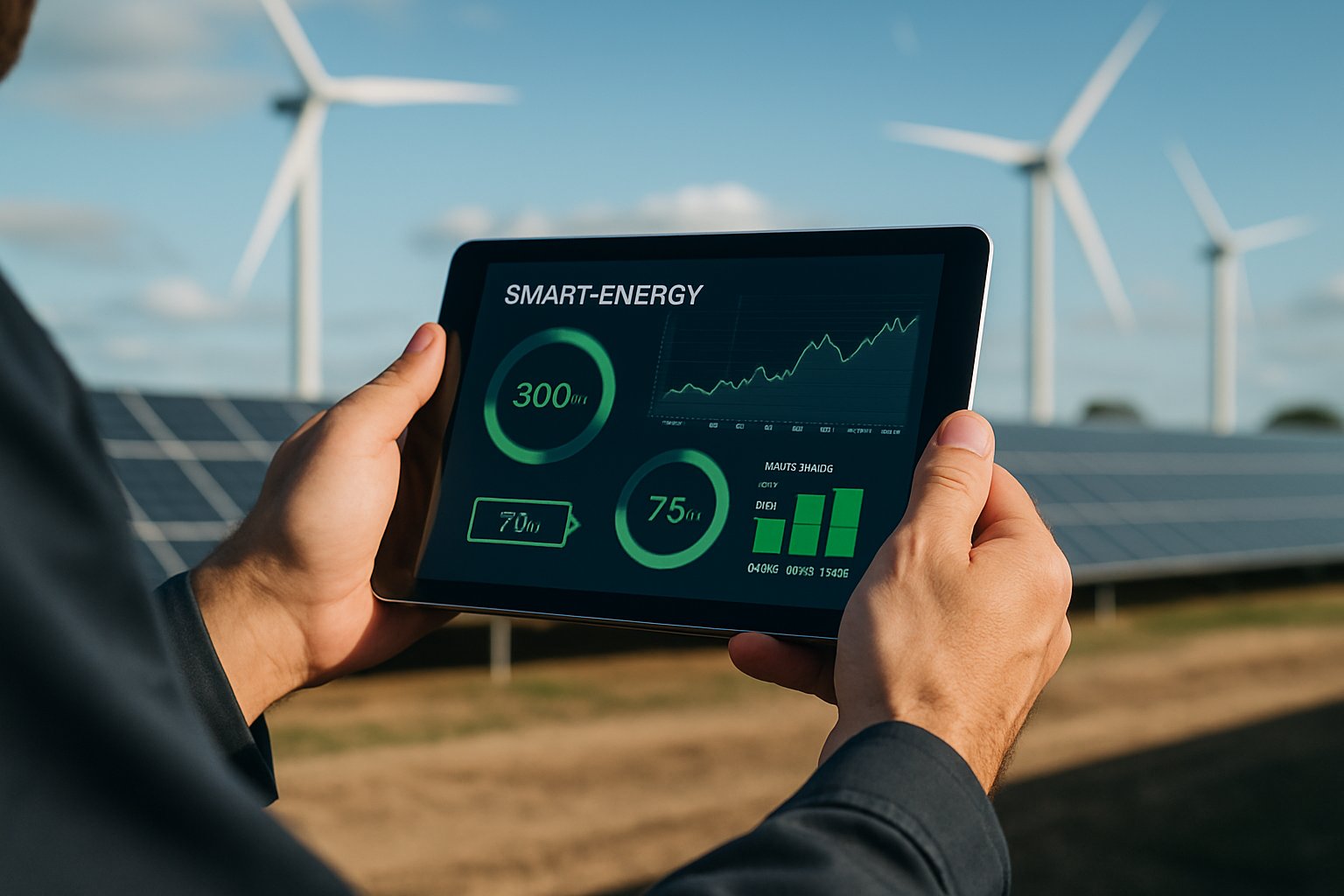
Industry analysts label such deployments mission-critical because mistakes trigger outages. Therefore, governance frameworks now pair algorithms with strict guardrails. ISO/IEC 42001 leads this movement by codifying organizational controls for responsible AI. Certification bodies like TÜV SÜD and A-LIGN have started issuing early badges. Moreover, vendors market compliance as a differentiator when selling to cautious utilities.
AI is changing operational philosophies across the grid. However, technology alone cannot guarantee trust, so platform specifics deserve closer scrutiny.
Qcells Platform Key Highlights
Qcells Energy Systems platform partnered with Microsoft to unify operational data on Azure and Fabric. Consequently, the Fleet Manager and VPP applications gain real-time visibility across thousands of assets. The EMS now predicts load shifts and battery availability with second-level granularity. Additionally, executives report 30-40 percent lower overhead and faster releases, according to the Microsoft case study.
Sanjeev Lakkaraju notes that unified telemetry cut troubleshooting time nearly in half. Shuai Zhang credits proactive analytics for preventing outages before customers notice anomalies. Moreover, the AI orchestrator can escalate complex incidents to human operators when guardrails trigger. Such human-in-the-loop design aligns with NIST guidance for mission-critical deployments.
The company demonstrates measurable efficiency gains through cloud-based orchestration. Nevertheless, tangible certification remains absent, raising governance questions that flow into innovation discussions.
Forecasting Drives Smart Coordination
Accurate forecasting underpins every automated decision within modern Energy Systems architectures. Predictive models estimate solar yield, market prices, and demand surges hours ahead. Consequently, assets can charge or discharge strategically, maximizing arbitrage revenue. Qcells trains predictive pipelines on historical weather, IEA statistics, and live inverter streams.
Furthermore, Microsoft Fabric accelerates data preparation, shortening model retraining cycles. Improved coordination across distributed devices follows, since all actors share the same situational picture. In contrast, siloed datasets usually force conservative dispatch, wasting capacity.
Better prediction and coordination create economic and resilience value. Therefore, auditors increasingly expect documented model performance when reviewing certification applications.
Certification Landscape Accelerates Rapidly
Market interest in ISO/IEC 42001 surged after its 2023 publication. Early adopters across finance, healthcare, and manufacturing secured certificates within months. Consequently, Energy Systems companies now evaluate the same pathway to reassure stakeholders. The standard requires documented risk registers, monitoring plans, and continual improvement processes.
However, no public record shows Qcells possessing ISO/IEC 42001 for its EMS. Company cybersecurity pages highlight NIST CSF alignment and IEEE 2030.5 compliance instead. Leaders can boost expertise via the AI+ Security™ Level 3 certification.
Certification demand grows, yet documented evidence still matters. Consequently, risk assessments must cover operational failure modes as we examine next.
Operational Risks And Safeguards
Mission-critical AI introduces failure modes unfamiliar to classic SCADA engineers. Therefore, test-evaluate-verify-validate pipelines become essential before Energy Systems autonomous control activates. The company publishes its cybersecurity controls, including zero-trust networks and continuous vulnerability scans. Additionally, IEEE 2030.5 certification ensures secure telemetry from field devices to the cloud.
Nevertheless, certification of governance does not guarantee flawless real-time behavior. Operators still need layered redundancy, manual override paths, and clear service-level agreements. Moreover, incident response exercises must simulate worst-case grid disturbances to validate resilience.
Safeguards mitigate many risks when combined with robust governance. In contrast, gaps remain in business alignment, which our next section explores.
Business Impacts And Opportunities
Autonomous optimisation unlocks several revenue streams for asset owners. Energy Systems aggregation earns capacity payments from wholesale markets. Secondly, precise forecasting reduces imbalance penalties. Furthermore, corporate buyers gain lower carbon footprints without expensive overprovisioning.
The company claims operational savings of up to 40 percent, though figures derive from vendor materials. Regulators may also reward proactive coordination that eases local grid congestion. Consequently, early movers can differentiate through transparency and responsible AI adoption.
Financial upside accompanies compliance pressure in equal measure. Therefore, leadership must map next steps carefully, which the final section details.
Actionable Recommendations For Leaders
Begin by inventorying all AI models driving operational decisions. Subsequently, align development roadmaps with ISO/IEC 42001 clauses to accelerate future certification. Engage certification bodies early, sharing documented TEVV results for critical scenarios. Additionally, establish joint exercises with utility partners to validate failover and coordination.
- Robust forecasting accuracy targets with continuous monitoring.
- Clear incident playbooks covering grid contingencies.
- Transparent reporting dashboards for stakeholders and auditors.
Moreover, track Energy Systems metrics monthly to verify value realization. Nevertheless, reserve budget for third-party penetration testing despite internal confidence.
Following these steps positions firms for safe, profitable automation. Consequently, agile governance can turn compliance from cost into competitive edge.
A leading solar manufacturer illustrates how intelligent Energy Systems can streamline operations and support decarbonization goals. However, the absence of confirmed ISO/IEC 42001 certification leaves governance questions open. Industry momentum shows that formal accreditation will soon influence procurement decisions.
Therefore, executives should pursue transparent roadmaps, robust forecasting, and verifiable safeguards without delay. Additionally, professionals may deepen expertise through the linked certification, strengthening organizational readiness. Explore further resources, benchmark peers, and act today to secure resilient Energy Systems leadership.


