

AI CERTs
2 hours ago
AI Executive Analysis: Telstra Cuts 200 Jobs in Automation Push
Australia’s biggest telco has entered another restructuring phase. Consequently, Telstra has flagged 209 joint-venture roles for potential removal. The move arises from its AU$700 million Data & AI venture with Accenture. An AI Executive team inside the venture says work will shift to India for faster delivery. Moreover, affected employees will receive redeployment options and transition support. Market watchers see the decision as both technological ambition and cost discipline. Nevertheless, questions about local skills and long-term control persist. This article unpacks the numbers, motives, and implications.
Telstra Accenture Venture Background
The venture launched in early 2025 with a seven-year horizon. Telstra promised annual spending of AU$100 million to modernise data platforms. Meanwhile, Accenture took a 60 percent stake, providing global talent and tooling. The joint board, led by an AI Executive, targets rapid generative AI rollout. Furthermore, responsible-AI principles guide the build. Analysts consider the partnership a bold corporate strategy amid flat telecommunications revenue. These facts set the context for the current cuts. However, understanding the proposed changes requires finer detail.
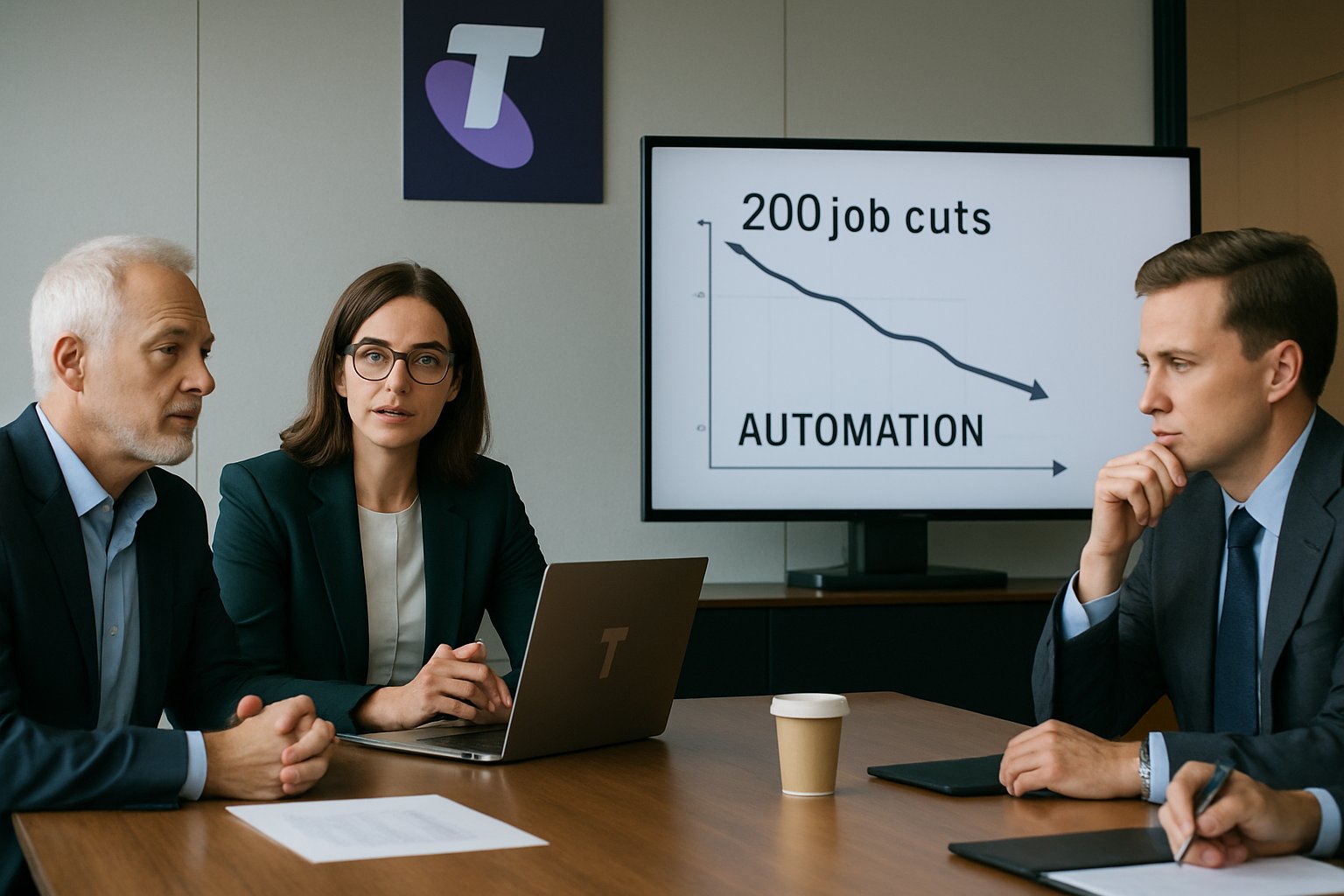
Telstra’s leadership framed the venture as transformational. Vicki Brady told investors that agentic AI would unlock productivity. In contrast, unions warned about future displacement. The debate foreshadowed tensions now playing out. Consequently, every workforce decision attracts scrutiny.
Key venture milestones include platform consolidation, data-lake modernisation, and internal AI tooling. Each milestone, executives claim, reduces duplication and speeds service creation. Therefore, management argues that some legacy roles are redundant. A second AI Executive statement reiterated that claim last week. These milestones now influence staffing models. Such context flows into the job reduction proposal.
These background details reveal deliberate long-term planning. Nevertheless, workforce effects were inevitable. The next section examines those proposed effects closely.
Proposed Job Reductions Explained
On 10 February 2026, staff received consultation papers. The documents list 209 roles “under consideration” for removal or transfer. Additionally, some tasks will relocate to Accenture’s delivery hub in India. A senior AI Executive said offshore teams accelerate delivery while controlling cost. Consequently, Australian headcount shrinks in specialised data functions.
Support measures include redeployment into other Telstra or Accenture positions. Furthermore, career-transition programs and redundancy benefits apply when relocation fails. Telstra insists that final numbers may fall after consultation. Nevertheless, employees remain anxious about displacement and future automation.
Independent analyst Paul Budde provided context: “Commercial pressure forces telcos to cut costs. AI and foreign labour are obvious tools.” His comment highlights the corporate strategy underpinning the proposal. Moreover, it underscores wider sector dynamics affecting jobs.
Summarising, the proposal combines technology adoption and financial discipline. Yet uncertainty around precise outcomes lingers. Therefore, focus shifts to the offshoring component driving debate.
Offshoring Versus Local Capability
Moving specialised roles offshore promises round-the-clock development velocity. However, critics fear erosion of domestic expertise. The AI Executive argues global delivery hubs scale projects faster. In contrast, unions say service quality suffers when knowledge leaves Australia. This tension mirrors earlier Telstra restructuring cycles.
Three core benefits cited by management include:
- Lower delivery cost through India-based teams
- Access to scarce AI skills at global scale
- Faster implementation of agentic automation tools
Nevertheless, analysts raise three associated risks:
- Loss of sovereign decision-making control
- Long-term skill displacement within the local market
- Potential customer backlash over offshore support
Furthermore, Paul Budde questions where enduring operational control will sit once build phases finish. His concern centres on strategic dependency. Consequently, policymakers may scrutinise the arrangement.
This offshoring debate mixes technology and geopolitics. Yet financial pressure remains the immediate driver. The upcoming section explores those corporate cost factors.
Underlying Corporate Cost Strategy
Telstra’s revenue growth has flattened in mature mobile and fixed markets. Therefore, leadership seeks efficiency levers. Automation ranks high among those levers. An internal AI Executive roadmap identifies customer care, network operations, and finance workflows for advanced automation. Moreover, the venture pools spending, avoiding parallel vendor contracts.
Telstra previously cut 2,800 enterprise roles in 2024. Subsequently, another 550 positions went in 2025. Management emphasised those rounds were not purely automation driven. Nevertheless, cumulative displacement now exceeds 3,500 over three years. Investors welcomed margin improvements. However, unions criticised the corporate strategy as short-termist.
The latest 209 roles form part of a wider efficiency program. Consequently, total workforce numbers could fall below 30,000 by decade’s end. Meanwhile, automation will expand across internal platforms. Responsible governance frameworks aim to balance speed and ethics. Telstra points to independent certification as evidence of good practice. Professionals can enhance their expertise with the AI Data Robotics™ certification.
In summary, cost optimisation guides many Telstra decisions. However, social licence considerations still apply. Those pressures reinforce the importance of careful workforce planning.
Workforce Displacement And Upskilling
Job displacement often accompanies large-scale automation. Nevertheless, companies can mitigate harm through proactive upskilling. The venture’s AI Executive team promises training pathways into new analytical roles. Additionally, Telstra has piloted prompt-engineering workshops for customer-care agents. These initiatives align with broader corporate learning strategy goals.
Industry observers say reskilling must match the pace of automation. Otherwise, structural unemployment may rise. Moreover, Australia risks falling behind on applied AI competence. Consequently, federal skills agencies track corporate training commitments closely.
Telstra touts its internal learning platform as a differentiator. Furthermore, collaboration with Accenture University will expand course libraries. Employees who complete advanced tracks could shift into data product ownership. That pathway reduces long-term displacement risk. However, its success depends on sustained funding.
These initiatives suggest a partial solution. Yet gaps persist, particularly for specialised legacy engineers. The following section assesses regulatory and policy considerations.
Policy Outlook And Risks
Canberra has previously urged critical-infrastructure firms to preserve domestic capability. Therefore, the communications minister may review the venture’s offshoring plans. Meanwhile, competition regulators monitor service quality after workforce changes. Any systemic outage blamed on reduced headcount could prompt inquiries.
Moreover, policymakers debate how corporate automation influences national employment. Treasury modelling shows AI could lift productivity by two percent annually. Nevertheless, regional job displacement might rise without targeted programs. Consequently, telcos serve as bellwethers for bigger labour-market shifts.
Another risk involves international data transfer. Offshoring raises compliance questions under Australia’s Privacy Act. The AI Executive states that secure architectures and regional hosting guard against breaches. However, regulators will likely demand evidence.
These policy factors add external pressure to Telstra’s internal calculations. The final section summarises key insights and outlines next steps for stakeholders.
Conclusion And Next Steps
Telstra’s proposed 209 cuts underline how an AI Executive can reshape corporate operations. The joint venture seeks faster automation, lower costs, and strategic agility. However, offshoring sparks concerns around local skill displacement and service quality. Policymakers and unions will watch outcomes closely. Furthermore, successful upskilling will determine long-term workforce resilience.
Consequently, professionals should track formal consultation results and subsequent redeployment statistics. Interested readers can future-proof careers by pursuing the linked AI certification. Staying informed ensures preparedness for the evolving AI landscape.


