

AI CERTs
2 months ago
AI-Driven Environmental Impact Scoring Transforms Corporate ESG
Corporate climate conversations shifted rapidly during 2024 and 2025. Moreover, new data shows demand for AI tools soared. Companies now chase "AI-Driven Environmental Impact Scoring" to survive tightening disclosure rules. These platforms connect life-cycle databases, remote sensing, and finance systems. Consequently, executives receive near-real-time emission scores across global supply chains. Scope 3 transparency moves from aspiration to board mandate. Nevertheless, gaps in data quality and governance persist. Vendors promote confidence scores, provenance logs, and audit-grade pipelines. Simultaneously, regulators in Brussels and Washington debate timelines and assurance needs. Therefore, strategic leaders must grasp the technology’s capabilities and limits. This guide explains market momentum, regulation, key vendors, benefits, risks, and future signals.
AI Platforms Accelerate Adoption
Global spending on carbon management software reached several billion dollars in 2025. Furthermore, "AI-Driven Environmental Impact Scoring" now headlines board presentations. Analysts forecast double-digit growth through 2030. Such growth underpins AI platforms that automate measurement tasks. Investors value vendors that package machine learning with reachable datasets. Corporate boards prioritize clear benchmarks for investor dialogues.
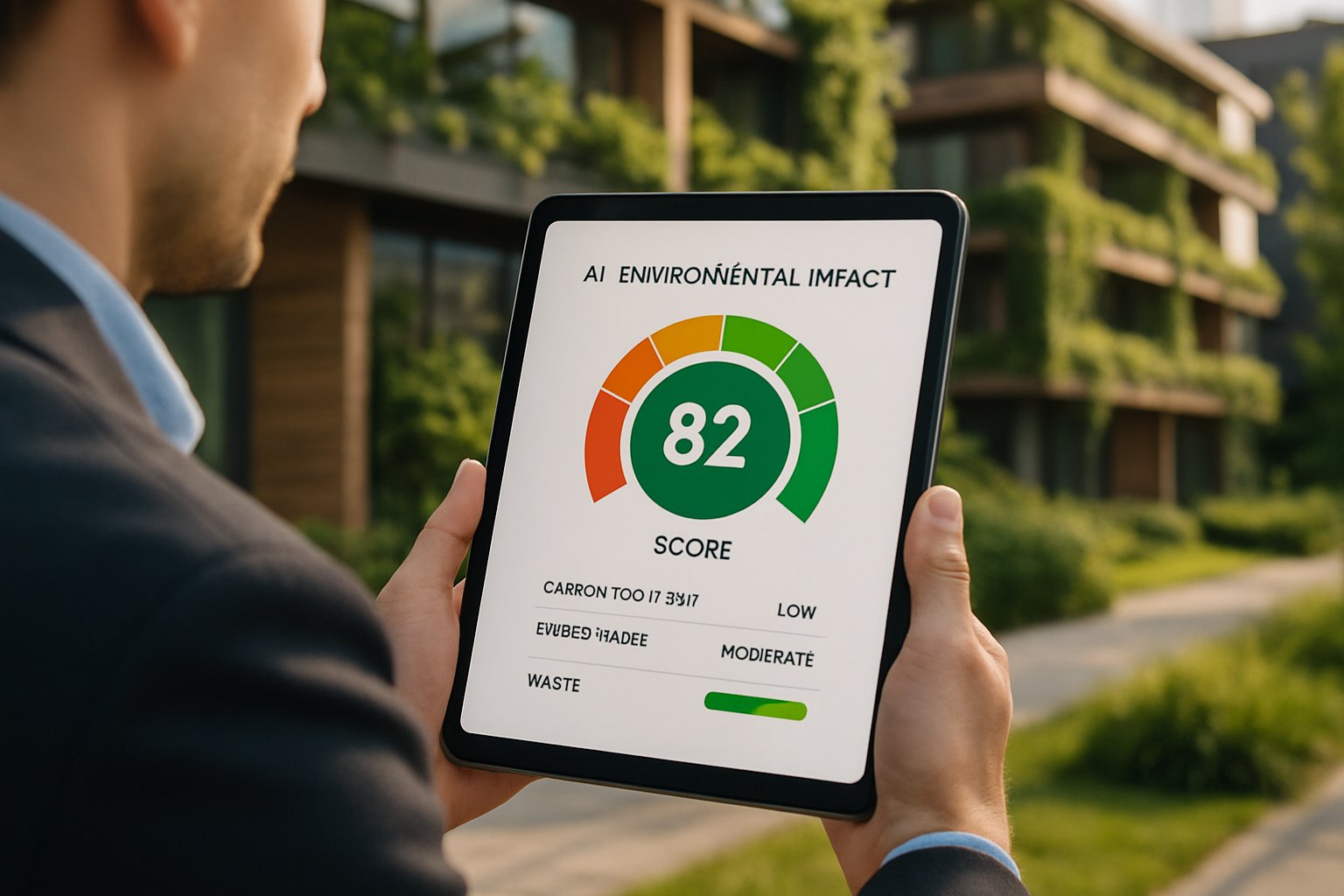
Watershed’s Open CEDA covers 148 countries and 400 industries. Additionally, Climate TRACE now publishes monthly asset-level data sets. These resources feed sustainability analytics engines that generate supplier-level emission estimates within minutes. In contrast, manual life-cycle assessments often take months. Monthly refresh cycles replace annual spreadsheet marathons.
The following statistics illustrate the adoption surge:
- Scope 3 represents 60-90 % of footprints for many sectors.
- Only about 10 % of firms measure Scopes 1-3 end-to-end.
- Market value expected to hit tens of billions by 2030.
These numbers show escalating urgency and opportunity. Executives crave certainty amid expanding datasets. However, regulations sharpen the focus on audit readiness, discussed next.
Regulations Drive Audit Grade
Corporate disclosure timelines remain fluid. Meanwhile, the EU’s CSRD Omnibus amendments shifted deadlines again in 2025. The U.S. SEC climate rule faces legal challenges, creating compliance uncertainty. Consequently, companies invest early to avoid unpleasant surprises. Stakeholders struggle to plan without reliable timelines.
Platforms incorporate controls that align with CSRD, IFRS S2, and evolving SEC drafts. Moreover, they embed MRV workflows that lock data versions for assurance. Integrated controls reduce manual reconciliations during audit procedures. Auditors appreciate granular logs showing data lineage and confidence scoring.
Experts warn that generative AI hallucinations could jeopardize filings. Therefore, many vendors adopt retrieval-augmented generation. Provenance tags help identify data owners quickly. This architecture links model answers to original documents, reducing risk and improving verifiability.
Regulatory flux intensifies demand for "AI-Driven Environmental Impact Scoring" capable of audit-grade outputs. Nevertheless, governance frameworks must mature further, as the next section explains. Audit teams integrate outputs directly into ESG reporting templates.
Key Players And Moves
Competition intensifies among specialist and incumbent providers. Persefoni positions itself as an enterprise carbon accounting hub. Moreover, its partnership with Workiva integrates carbon data into risk dashboards. Persefoni also supports automated attestations using API fed evidence. Its dashboards highlight deviations against science-based targets.
Watershed pairs open datasets with product-footprint AI. Consequently, customers receive spend-to-SKU emissions in hours. Google Cloud partnership accelerates Watershed model training. Kayrros combines satellite feeds and an LLM interface, letting users query facility methane leaks conversationally.
Traditional ESG ratings firms, including S&P Global and MSCI, add new datasets and algorithms. In contrast, smaller startups such as CarbonChain target heavy industry with commodity-specific factors. These incumbents benefit from established data pipelines with corporates.
"AI-Driven Environmental Impact Scoring" anchors each roadmap, yet differentiation hinges on provenance controls. Furthermore, professionals can enhance their expertise with the Chief AI Officer™ certification. Clear model cards enhance trust for assurance teams.
Vendor strategies underline a shift toward integrated ecosystems. However, understanding tangible benefits remains essential, as the following section details. Traditional ESG reporting vendors now expand datasets.
Benefits Power Corporate Strategy
Speed ranks as the first benefit. Watershed claims minutes for product footprints previously requiring months. Similarly, Kayrros provides near-real-time methane alerts.
Secondly, supply-chain visibility improves. Moreover, dashboards spotlight suppliers responsible for the majority of Scope 3 emissions. Procurement teams can prioritize engagement and negotiate greener contracts.
"AI-Driven Environmental Impact Scoring" also embeds metrics inside ERP and finance systems. Consequently, executives model carbon prices alongside cash costs. Decision quality rises while compliance risks drop.
Key advantages include:
- Automated data ingestion from invoices and sensors.
- Dynamic baselines for science-based targets.
- Single data layer for ESG reporting across frameworks.
- Faster scenario analysis using sustainability analytics modules.
These benefits translate into measurable savings and reputational value. Nevertheless, risks accompany the rewards, explored next.
Risks Demand Strong Governance
Data quality remains a core issue. Suppliers may provide incomplete or inconsistent information. Therefore, platforms often fallback to industry averages, raising accuracy concerns. Low quality in upstream spend data skews results dramatically.
Generative models can hallucinate references. Consequently, auditors fear unreliable numbers entering public disclosures. Boards must mandate human review and documented model versioning. Early alerts prevent publication of faulty numbers.
"AI-Driven Environmental Impact Scoring" vendors combat these risks with confidence scores and RAG pipelines. Nevertheless, variance across methodologies still confuses investors. Transparent methodologies aid comparability across peers.
Regulatory penalties for greenwashing are growing. Moreover, reputational damage spreads quickly across social channels. Companies need rigorous governance policies aligned with sustainability analytics best practices. Fixed taxonomies curb subjective materiality choices.
Robust controls mitigate many pitfalls. However, keeping pace with evolving technology requires awareness of future trends, outlined next.
Future Trends To Watch
Consolidation will reshape the market. Larger software firms continue to acquire niche carbon specialists, streamlining offerings. Merge activity aims to standardize APIs and factor libraries.
Satellite verification will become standard. Furthermore, independent datasets like Climate TRACE will feed sustainability analytics dashboards that cross-check corporate reports automatically. New EO satellites will increase spatial resolution further.
Audit-grade provenance will mature. Consequently, vendors will expose immutable logs ready for regulator inspection. "AI-Driven Environmental Impact Scoring" will embed blockchain hashes and digital signatures. Governments may mandate open access to key datasets.
Finally, skills demand will rise. Sustainability leaders must understand machine learning, data governance, and ESG reporting tactics. Therefore, certifications such as the Chief AI Officer™ offer structured paths. Soft skills, including supplier negotiation, will remain critical.
Subsequently, investors will favor firms showcasing transparent "AI-Driven Environmental Impact Scoring" metrics during earnings calls. Shareholder resolutions will target laggards aggressively.
These trends signal continued evolution and accountability. In contrast, today’s leaders must act now, as the conclusion highlights.
Strategic Takeaways For Leaders
Adoption of "AI-Driven Environmental Impact Scoring" platforms is accelerating. Moreover, regulations require auditable data pipelines. Vendors respond with provenance, confidence metrics, and satellite verification. Consequently, companies gain granular insights that cut costs and carbon and sharpen ESG reporting outcomes. Nevertheless, risks from poor data and AI governance persist. Leaders must pair technology with strong oversight and skilled teams. Explore certifications and stay informed to maintain a competitive edge.


