

AI CERTs
2 months ago
AI Dependency Graph Analyzers Uncover Hidden Open-Source Risks
Hidden vulnerabilities rarely stay isolated. However, modern software inherits risk through sprawling open-source dependency trees. AI dependency graph analyzers now bring visibility to those obscure paths. These tools merge static analysis, vulnerability feeds, and graph science to expose cascading threats. Consequently, security leaders finally quantify transitive impact, not just headline CVEs. The 2025 research wave combined academic rigor and vendor urgency. Moreover, policy agencies updated guidance to operationalize Software Bills of Materials, or SBOM, for supply chain security. This article synthesizes data, product launches, and expert commentary. Readers will learn why the approach matters, where gaps persist, and how to prepare teams. Professionals can also boost skills through the AI Executive Essentials™ certification.
Why Dependency Graphs Matter
Software projects rarely rely on a single library. Instead, every import pulls multiple transitive packages into builds. Researchers quantified this sprawl in April 2025 using an LLM ecosystem graph containing 15,725 nodes.
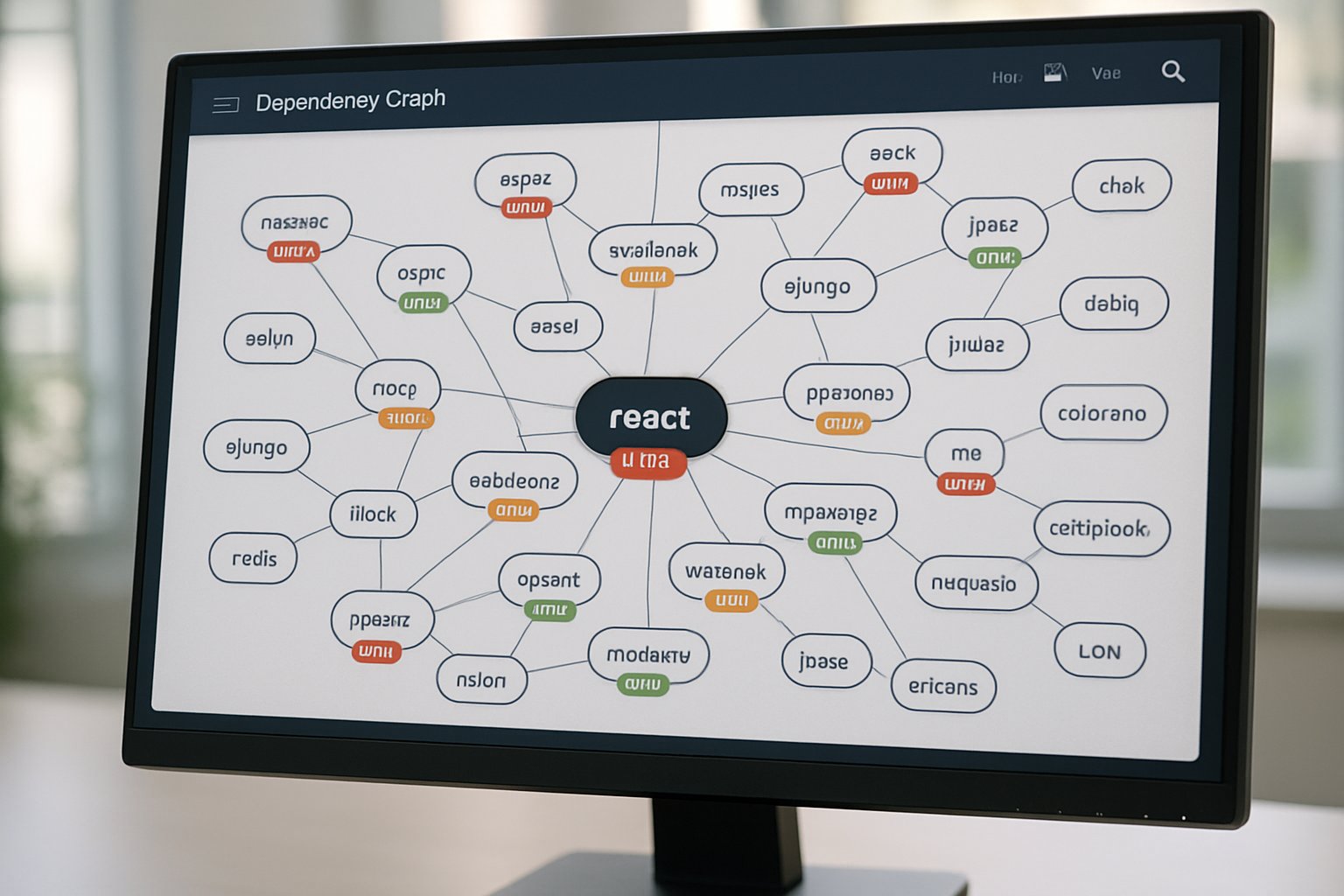
The top five hub packages each had roughly 1,282 direct dependents. Consequently, a single vulnerability could ripple across hundreds of projects within hours. Traditional scanners missed that propagation because they inspect components in isolation.
AI dependency graph analyzers address the blind spot by linking every node and edge. Moreover, reachability analysis shows whether flawed code actually loads at runtime. This blended insight drives precise prioritization.
Graphs convert abstract trees into measurable risk pathways. This visibility reshapes remediation urgency. However, technology only helps when integrated into daily workflows.
AI Tools Enter Workflow
Vendors rushed to operationalize the research. Kusari released Inspector on 17 June 2025 as a pull-request advisor. The bot scans full graphs and SBOM files before recommending merges.
Tim Miller, Kusari CEO, said the product puts “robust security insights right where developers need them.” Semgrep, GitHub, and Snyk have added similar visualizations during 2025. Consequently, developers see risk context without leaving familiar interfaces.
Key launches illustrate the industry momentum:
- Kusari Inspector – June 17, 2025
- Semgrep Dependency Graph – May 2025
- GitHub Bill of Materials APIs – April 2025
Each launch embeds AI dependency graph analyzers directly into CI pipelines. Therefore, AI dependency graph analyzers function as real-time reviewers.
Workflows gain instant, contextual warnings. Developer velocity stays high while risk drops. Yet tooling is only as good as the data it ingests.
SBOM Limitations Exposed Early
SBOM documents promise component transparency. However, June 2025 audits revealed alarming gaps. Researchers scanned 7,876 projects and saw omissions exceeding ninety percent in some cases.
The team also demonstrated a parser confusion attack that hid malicious packages from certain generators. Consequently, AI dependency graph analyzers consuming those manifests may miss critical edges. CISA responded with draft minimum elements to improve documentation quality.
Common weaknesses include:
- Inconsistent package naming conventions
- Missing transitive dependencies
- Format parser discrepancies
Such weaknesses undermine supply chain security insights.
Audits show documentation alone cannot guarantee safety. Therefore, validation must accompany generation. Next, we examine how AI tightens that validation loop.
Practical Risk Mitigation Steps
Organizations can combine several practices for defense in depth. First, enforce build gates that run AI dependency graph analyzers during each commit. Secondly, compare generated SBOM files against live dependency graphs to catch omissions.
Third, prioritize patches using graph reachability scores rather than CVSS alone. Moreover, monitor hub packages with thousands of dependents for early warnings. Endor Labs data shows 57% improvement when AI tools guide version choices.
Consider this action checklist:
- Run AI dependency graph analyzers in CI
- Validate SBOM accuracy regularly
- Track hub dependency health
- Educate teams on parser threats
Teams may also pursue advanced training. Professionals can deepen governance expertise through the AI Executive Essentials™ program.
Coordinated process, tooling, and skills strengthen supply chain security. Nevertheless, evolving standards will influence success. Therefore, policy developments deserve close attention.
Future Policy And Standards
Government agencies accelerated work on supply chain security rules during 2025. CISA labeled the software bill of materials a key building block in updated guidance. Meanwhile, NSA and international partners aligned around SPDX and CycloneDX formats.
Proposed minimum elements demand dependency graphs, provenance data, and vulnerability context. Consequently, vendors must expose APIs that feed AI dependency graph analyzers. OpenSSF working groups are drafting interoperability tests to enforce consistency.
Henrik Plate warns that AI coding agents also introduce novel weaknesses. Therefore, standards will likely extend to agent recommendations and version pinning. Stakeholders should monitor consultation periods to influence practical requirements.
Regulation will ingrain graph thinking into procurement. Consequently, early adopters gain compliance head starts. With policies evolving, forward-looking analytics remain vital.
Conclusion And Next Steps
AI dependency graph analyzers spotlight transitive risks that once hid in plain sight. Research, products, and policy now converge around that insight. However, data quality and standardization challenges persist.
Organizations should integrate automated graph scans, validate SBOM accuracy, and pursue upskilled talent. Moreover, monitoring policy drafts will prevent surprise compliance gaps.
Consequently, start evaluating your pipelines today. Download updated guidance, pilot AI dependency graph analyzers, and explore certifications to lead secure transformations. Nevertheless, ignoring AI dependency graph analyzers leaves blind spots.


