

AI CERTS
2 hours ago
AI Benchmarking Evolves: Microsoft ADeLe’s Cognitive Assessment
Consequently, practitioners can predict performance on unseen tasks. Moreover, policymakers gain interpretable evidence for risk classification. This article unpacks ADeLe's design, results, and strategic implications. Along the way, we consider Generalization and Human Alignment challenges. Finally, we link resources and certification paths for forward-thinking teams. Let's explore how cognitive profiling reshapes model evaluation standards.
Cognitive Profiling Emerges Today
Traditional leaderboards reduce diverse tasks to one aggregate metric. In contrast, many benchmarks hide subtle ability gaps. Consequently, deployment teams face unexpected failures in production. ADeLe proposes a cognitive lens instead of flat scoring. It scores each task along 18 human-interpretable demand scales. Each scale ranges from 0 to 5, describing increasing difficulty.
Furthermore, the battery includes 63 tasks and 16,108 annotated instances. These numbers rival major AI Benchmarking suites while adding rich semantics. Therefore, stakeholders obtain multidimensional evidence rather than opaque averages. Those insights set the stage for deeper diagnostic power. ADeLe transforms raw results into interpretable cognitive profiles. However, understanding the rubrics themselves is essential before trusting them.
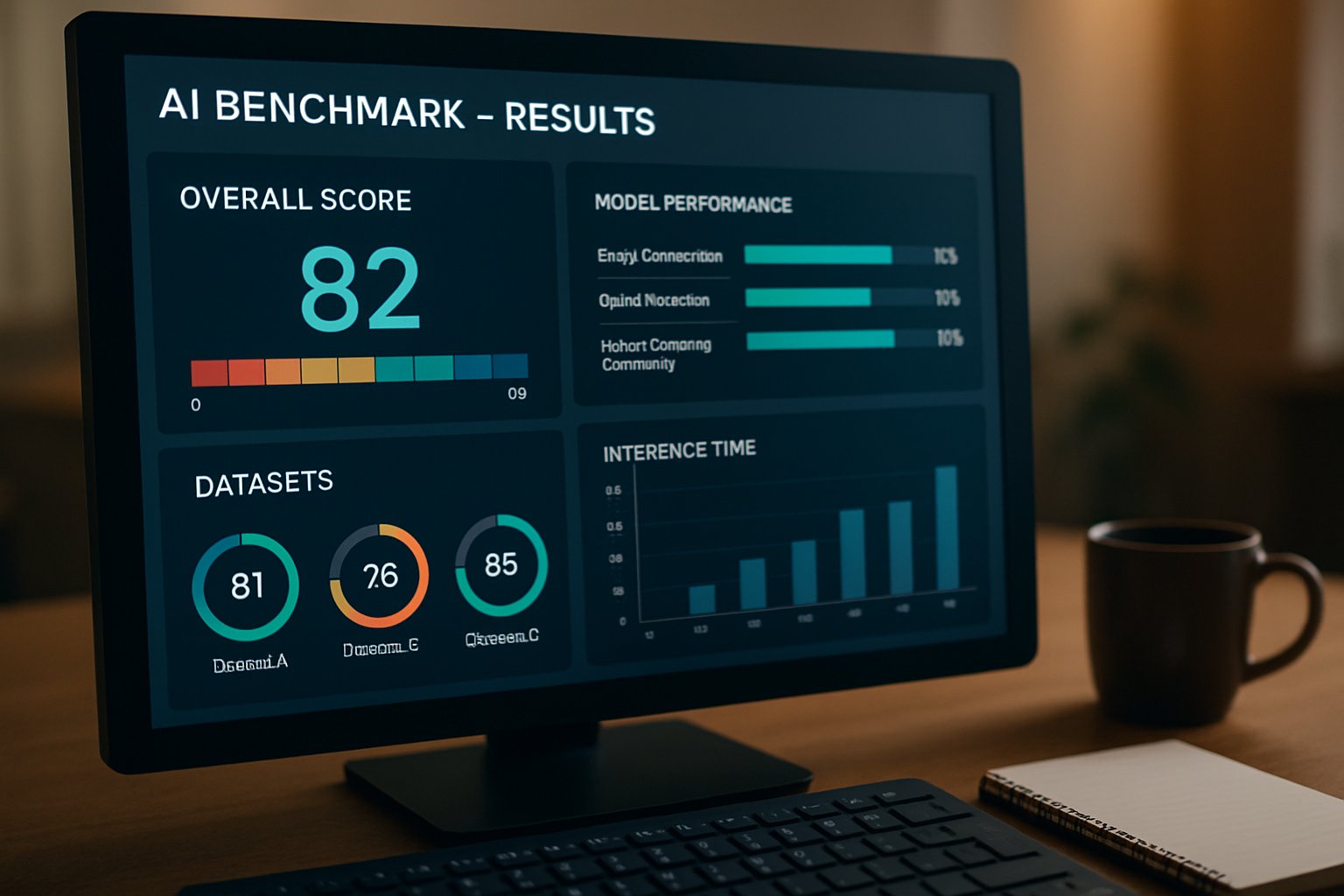
Inside ADeLe's Demand Rubrics
The project introduces the DeLeAn rubric family. Rubrics span attention, reasoning, memory, and domain knowledge dimensions. Moreover, extraneous traits like unguessability capture adversarial hardness.
- Attention/Scan – evaluates rapid information selection.
- Logical Reasoning – measures step-wise inference capacity.
- Causal Judgement – probes cause-effect understanding.
- Formal Sciences – checks maths and code knowledge.
- Social Cognition – assesses theory-of-mind demands.
Annotators applied these scales to every instance using GPT-4o plus human checks. Additionally, inter-rater procedures maintained rubric consistency across languages and domains. The team reports reliable agreement, though exact kappa values remain forthcoming. Nevertheless, the structured rubric set enables systematic capability mapping. This approach differs from traditional AI Benchmarking that treats tasks monolithically. Clear rubrics ground the framework in interpretable science. Next, we examine how those rubrics feed ability profiles.
Ability Profiles Explain Performance
ADeLe treats every model like a student facing graded questions. For each scale, it builds a subject characteristic curve. Consequently, practitioners see the demand level where success probability hits 50%. These inflection points collectively form an ability profile. Moreover, profiles expose hidden strengths and weaknesses across 15 tested LLMs. For example, one frontier model excels at formal sciences but lags in social cognition. In contrast, smaller instruction-tuned systems show the opposite pattern. Such granular insight surpasses legacy AI Benchmarking tables. Teams can target data collection or fine-tuning where curves dip. Ability profiles translate numbers into actionable guidance. However, predictive accuracy ultimately determines business value.
Predictive Power And Generalization
The authors trained a random forest that ingests demand vectors and historical outcomes. Subsequently, the model predicts instance-level success for unseen benchmarks. Reported AUROC reaches 0.88, beating black-box baselines by wide margins. Moreover, performance holds under out-of-distribution Generalization scenarios. This robustness addresses a central Generalization concern for real deployments.
Therefore, enterprises can estimate risk before shipping new features. The EU GPAI report even cites ADeLe for regulatory assessment workflows. Such recognition positions ADeLe as a next-generation AI Benchmarking tool. Classic AI Benchmarking fails to provide such foresight. Teams seeking deeper skills should pursue the AI Researcher™ certification. Demand-based prediction delivers both accuracy and Generalization benefits. Nevertheless, ethics and Human Alignment still require careful attention.
Opportunities For Human Alignment
ADeLe's interpretability supports value-sensitive design conversations. Policy teams can trace failures to specific cognitive stressors. Consequently, developers iterate interventions that improve Human Alignment outcomes. Moreover, transparent curves help auditors explain residual biases. The framework even flags tasks demanding high social cognition or causal reasoning.
Those flags alert reviewers to potential misalignment risks. However, the current rubric set reflects mostly Western educational norms. Broader community input could refine definitions for inclusive Human Alignment audits. AI Benchmarking communities now experiment with value-oriented rubrics. Integrating Human Alignment goals into AI Benchmarking standards requires community consensus. Alignment conversations benefit from cognitive clarity. Still, several open challenges must be addressed.
Limitations And Future Work
Automated annotation reliance introduces possible circularity. Although human checks exist, GPT-4o biases may persist. Additionally, data sharing restrictions hinder full reproducibility. Researchers must sign terms blocking raw item publication to avoid contamination. Gaming risk also grows once vendors optimise for these rubrics. The authors propose community stewardship and periodic rubric refreshes. Furthermore, multimodal expansion remains untested at comparable scale. Consequently, continued validation across languages, modalities, and cultures is essential. Despite hurdles, ADeLe advances rigorous AI Benchmarking significantly. Limitations invite replication and open governance efforts. Meanwhile, final insights can guide decision-makers today.
Key Takeaways
ADeLe shifts evaluation from flat scores to cognitive demand mapping. Consequently, teams gain explanations, risk forecasts, and alignment signals. Predictive performance proves robust across Generalization hurdles. However, annotation bias and gaming risk remain open issues. Still, the framework propels AI Benchmarking toward a reproducible science. Professionals should explore the linked AI Researcher™ certification to deepen analytic expertise. Moreover, early adopters can pilot ADeLe within internal model gating pipelines. Start profiling your systems now and share findings with the broader community.


