

AI CERTs
2 hours ago
AI Banking Cuts Drive Job Displacement Debate
Protests outside European branches highlight mounting fear of Job Displacement as banks automate at record speed. Meanwhile, union banners accuse executives of trading people for algorithms. Consequently, public scrutiny of banking automation has intensified.
Major lenders such as UBS and Lloyds link cost programmes to artificial intelligence. Additionally, Analysts predict broader restructuring waves as chatbots and risk models mature. In contrast, some chiefs caution against losing vital human skills.
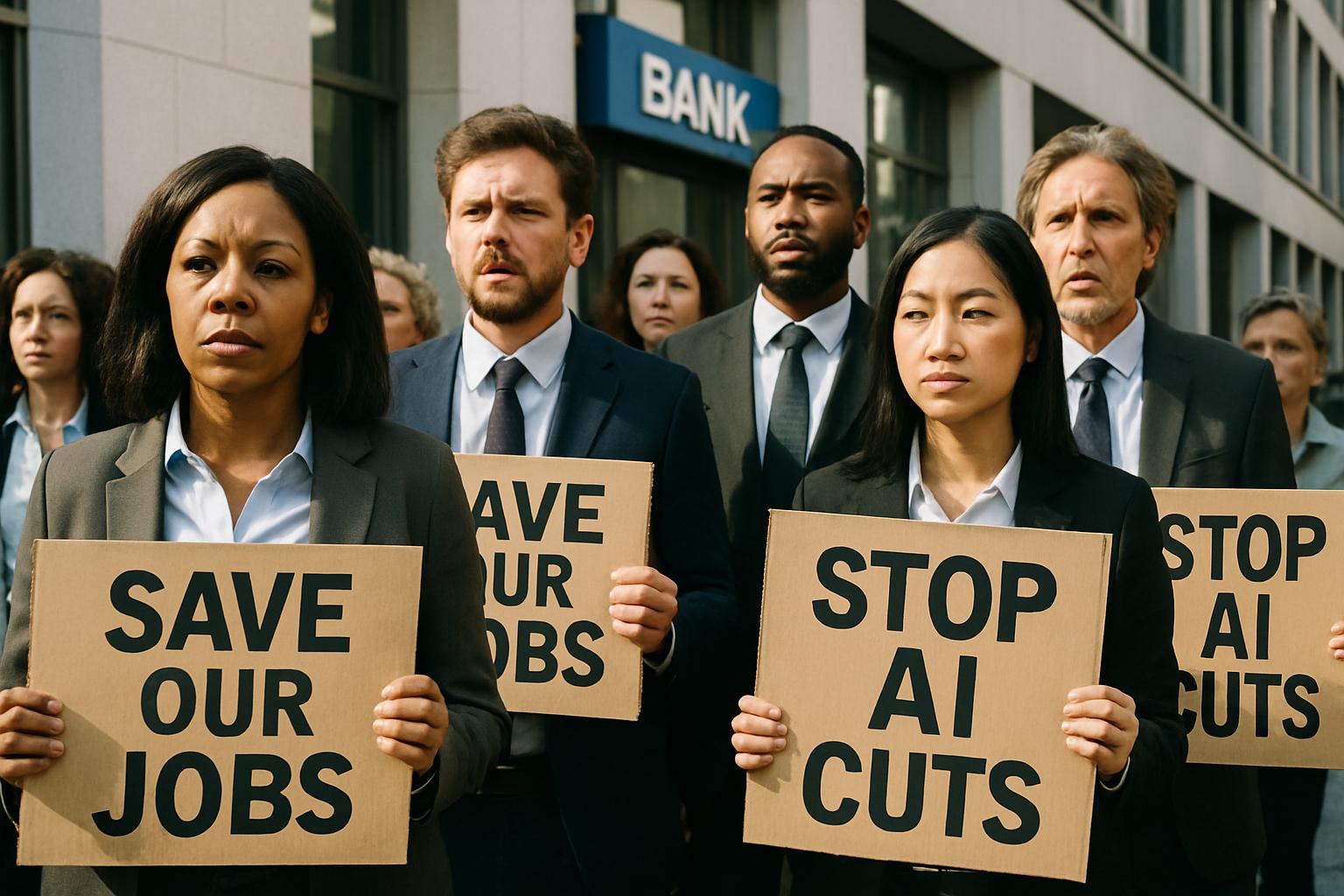
Morgan Stanley estimates that 200,000 European banking roles could vanish by 2030. Therefore, Job Displacement has shifted from abstract concept to boardroom metric. This article unpacks the forces, reactions, and future scenarios.
AI Reshapes Banking Jobs
Banks deploy voice bots, generative models, and robotic workflows across front and back offices. However, productivity claims vary by unit and geography. UBS pilots show faster trade confirmations in Forex settlements yet limited savings in advisory desks.
Commonwealth Bank attempted to remove 45 service staff after installing a phone assistant. Nevertheless, union pressure forced a reversal within weeks. The episode illustrates how rapid automation can misjudge call patterns and spark Job Displacement backlash.
AI delivers speed yet invites social risk. Consequently, investor narratives now dominate board debates. Next, we examine how Analysts amplify that debate.
Pressure From Investor Analysts
Earnings calls increasingly feature granular automation targets. Moreover, Analysts highlight cost-to-income improvements up to thirty percent in some workflows. Morgan Stanley models combine AI gains with branch shrinkage to forecast billions in savings.
Investor decks from Morgan Stanley clients showcase dashboards that rank divisions by automation potential. Consequently, executives feel compelled to attach headcount numbers to each bar. Job Displacement metrics therefore appear alongside capital ratios.
Key figures now shape strategic plans:
- 200,000 European roles flagged by leading research as at risk before 2030.
- ABN AMRO plans 5,200 cuts tied to automation over three years.
- UBS targets double-digit efficiency gains in Forex processing units.
These numbers feed shareholder expectations for relentless pruning. However, labour groups react strongly to such projections.
Investor pressure crystalises numerical targets yet overlooks human context. Subsequently, unions mobilise to fill that gap.
Union Pushback Intensifies Worldwide
Finance Sector Union staged demonstrations outside Sydney call centres after the CBA announcement. Meanwhile, Dutch unions challenged ABN AMRO’s long-term plan in collective bargaining talks. Similar murmurs surface among UBS employees reviewing internal chatbots.
Union leaders argue staff should transition, not exit. Moreover, they demand funded reskilling and transparent AI audits. Job Displacement without pathways, they warn, erodes trust and service quality.
Tribunal victories empower further challenges. Nevertheless, each win remains case specific and jurisdiction dependent.
Organised labour now wields public sympathy and legal tools. Consequently, banks reassess messaging before announcing cuts.
The statistical horizon further shapes those deliberations.
Risk Projections And Statistics
Quantifying risk informs both strategy and bargaining. Therefore, Morgan Stanley's ten percent headline number resonates across boardrooms. Other research houses echo similar ratios, reinforcing Job Displacement discussions.
Bloomberg Intelligence reports show automation promises lift profit margins yet require upfront capital. In contrast, BIS papers warn of model risk concentration and systemic exposure. Forex volatility also complicates algorithmic stress tests for trading desks.
Hard numbers anchor meetings but rarely capture social cost. Subsequently, qualitative dashboards are emerging to track redeployment success.
Statistics spotlight the scale yet hide execution challenges. Therefore, case studies reveal operational reality.
Those lessons surface next.
Operational Lessons From Cases
CBA’s reversal underscores the danger of incomplete call-flow data. Moreover, customer wait times rose despite the bot’s promised efficiency. Banks including UBS monitor similar metrics before expanding pilots.
ABN AMRO staggered its chatbot release after staff testing flagged training gaps. Nevertheless, 5,200 roles remain scheduled for removal. Management insists retraining funds will mitigate Job Displacement pain.
- Robust shadow period with human oversight.
- Clear retraining pathways plus certification incentives.
- Transparent KPI reporting to boards and unions.
Case evidence confirms culture and data quality dictate outcomes. Consequently, regulators step in to standardise safeguards.
The regulatory landscape appears next.
Regulators And Future Outlook
Central bankers acknowledge productivity gains yet highlight operational, model and privacy risks. BIS recommends governance frameworks and scenario testing for generative tools. Consequently, banks brace for supervisory checklists covering Job Displacement mitigation.
Policy signals also influence capital allocation to AI budgets. Meanwhile, Forex dealers monitor algorithmic compliance obligations across markets. Observers expect public consultation papers within twelve months.
Professionals can enhance oversight skills with the Chief AI Officer™ certification. Moreover, such credentials strengthen career resilience against Job Displacement forces.
Emerging rules may stabilise adoption while protecting workers. Nevertheless, leadership decisions will determine final impacts.
A balanced roadmap is essential.
Bank automation will accelerate, fuelled by competition and tighter margins. However, recent protests prove social licence must accompany each algorithm. Morgan Stanley may refine its forecasts, yet unions will still gauge announcements against lived realities. Therefore, executives should pair technical sprints with transparent impact audits. Doing so reduces reputational exposure and curbs uncontrolled Job Displacement. Professionals who lead that balance can future-proof their roles and teams. Consequently, now is the moment to pursue strategic AI credentials and join the conversation. Consider enrolling today to translate policy guidance into profitable, ethical innovation.


