

AI CERTS
2 hours ago
AI Arbitrator Transforms Construction Dispute Settlement
Moreover, startups market radical savings for cash-strapped small businesses. Meanwhile, academics warn about hallucinations that plague large language models. These tensions define today’s alternative dispute resolution landscape. This article explores emerging data, benefits, and risks behind the headline technology. Importantly, it explains how construction cases became the first proving ground. It also outlines enforceability hurdles a judge may soon confront. Finally, readers will discover upskilling paths to stay ahead. Let us dive deeper into this rapidly evolving field.
Market Forces Reshaping ADR
Global alternative dispute services generated roughly nine billion dollars last year, according to multiple analysts. Furthermore, online and hybrid proceedings drove mid-single-digit growth despite macroeconomic headwinds. Consequently, investors poured new capital into AI Arbitrator platforms promising quicker resolutions. Demand spikes when parties want confidential outcomes without congested courts. Therefore, suppliers emphasise speed and predictability during marketing pitches. The AI Arbitrator fits neatly within that narrative by trimming document review time.
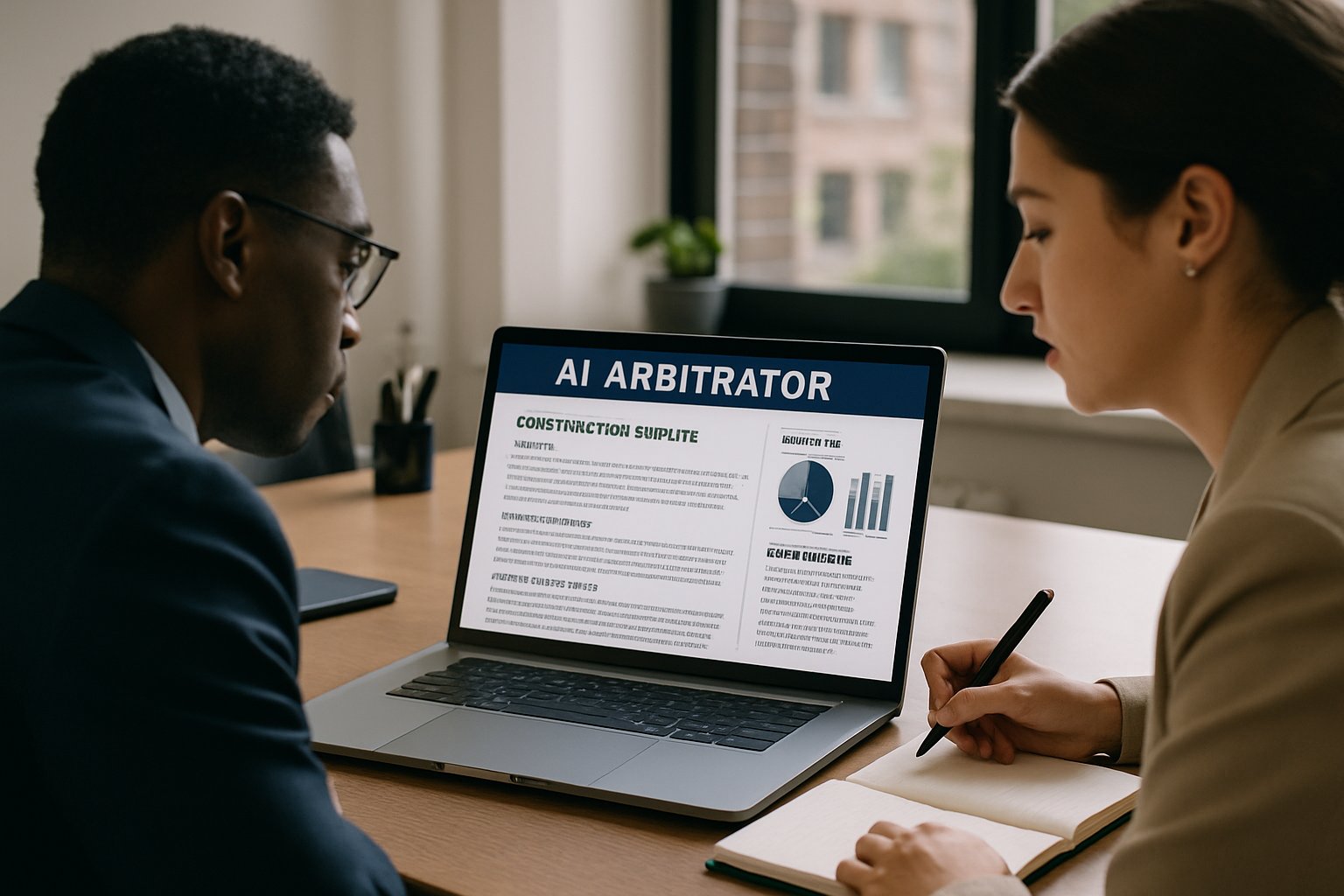
In contrast, critics caution that cheaper processes could encourage frivolous claims. Nevertheless, surveys show small businesses welcome any mechanism that shortens cash-flow disruption. These economic dynamics set expectations for every subsequent pilot. Understanding them clarifies why stakeholders now experiment aggressively.
Market momentum now rewards demonstrable efficiency gains. However, proving accuracy remains the next test for credibility.
Institutional Pilot Insights Rise
The AAA launched its AI-native arbitrator on 3 November 2025 for documents-only construction claims. Moreover, AAA officials projected the AI Arbitrator would decide cases within 45 days instead of 75. They also forecast baseline cost reductions of at least 35 percent. Bridget Mary McCormack stated that now is the time to embrace efficiency.
Importantly, the pilot keeps a human arbitrator in the loop who reviews every AI Arbitrator draft award. Consequently, parties receive both algorithmic analysis and human reassurance. Monthly updates through January 2026 showed throughput improvements without reported accuracy incidents.
However, the sample size remains modest, and independent audits have not yet surfaced. Academic observers therefore urge transparent publication of anonymised case files. These early signals nonetheless demonstrate institutional willingness to modernise.
AAA’s cautious rollout offers valuable governance lessons. Next, private vendors must prove scalability under more varied fact patterns.
Startup Ambitions Clash Boldly
Startups like Arbitrus.ai promise binding awards within three days after submissions. Additionally, marketing claims a staggering 90 percent cost drop versus traditional arbitration. The AI Arbitrator concept here moves from assistant to autonomous decision-maker.
In contrast, the JudgeGPT platform offers a virtual judge simulation for strategic preparation. Founders assert ensemble models and rigorous source verification eliminate hallucinations. Nevertheless, no peer-reviewed replication supports those bold assurances.
Venture capital enthusiasm remains high because an AI Arbitrator exit could deliver unicorn multiples. Consequently, investors accept regulatory risks in exchange for first-mover advantages. Startups also highlight cross-border settlement potential via smart contracts and tokenised fees. Yet, enforceability questions linger, especially under the New York Convention.
Entrepreneurial velocity drives innovation yet magnifies accountability gaps. Therefore, technical foundations deserve closer analysis before mass adoption.
Technical Foundations Explained Clearly
Most systems follow a predictable pipeline from data ingestion to AI Arbitrator award drafting. First, parties upload pleadings and evidentiary documents through secure portals.
- Claim extraction identifies issues and relevant authorities.
- LLMs prepare draft findings with citations and suggested remedies.
- Human reviewers validate reasoning, adjust language, and sign the award.
Furthermore, vendors apply retrieval augmentation to ground answers in verified case law. They also run cross-model comparison to flag potential hallucinations. Nevertheless, an academic study in 2024 recorded 58 percent hallucination rates in generic legal tasks. Therefore, rigorous prompt design and post-processing audits remain mandatory.
Some providers train exclusively on construction awards to limit domain drift. AAA adopted that narrow scope during its initial rollout. Other vendors chase broad commercial disputes, increasing AI Arbitrator technical complexity. These architectural choices shape performance, cost, and risk profiles.
Sound engineering reduces mistakes but cannot guarantee perfect truthfulness. Consequently, risk management frameworks must accompany every technical deployment.
Risks Temper Emerging Hype
Accuracy failures could undermine AI Arbitrator trust and enforceability. Moreover, biased training data may disadvantage vulnerable parties. Cody Venzke from the ACLU warned that near perfection is non-negotiable when rights are at stake. In contrast, vendors argue probabilistic systems already outperform overwhelmed humans on routine matters.
Legal enforceability presents another hurdle, especially for fully automated awards. Courts may invoke public policy exceptions under the New York Convention to refuse machine rulings. Furthermore, parties might challenge consent validity if contracts mandate hidden algorithmic procedures. Privacy regulators also scrutinise cross-border data transfers during cloud processing.
These intertwined risks demand transparent design, audits, and option for human appeal. Nevertheless, continuous monitoring can mitigate reputational fallout when errors occur.
Risk awareness now influences procurement decisions across corporate legal departments. Next, enforcement realities will determine long-term viability.
Enforcement Outlook Ahead Globally
Enforcement hinges on whether judges view machine reasoning as sufficiently reasoned and impartial. Presently, no reported decisions have tested a purely algorithmic award under Article V grounds. However, arbitration counsel expect early cases within eighteen months. Therefore, vendors monitor dockets closely, ready to file amicus briefs supporting recognition.
AAA reduced risk by retaining human signatories, aligning with existing jurisprudence. Startups pursuing full automation accept higher litigation exposure. Consequently, they explore voluntary compliance incentives, such as escrowed bonds and rapid settlement windows. International institutions like ICC and LCIA watch developments before updating procedural rules.
Meanwhile, policymakers debate creating certification regimes analogous to autonomous vehicle safety. Such regulatory clarity could reassure markets and increase uptake.
Judicial acceptance remains the final adoption barrier. However, professionals can prepare by diversifying skills and compliance strategies.
Professional Skills Roadmap Now
Legal teams increasingly seek hybrid talent fluent in technology, governance, and doctrinal analysis. Moreover, familiarity with automated arbitration workflows positions professionals for emerging roles inside institutions and startups. Engineers who understand evidence rules can build safer, explainable pipelines. Lawyers who code can audit model outputs and advise on enforceability.
Consequently, multidisciplinary certificates are gaining traction with corporate counsel. Professionals can enhance their expertise with the AI Legal™ Certification program. The syllabus spans algorithmic ethics, international construction arbitration, and cross-border settlement enforcement. In contrast, waiting risks obsolescence as automated workflows mature quickly. These insights underscore an urgent need for proactive learning. Therefore, readers should enrol now and shape responsible adoption.


