

AI CERTs
2 months ago
AI Advances Boost Subseasonal Weather Prediction
Polar scientists watched Arctic ice reach a record winter low in March 2025. Meanwhile, AI engineers saw opportunity. Consequently, new models began decoding faint Arctic teleconnections that shape mid-latitude cold waves.
Today, Subseasonal Weather Prediction stands at a turning point. Furthermore, advanced Climate AI tools can now expose patterns invisible to classical numerical models. In contrast, earlier medium-range breakthroughs barely touched the tricky two-to-six-week horizon. Moreover, MIT Research confirmed the approach by flagging a December 2025 East Coast freeze weeks ahead.
Arctic Signals Meet AI
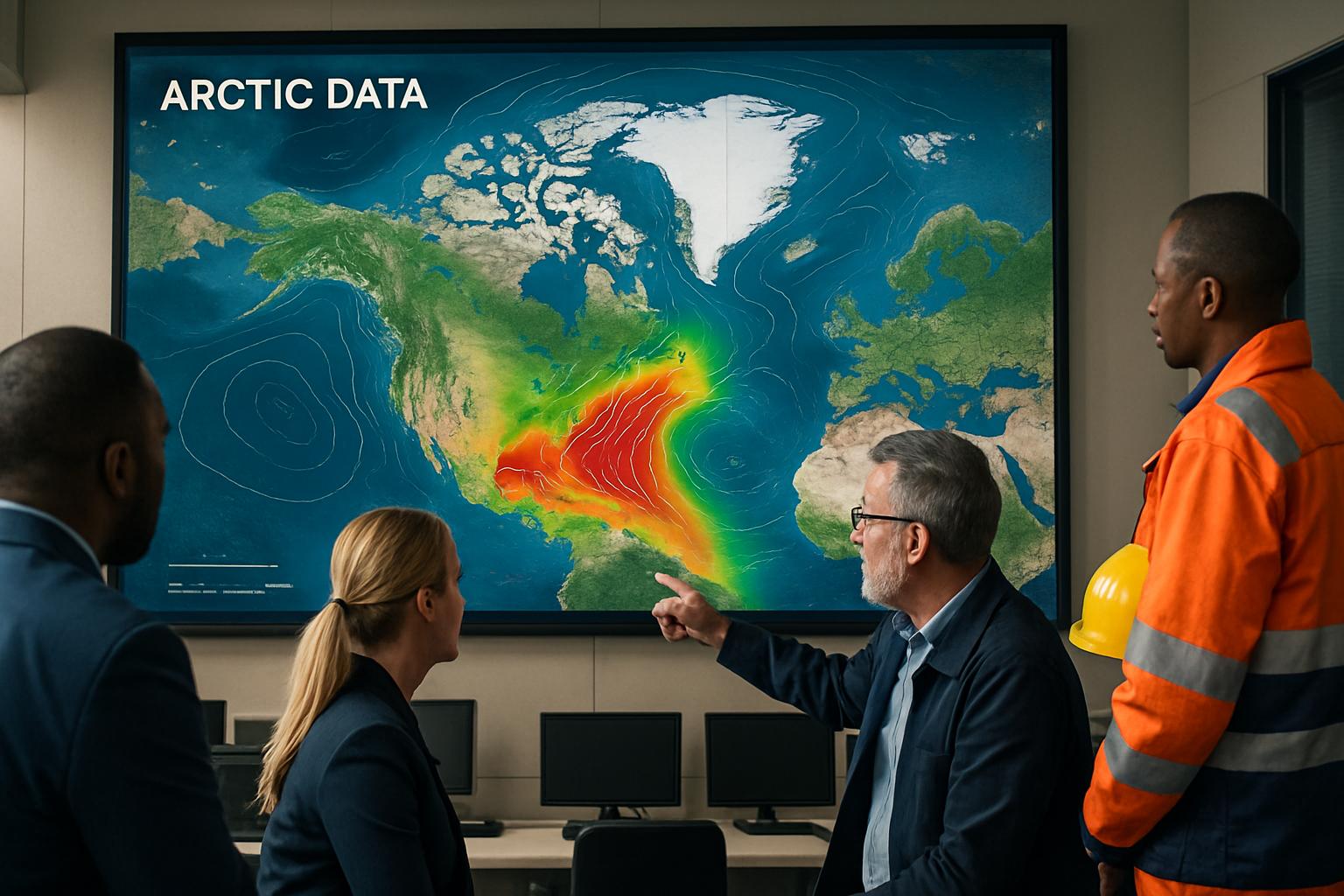
Arctic Data are rich with hints of future turbulence. However, conventional models struggle to exploit these noisy precursors beyond ten days.
AI architectures now mine satellite fields, snow indices, and sea-ice metrics for hidden patterns. Therefore, researchers encode the Arctic signature directly into learning pipelines, reducing reliance on hand-crafted heuristics.
These strategies transform raw Arctic observations into predictive gold. Consequently, the next section examines breakthroughs that powered this shift.
Cutting-edge Modeling Breakthroughs
Aardvark Weather replaced much of the numerical pipeline with an end-to-end transformer. Moreover, the Nature paper showed it ingests just eight percent of conventional observations. Generation time fell to one second on four GPUs, slashing compute costs.
DeepMind's GraphCast earlier delivered ten-day accuracy gains using graph neural networks. Subsequently, GenCast ensemble variants explored probabilistic outputs that suit operational Forecasting needs. Together, these lines established technical credibility for longer horizons. In turn, Subseasonal Weather Prediction became a realistic engineering target. Climate AI platforms now offer reproducible notebooks that host these models. Teams augment training sets with high-resolution Arctic Data gathered from NSIDC.
Model innovation paved the runway for subseasonal experiments. Meanwhile, competitions began testing that promise in real-time arenas.
Emerging Global Operational Competitions
ECMWF launched AI Weather Quest in 2025 to benchmark multi-week skill. Consequently, over thirty-five teams submitted sixty models targeting days nineteen to thirty-two.
Judah Cohen’s MIT Research group topped the fall leaderboard. Furthermore, their hybrid system fused machine learning with Siberian snow and polar vortex indices. The tool flagged a mid-December East Coast chill three weeks early.
Competition results validated Arctic diagnostics inside learning systems. Therefore, attention shifted toward tangible efficiency and economic gains.
Statistical Gains And Efficiency
Operational centers chase every percentage of accuracy. Aardvark fine-tuning improved temperature mean absolute error by up to six percent in target regions. Moreover, the model consumed orders of magnitude less compute than flagship supercomputer runs.
GraphCast achieved comparable wins at medium range, delivering forecasts under one minute. Consequently, cost and carbon savings become hard to ignore.
Key numbers underscore the shift:
- Aardvark: 1 second runtime on four A100 GPUs
- Eight percent observation load versus traditional systems
- GraphCast: 10-day lead, one minute runtime
- Arctic ice 2025 maximum: 14.33 million km², record low
- AI Weather Quest: 35 teams, 60 models, global leaderboard
Together, these gains hint at affordable global forecasting democratization. Consequently, the following section explores what this means for stakeholders.
Practical Stakeholder Implications Explained
Energy utilities sit atop the beneficiary list. Moreover, a three-week heads-up on potential cold surges guides fuel hedging and crew schedules.
Transportation planners adjust salt stockpiles and staffing when alerted early. Additionally, agriculture managers can shield sensitive crops from frost damage.
Emergency agencies value extra days for public messaging and logistics. Consequently, demand grows for AI-literate professionals who understand both models and operations. Professionals can enhance their expertise with the AI+ Healthcare™ certification.
Industry use cases hinge on credible lead time, cost, and interpretation gains. In contrast, outstanding risks could slow widespread deployment. Next section unpacks those risks.
Remaining Risks And Roadmap
AI systems still falter on extreme, rare, or shifting climate regimes. Moreover, non-stationarity under rapid warming demands continual retraining or hybrid physics solutions. Interpretability also matters because forecasters must justify warnings to governments.
Consequently, ECMWF and NOAA run multi-season mirrors before operational integration. Nevertheless, early field tests continue expanding. Meanwhile, researchers explore ensemble uncertainty quantification and causal discovery modules.
Risks remain but look manageable with rigorous evaluation and transparent design. Therefore, strategic roadmaps propose hybrid deployments within three years.
Conclusion And Future Outlook
Subseasonal Weather Prediction is entering a data-rich, AI-driven era. Advances in Climate AI, Arctic Data mining, and efficient modeling deliver measurable skill and cost benefits. Furthermore, MIT Research victories illustrate how targeted diagnostic features enhance accuracy weeks ahead. Nevertheless, rigorous verification and clear communication must guide operational rollouts.
Professionals should follow competitions, test open models, and pursue specialized credentials to stay relevant. Consequently, exploring certifications like the AI+ Healthcare™ program can build cross-domain expertise. Act now and help shape the next generation of resilient, AI-enhanced forecasts.
Reliable Subseasonal Weather Prediction can cut outage costs by millions. Trust remains the currency for operational Subseasonal Weather Prediction adoption. Long-range planners will soon rely on AI-enabled Subseasonal Weather Prediction as routine practice.


