

AI CERTS
3 months ago
Agentic Strategy: 2025 CIO Playbook for Autonomous AI Agents
Consequently, CIOs must grasp architecture, governance, and vendor moves before funding pilots. Moreover, early adopters expect 171% ROI, yet security gaps and skill shortages persist. This article unpacks market drivers, design essentials, and pragmatic steps for enterprise success. Additionally, it connects those insights to relevant certifications that strengthen leadership credibility. Read on to master the Agentic Strategy required for safe, scalable intelligent Workflows. In contrast, ignoring oversight today could trigger costly rewrites tomorrow. Consequently, leaders must act decisively yet responsibly.
Recent Market Momentum Drivers
Investor announcements dominated 2025 headlines, signaling rapid commercialization. Furthermore, OpenAI launched Operator in January and folded agents into ChatGPT by July. Salesforce countered with Agentforce 2dx in March and Agentforce 3 in June. Meanwhile, AWS unveiled frontier agents during re: Invent, targeting modernization of legacy Systems. Analysts quickly quantified the surge. Consequently, PagerDuty surveys showed average expected agentic ROI hitting 171%.
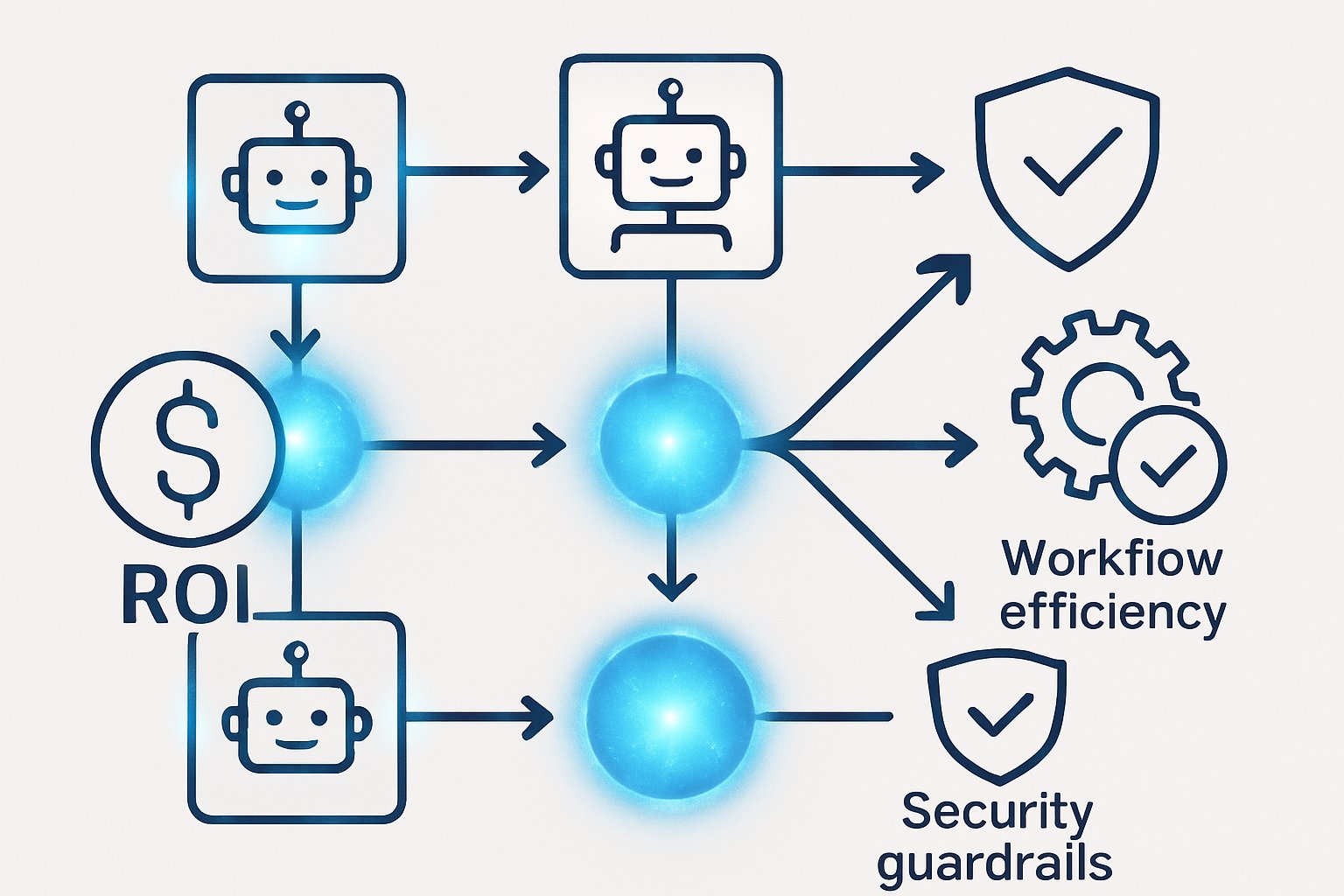
Key 2025 numbers appear below:
- 15% of IT application leaders piloting autonomous AI agents (Gartner).
- USD 1.6 B autonomous agents market size in 2024 (Market Growth Reports).
- 40% of agentic projects at risk of cancellation by 2027 (Gartner).
Nevertheless, analysts caution that rosy forecasts overlook governance shortfalls. Therefore, any Agentic Strategy must ground excitement in disciplined program management. These market signals highlight both momentum and fragility. However, understanding the technical stack provides clearer implementation guidance.
Rapid vendor progress fuels investment optimism yet exposes potential fragility. Next, we dissect the essential technology components powering enterprise agents.
Essential Core Technology Stack
Any viable deployment depends on a layered architecture. Moreover, leading platforms now bundle six foundational modules. Firstly, a large language model provides reasoning and planning. Secondly, memory stores and retrieval augment context, ensuring longer Workflows stay coherent. Thirdly, tool adapters connect APIs, GUIs, and legacy Systems for real execution. Fourthly, an orchestration scheduler coordinates tasks, prioritizes conflicts, and tracks state. Subsequently, observability dashboards surface decision traces, costs, and anomalies in real time. Finally, identity and secrets management enforces least privilege, a non-negotiable Guardrails layer. Therefore, CIO teams must validate each module before signing contracts. A clear module checklist sharpens the Agentic Strategy and simplifies vendor comparisons. Understanding these building blocks accelerates design discussions. The next section details how governance Guardrails convert design into trusted operation.
Robust Governance Guardrails Needed
Autonomy without oversight invites disaster. Consequently, Gartner warns of agent sprawl and opaque decisions. In contrast, mature Guardrails transform autonomy into durable value. Core controls map neatly to the NIST AI RMF functions. Furthermore, EU AI Act obligations require human oversight for higher-risk Systems. Salesforce and AWS now market command centers, yet observers label them early versions.
Effective Risk Mitigation Steps
CIOs can adopt the following phased measures:
- Sandbox agents and restrict production data access.
- Enable detailed logging of every action and tool call.
- Impose step budgets and human escalation thresholds.
- Rotate secrets regularly and audit permissions monthly.
Additionally, security vendors advise installing kill switches and automated anomaly alerts. Nevertheless, policies alone do not guarantee adoption. Therefore, the Agentic Strategy must embed governance tasks into daily operations. Strong Guardrails reduce regulatory risk and build executive trust. With oversight defined, organizations can plan practical adoption phases.
CIO Practical Adoption Playbook
Pilot scope determines success more than model choice. Moreover, experts recommend starting with high-volume, low-judgment Workflows like invoice matching or incident triage. Begin with a sandbox running against synthetic data then graduate to limited production traffic. Meanwhile, measure cycle-time savings, error rates, and human hours returned. Subsequently, expand to adjacent processes once metrics beat predefined thresholds.
Actionable ROI Measurement Tips
Teams should follow three golden guidelines.
- Compare baseline and agent throughput weekly.
- Translate minutes saved into fully loaded labor cost.
- Track model and infrastructure spend per transaction.
Consequently, a transparent scorecard keeps sponsorship strong and flags drift early. The Agentic Strategy also mandates rolling knowledge-base updates so agents stay current. A phased Agentic Strategy roadmap avoids costly rewrites later. These disciplined steps convert experiments into durable Automation wins. Focused pilots with clear metrics minimize hype risk. Next, we examine which vendors currently dominate the tooling conversation.
Current Vendor Landscape Update
Vendor competition intensified during 2025. OpenAI now offers Operator and ChatGPT agents for web tasks and developer APIs. Salesforce positions Agentforce as a digital labor platform complete with marketplace extensions. Additionally, AWS touts frontier agents inside Transform to accelerate mainframe migration Automation. Microsoft integrates higher autonomy inside Copilot Studio and exposes Guardrails through Entra and Purview. Anthropic, Google, and security partners fill specialized niches, especially regulated vertical Systems. Nevertheless, analysts emphasize feature lists matter less than governance maturity and ecosystem openness. Therefore, your Agentic Strategy should rank vendors by observability depth, connector breadth, and pricing clarity. Competitive parity exists in core features yet diverges in control depth. Finally, upskilling remains essential for sustained enterprise competence.
Strategic Skill Upskilling Paths
Technology alone will not close capability gaps. Consequently, enterprises must invest in structured learning for architects, security leads, and product owners. Several industry certifications now address agentic design, governance, and Automation patterns. Professionals can deepen skills via the AI Marketing Strategist™ certification. Moreover, vendor academies from Salesforce, AWS, and Microsoft provide agentic design labs and sandbox credits. Subsequently, pairing course work with small pilots accelerates knowledge retention and cultural adoption. The Agentic Strategy gains momentum when training, tooling, and incentives align. Continual learning protects against skill obsolescence and vendor lock-in. We now conclude with a concise action recap.
Successful agent adoption hinges on balanced ambition and disciplined controls. Therefore, the Agentic Strategy outlined here empowers CIOs to automate safely while maximizing ROI. Moreover, selecting right vendors, enforcing safeguards, and tracking metrics sustain momentum beyond pilot stages. Continual upskilling locks those gains and protects enterprise competitiveness. Professionals should pursue endorsed certifications to validate expertise and guide cross-functional conversations. Consequently, begin crafting your roadmap today and position your organization for autonomous advantage.


