

AI CERTS
3 months ago
Personalized Health AI drives next-gen skincare boom
Market researchers estimate customized skincare to be worth about USD 25-33 billion today. Moreover, forecasts suggest the figure might nearly double within ten years. Analysts argue that rising Healthcare adoption and Consumer trust fuel this expansion. Nevertheless, questions about validation, privacy, and inclusivity remain unresolved. This piece explores the players, technology, and business stakes shaping the frontier.
Global Market Momentum Grows
Market data underscores surging interest in hyper-custom formulas. ResearchAndMarkets values the segment at USD 25.1 billion for 2024. Furthermore, IMARC and Precedence Research publish similar valuations near USD 30 billion. Analysts tie the climb to better algorithms, falling sensor costs, and wider Healthcare digitization.
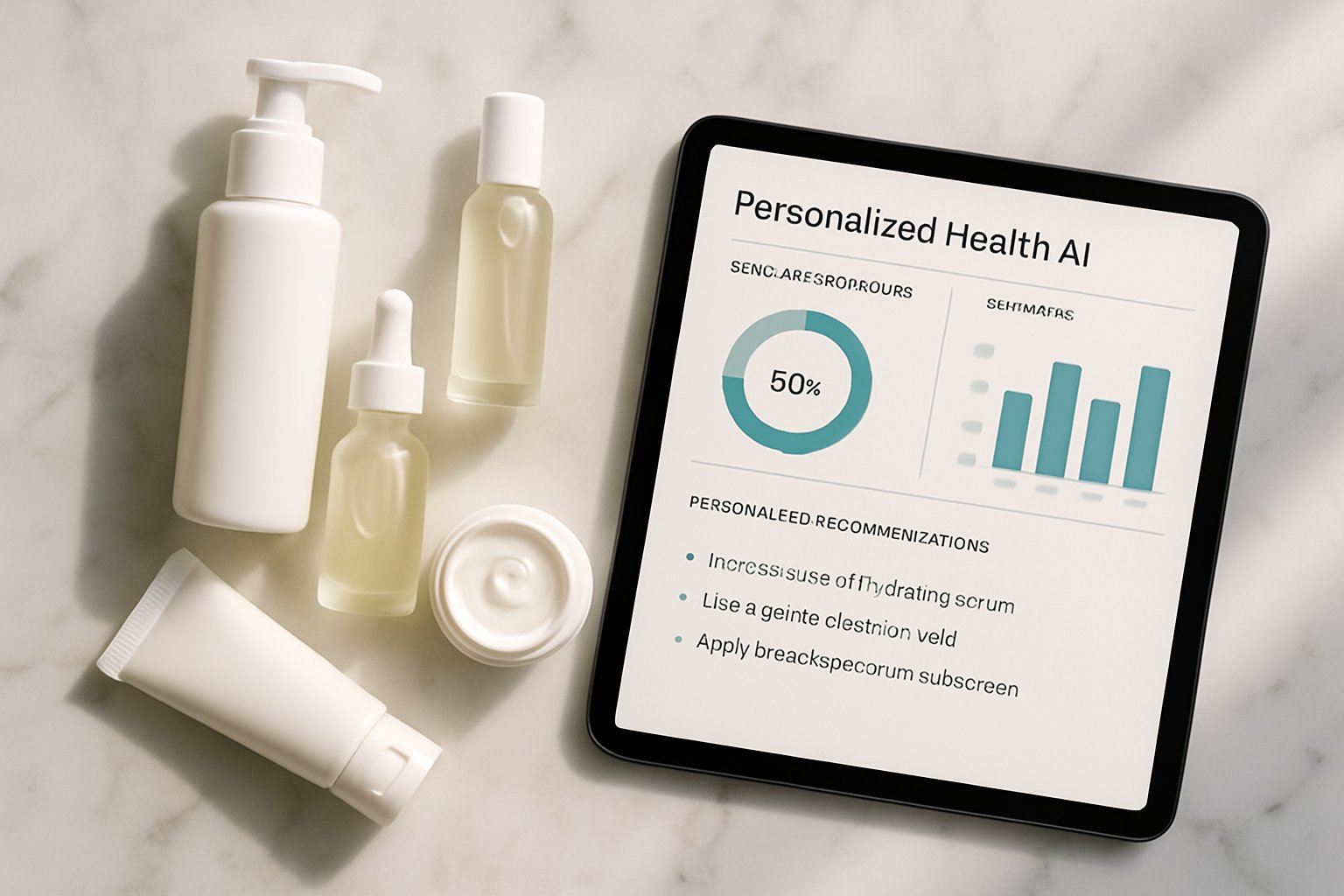
- CAGR 8.3% projected through 2034
- Potential value USD 47.4 billion by 2034
- 60% Consumer openness to AI beauty advice
- 45% report greater purchase confidence with visual try-on
Personalized Health AI is driving this valuation path. These numbers confirm accelerating demand and investment. However, competition intensifies as entrants rush for share. The next section unpacks the technology enabling this momentum.
Tech Under The Hood
Computer-vision models now classify up to fourteen Skin attributes from one selfie. Subsequently, recommender engines map results to ingredient graphs and dynamic formulation rules. Generative SkinGPT tools visualize before-after effects, enhancing Personalization and educating shoppers. Robotic mini-labs then blend micro-batches within minutes, embodying Personalized Health AI in physical form.
Therefore, Personalized Health AI now spans the entire feedback loop from scan to serum. SmartSKN couples K-OWN with robotic arms, while Haut.AI packages APIs for brand websites. In contrast, legacy beauty giants deploy L’Oréal Perso and Perfect Corp modules. Together, these modules create seamless digital-to-physical pipelines. Consequently, new revenue channels emerge for agile firms.
Emerging Business Models Rise
Every major Startup experiments with two-sided strategies. SmartSKN sells devices to professionals and direct subscriptions to at-home users. Meanwhile, Haut.AI licenses SDKs to retailers, earning usage fees and insights. Additionally, brands deploy white-label Personalized Health AI to personalize store kiosks. Consequently, diversified revenue hedges against fickle Consumer cycles. Subscription refills also support sustainability by matching batch size to real usage. These models prioritize margin alongside engagement. Nevertheless, unresolved risks could erode trust if ignored. Risk drivers follow below.
Critical Key Risks Persist
Data privacy tops concerns because selfies reveal health attributes. Therefore, operators must satisfy HIPAA, GDPR, and new cosmetics rules. Algorithmic bias can misdiagnose darker Skin tones, harming inclusion. Moreover, clinical claims from each Startup often lack peer-reviewed transparency. Analysts warn that overhyped Personalized Health AI may backfire without rigorous validation. Advocate groups demand clear usage terms and easy data deletion. Risk management will determine winners in this space. In contrast, regulation can also create barriers for new entrants. Legislative shifts are accelerating.
Regulatory Outlook Rapidly Shifts
Authorities struggle to classify AI skincare as medical device or cosmetic tool. Consequently, the EU Artificial Intelligence Act may compel algorithmic risk audits. The U.S. Cosmetics Act extends labeling and adverse event reporting to AI-assisted products. Meanwhile, regional Healthcare agencies in Asia issue draft guidance on imaging data. Startups investing early in compliance can market Personalized Health AI as trustworthy innovation. Moreover, adherence reduces launch delays and costly fines. Policies will crystallize standards over the next two years. Therefore, companies must budget for strong legal counsel. Skill demands illustrate the next challenge.
Future Outlook And Skills
Scaled deployment requires talent across machine learning, dermatology, and regulatory affairs. Moreover, project managers fluent in Personalized Health AI orchestrate these teams efficiently. Professionals can enhance their expertise with the AI Project Manager™ certification. Additionally, curricula now integrate Healthcare principles, Skin biology, and ethical Personalization methods. Consumer enthusiasm will hinge on transparent outcomes and fair pricing. Consequently, stakeholder collaboration may unlock the forecasted billions. Skill investment is a controllable success factor. Nevertheless, strategic clarity also matters.
AI-native skincare has moved from concept to commerce within three fast years. Global demand, fueled by SmartSKN, Haut.AI, and other Startup peers, shows no sign of slowing. However, success depends on disciplined data handling, unbiased algorithms, and verified clinical outcomes. Policies are tightening, yet forward-thinking teams already align designs with regulators. Consequently, Personalized Health AI will likely anchor future product pipelines across beauty and broader Healthcare. Meanwhile, deliberate Personalization strategies can deepen Consumer loyalty while limiting waste. Professionals mastering Personalized Health AI stand to guide that evolution and capture new value. Consider acquiring advanced credentials today to remain essential in tomorrow's data-driven beauty economy.


