

AI CERTS
7 months ago
OpenAI Benchmark Shows Model Capability with 77% Olympiad Score
However, the same system achieved only 25 percent on the open-ended Research track. Consequently, scientists and investors demanded deeper context. This article dissects the results, the methodology, and the implications for everyday laboratory work. Moreover, we compare competing models to highlight relative strengths and lingering weaknesses. Meanwhile, experts warn that competition questions differ sharply from genuine Scientific Reasoning in the wild. The difference matters when stakes involve multimillion-dollar drug pipelines or clean-energy prototypes.
FrontierScience Benchmark Overview Details
FrontierScience arrives as the latest public Benchmark measuring advanced language-model skills. Unlike earlier multiple-choice datasets, the suite offers rubric-scored answers with partial credit. Furthermore, designers split the tasks into an Olympiad track and a Research track. Both tracks cover Physics, chemistry, and biology, yet they diverge in structure. In contrast, Olympiad items demand concise derivations, while Research problems allow free-form exploration. Numbers reported by TIME suggest about 100 Olympiad items and 60 Research items.
Evaluation relied on a model-based grader backed by GPT-5 variants plus human calibration runs. Therefore, raw outputs passed through rubrics before final scores appeared. Each solution needed at least seven rubric points for full credit, according to media summaries. Nevertheless, analysts caution that model graders can inflate results if prompts leak answer structure. These details set the stage for deeper performance analysis.
The Benchmark design marks progress beyond trivial quizzes. However, the Olympiad track tells only part of the story, as the next section shows.
Olympiad Track Performance Results
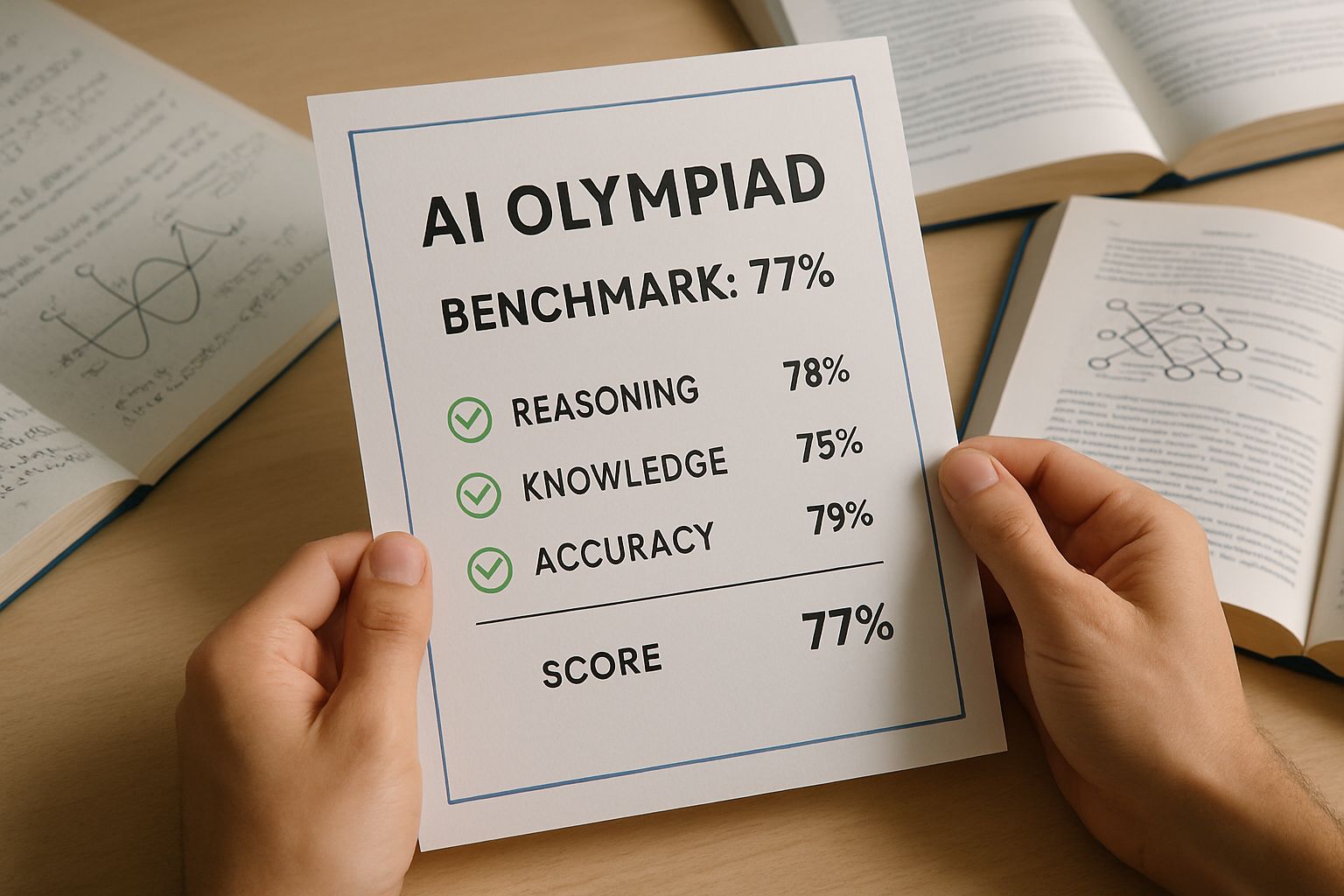
OpenAI reported that GPT-5.2 scored 77.1 percent on the Olympiad track. Consequently, headlines equated the result with near-human contest prowess. Yet context reveals important nuance.
- Flagship OpenAI model: 77.1% contest track, 25.3% Research
- Gemini 3 Pro: 76.1% contest track, 12.4% Research
- Claude Opus 4.5: 71.4% contest track, 17.5% Research
- Grok 4: 66.2% contest track, 15.9% Research
Moreover, the Olympiad problems tackled core Physics topics like mechanics and electromagnetism. Many questions required multi-step algebraic manipulation, unit analysis, and precise Scientific Reasoning. The flagship model often excelled when the chain of logic was short. However, performance dropped when longer derivations exceeded internal context limits. Meanwhile, smaller OpenAI models lagged by ten points or more. These gaps illustrate rising but uneven Model Capability across the lineup. These numbers reflect practical Model Capability under contest constraints.
Olympiad data confirms rapid accuracy gains. Nevertheless, constrained questions fail to mirror messy laboratory uncertainty.
Research Track Limitations Exposed
If the Olympiad score excited investors, the Research score delivered a sober reality check. GPT-5.2 reached only 25 percent, far below human graduate-level expectations. Furthermore, Google, Anthropic, and xAI trailed even further on this open-ended section. Tasks demanded hypothesis framing, method selection, and robust result interpretation. Such operations reflect authentic Scientific Reasoning rather than classroom drills. In contrast, missing context or ambiguous data often confused every model tested. Reviewers labeled these failures as major Model Capability gaps. Consequently, OpenAI researchers emphasized the need for stronger planning modules and multimodal inputs.
The score also revealed cost trade-offs. Running the flagship model with extended reasoning steps improved accuracy but consumed more tokens and latency. Therefore, practical deployment must balance budget and benefit. These economic factors influence enterprise adoption decisions.
The Research track exposes crucial weaknesses. However, deeper training and tool use could narrow the gap, as comparative data reveals next.
Comparative Model Capability Rankings
Benchmark numbers alone rarely tell the full story. Accordingly, analysts compared relative Model Capability using normalized deltas. GPT-5.2 led by one point on Olympiad but doubled Gemini on Research points. Moreover, Claude Opus outperformed Gemini on Research, despite trailing on Olympiad. Physics domain expertise perhaps boosted Claude’s open-ended answers.
Another perspective considers consistency across disciplines. OpenAI reported Physics accuracy at 81 percent on Olympiad, topping biology and chemistry. Meanwhile, Research physics questions saw only 28 percent correctness. Such variance signals unsteady Scientific Reasoning across task types. Investors tracking AI for drug discovery will note that chemistry questions fared similarly. Therefore, cross-domain benchmarking matters for commercial roadmaps. Robust Model Capability will require consistency across every scientific domain.
Cross-model analysis shows nuanced leadership. Nevertheless, big headlines mask subtle trade-offs, which policy and safety teams must evaluate.
Scientific Impact And Caveats
Strong Olympiad results could accelerate literature review and quick calculations in Physics labs. Scientists may delegate derivations, unit conversions, and formatting to advanced AI copilots. Additionally, students training for competitions gain instant feedback from model tutors. However, open-ended research remains fragile, as demonstrated.
Critics highlight Benchmark limitations. First, item counts remain small, reducing statistical power. Second, model-based graders risk systematic bias. Third, text-only tasks omit experimental data streams. Consequently, human oversight stays essential even when Model Capability seems impressive.
Professionals can enhance their expertise with the AI Learning & Development™ certification. The program covers prompt engineering, verification workflows, and responsible AI supervision.
Practical impact depends on disciplined deployment. In contrast, hype without guardrails could erode public trust, so governance matters.
Future Work And Certifications
OpenAI promises periodic Benchmark updates as models evolve. Subsequently, independent labs plan to replicate results with transparent grading code. Community audits may adjust Model Capability claims after broader scrutiny. Moreover, next versions should incorporate real lab images, simulation outputs, and physical reasoning tasks. Developers also explore tool augmentation, letting the flagship engine run symbolic solvers for tougher Physics questions.
Talent strategy must adapt equally fast. Therefore, enterprises now fund cross-training programs linking domain science and prompt design. Many organizations reimburse staff who secure the AI Learning & Development™ credential. Such moves hedge risk while lifting reasoning baselines.
Iterative testing and education will shape responsible progress. Consequently, leaders should monitor metrics and invest in human expertise.
FrontierScience offers a sharper lens on advanced language models. GPT-5.2’s 77 percent Olympiad score showcases remarkable Model Capability for structured tasks. However, the 25 percent Research outcome underlines lingering deficiencies in authentic Scientific Reasoning. Comparative data across Gemini, Claude, and Grok echoes the same pattern. Therefore, decision makers should treat contest-level success as a promising but partial milestone. Meanwhile, disciplined evaluation, transparent rubrics, and certified talent provide the best safeguards. Professionals ready to lead can start by earning the AI Learning & Development™ certification. Such credentials complement emerging tools and fortify Model Capability across future research programs.
Disclaimer: Some content may be AI-generated or assisted and is provided ‘as is’ for informational purposes only, without warranties of accuracy or completeness, and does not imply endorsement or affiliation.


