

AI CERTS
5 months ago
ISO 42001: Elevating AI Management Systems Governance
However, leaders still ask what the standard covers, how audits work, and why adoption is accelerating. This article answers those questions, mapping ISO 42001 to business goals, compliance realities, and practical execution. Along the way, it shows how AI Management Systems deliver a competitive advantage when implemented with discipline. Moreover, readers gain concrete tips, statistics, and resources for their own journey toward trusted AI. Industry quotes from AWS, Google, and Deloitte ground the analysis in real adoption data. Finally, embedded links guide professionals toward advanced learning paths that reinforce organizational skills.
ISO 42001 Standard Overview
ISO 42001 is a management-system standard, not a coding manual. Therefore, it focuses on processes, roles, records, and continual improvement cycles. Organizations must define scope, stakeholder needs, objectives, and measured outputs for their AI Management Systems. In contrast, regional laws set outcome targets, while ISO 42001 supplies an auditable compliance mechanism. Consequently, the standard acts as a unifying framework that harmonizes internal policies with external regulations.
Additionally, clauses address data governance, model validation, human oversight, transparency, and incident response. Major sections total 51 pages, yet auditors expect supporting evidence that can fill terabytes. Nevertheless, the concise text provides a shared vocabulary that simplifies vendor and customer conversations. These fundamentals clarify what the standard demands. They also reveal why early adopters cite faster stakeholder trust. Meanwhile, deeper governance details appear in the next section.
Governance Framework Essentials
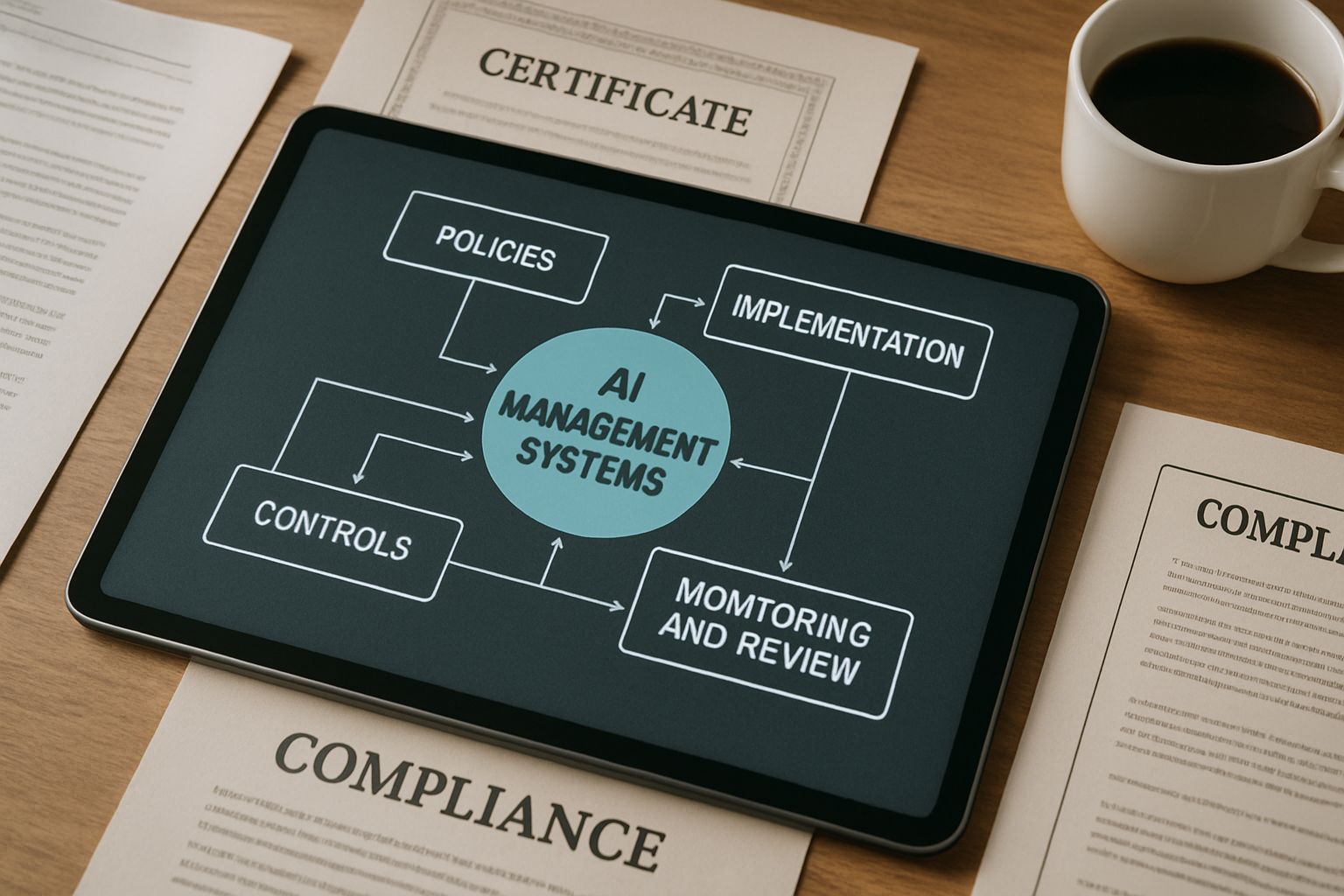
Effective governance requires clear authority, documented decisions, and measurable controls. ISO 42001 demands an accountable senior role, often the Chief AI Officer or similar leader. Furthermore, cross-functional committees must steer data ethics, bias mitigation, security, and legal review. The governance framework links policies to day-to-day engineering tasks through versioned procedures. Consequently, auditors trace each model release back to approvals, test results, and sign-off evidence.
Compliance teams love the clarity because it reduces interpretive disputes during external reviews. Robust risk management registers form part of every meeting agenda. Moreover, Deloitte’s survey showed 38% of executives see regulation uncertainty as a primary barrier. ISO 42001 narrows that uncertainty by prescribing meeting cadences and artefact templates. When embedded into AI Management Systems, this structure keeps accountability visible. These features speed decision cycles, cutting weeks from go-live schedules. Therefore, they set the stage for the current audit boom. Subsequently, we examine why accredited auditors now face packed calendars.
Certification Demand Surge
Press releases show a steady drumbeat of ISO 42001 certificates since late 2024. AWS, Google Cloud, and Microsoft announced achievements within four months of each other. Additionally, Anthropic, Darktrace, and dozens of niche vendors quickly followed. BSI, Schellman, and TÜV SÜD report overflowing audit pipelines across sectors. Market differentiation remains the biggest motivation, according to Deloitte analysts. AI Management Systems certification lets suppliers stand out during competitive procurement.
Consequently, cloud customers now request proof of compliance during vendor onboarding. Accredited certificates typically remain valid for three years, with annual surveillance audits. Moreover, the two-stage audit mirrors ISO 27001, easing scheduling for experienced security teams. These realities explain the current surge. They also highlight why laggards risk losing deals. Meanwhile, regulation concerns propel adoption even faster, as the next section details.
Compliance And Regulation Fit
Regional laws, especially the EU AI Act, set binding obligations on output quality and transparency. In contrast, ISO 42001 offers a voluntary but structured path to prove organisational readiness. Therefore, many legal teams treat AI Management Systems as a compliance bridge. The standard covers risk assessment, documentation, and human oversight that overlap with forthcoming European harmonised standards. However, experts warn that certification alone does not guarantee legal immunity. Organizations must still pass product-level conformity assessments where regulators demand them. Nevertheless, having an audited framework speeds evidence collection and eases regulator discussions. These insights confirm ISO 42001’s complementary role. They also underscore why boards prioritize early adoption. Consequently, attention turns next to risk management disciplines inside the standard.
Building Robust Risk Management
ISO 42001 dedicates an annex to risk identification, evaluation, treatment, and monitoring. Teams must catalogue each AI system, data set, and model version alongside potential harms. Subsequently, quantified scores drive mitigation plans and residual thresholds. AI Management Systems embed these registers into change control workflows, ensuring updates trigger new reviews. Moreover, auditors expect living dashboards, not static spreadsheets. Consequently, vendors now ship model observability tools tailored for risk management evidence. Google, Microsoft, and AWS blogs showcase telemetry pipelines that feed auditor portals automatically. Additionally, incident logs and corrective actions must close within documented timelines. This pragmatic framework converts abstract principles into daily engineering tasks. These practices reduce residual exposure while boosting stakeholder confidence. They also prepare organisations for the final implementation steps. Meanwhile, readers need a concrete action list, which follows next.
Implementation Roadmap Steps
Launching an ISO program follows a predictable sequence. First, determine organisational scope and maturity gaps. Next, design policies, controls, and metrics aligned with AI Management Systems requirements. Subsequently, run the system for at least three months to gather operational evidence. Stage one audits review documentation, while stage two validates live practice. Furthermore, annual surveillance confirms continued compliance. Professionals can deepen expertise through the AI Product Manager™ certification. The following checklist consolidates auditor expectations.
Detailed Audit Evidence Checklist
- Scope statement and system inventory
- Risk management register and scores
- Governance policy documents and minutes
- Monitoring dashboards with model metrics
- Corrective action log and follow-ups
These steps convert guidance into tangible milestones. They also illuminate budget and staffing needs. Consequently, final reflections are now in order.
ISO 42001 adoption is rising because it transforms abstract principles into operational proof. Moreover, AI Management Systems create a reusable backbone for certification, compliance, framework alignment, and risk management excellence. Consequently, organizations secure market differentiation and regulatory readiness simultaneously. Nevertheless, success demands executive sponsorship, disciplined execution, and relentless improvement. Ready to lead the charge? Explore the resources above, assess your maturity, and pursue accredited audits to place trusted AI at the heart of your strategy.
Disclaimer: Some content may be AI-generated or assisted and is provided ‘as is’ for informational purposes only, without warranties of accuracy or completeness, and does not imply endorsement or affiliation.


