

AI CERTS
7 months ago
US Efforts Advance AI Safety Evaluation Frameworks
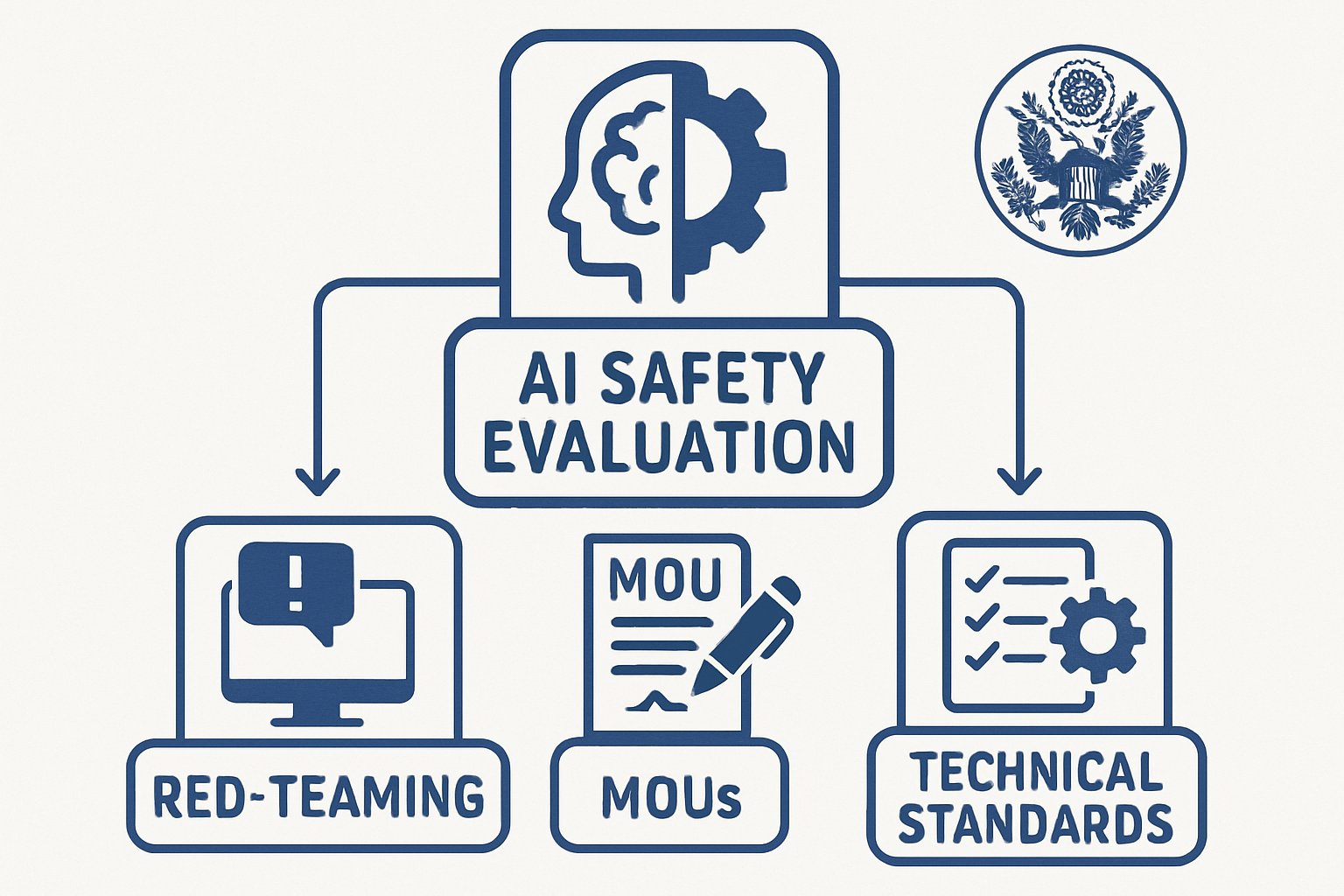
Today, the institute—freshly rebranded as CAISI—sits at the center of every major AI Safety Evaluation.
Furthermore, its agreements with OpenAI and Anthropic grant federal testers rare pre-release model access.
This article unpacks the institute’s evolution, testing programs, political headwinds, and what comes next.
Readers will gain verified timelines, key statistics, and expert insights on how voluntary evaluations influence innovation.
Additionally, we will examine unresolved transparency gaps and international implications for future regulation.
Origins And Rapid Growth
NIST launched the U.S. AI Safety Institute in 2023 under the Commerce Department.
Moreover, initial funding and political backing came from the Biden-Harris administration, signaling broad government commitment.
Within twelve months the institute built measurement science roadmaps and recruited Paul Christiano as Head of AI Safety.
Consequently, membership ballooned once the AISIC consortium opened in February 2024.
More than 200 companies, universities, and civil-society groups joined to co-develop evaluation benchmarks.
These milestones anchored an early culture of shared AI Safety Evaluation across sectors.
The institute’s first year therefore delivered scale and legitimacy.
However, real influence emerged through headline model agreements, covered next.
High Profile Model Agreements
On 29 August 2024, NIST signed separate memoranda of understanding with OpenAI and Anthropic.
The voluntary deals granted testers access to frontier models both before and after launch.
In contrast, previous public evaluations relied on already released systems, limiting scope.
Sam Altman celebrated the collaboration, while Anthropic co-founder Jack Clark called independent vetting essential.
Furthermore, Elizabeth Kelly framed the signing as a watershed for rigorous AI Safety Evaluation science.
Yet the exact MOU text remains undisclosed, prompting transparency concerns.
These agreements marked unprecedented openness by leading developers.
Nevertheless, multi-agency risk testing soon expanded beyond corporate partnerships.
TRAINS Taskforce Scope Explained
Formed on 20 November 2024, the TRAINS Taskforce coordinates interagency expertise on national-security risks.
Participants include DoD, NSA, DOE laboratories, DHS, CISA, and NIH.
Additionally, red teaming specialists from each bureau probe models for cyber, bio, and infrastructure threats.
NIST positions TRAINS as the technical backbone for defense-oriented evaluations.
Consequently, test suites increasingly integrate classified scenarios and domain-specific metrics.
However, officials affirm that core findings will inform broader AI Safety Evaluation guidance.
TRAINS therefore institutionalizes security-focused red teaming across government.
Subsequently, leadership upheavals altered the institute’s branding and mission tone.
Shift To CAISI Mission
Elizabeth Kelly departed in February 2025, sparking speculation about future priorities.
Four months later, Commerce Secretary Howard Lutnick rebranded the institute as the Center for AI Standards and Innovation.
He argued that focus should narrow to demonstrable security risks and international standards leadership.
Meanwhile, critics warned of mission drift away from broad societal harms toward competitiveness goals.
Time and The Verge highlighted fears of safetywashing through tightened communication controls.
Nevertheless, CAISI leaders insist the rebrand strengthens global AI Safety Evaluation credibility by embedding standards expertise.
The name change thus reframes objectives around measurable compliance.
Next, we examine how testing methods grapple with practical limits.
Testing Methods And Limits
Core evaluations involve capability benchmarks, adversarial red teaming, and scenario-based stress tests.
Moreover, measurement scientists continuously refine prompts, scoring rubrics, and aggregation metrics.
Yet limited public disclosure hampers external peer review of AI Safety Evaluation outcomes.
Independent groups such as METR applaud the institute’s statistical rigor but request reproducible protocols.
Additionally, voluntary MOUs allow companies to veto publication of sensitive failure cases.
Consequently, stakeholders debate whether current standards truly incentivize mitigation.
- Consortium size: over 200 organizations
- MOU date: 29 August 2024
- TRAINS launch: 20 November 2024
- Head of AI Safety named: 16 April 2024
These figures illustrate fast progress alongside lingering opacity.
Consequently, industry implications warrant closer analysis.
Implications For Wider Industry
For developers, early federal AI Safety Evaluation testing can surface catastrophic failure modes before market launch.
Consequently, mitigation insights may reduce recall rounds and reputational hazards.
In contrast, mandatory waiting periods could slow release cycles, affecting competitive dynamics.
Enterprise buyers also track CAISI results when choosing foundation models for regulated workloads.
Moreover, meeting rigorous safety standards may become a procurement prerequisite for healthcare, finance, and defense contractors.
Professionals can enhance their expertise with the AI+ UX Designer™ certification.
Industry adoption therefore hinges on credible, timely disclosure of evaluation scores.
Finally, we assess forthcoming milestones and actions.
Looking Ahead And Actions
NIST plans to publish a harmonized benchmark catalog before year-end, aligning domestic metrics with international partners.
Meanwhile, CAISI staff hint at public dashboards summarizing anonymized AI Safety Evaluation data.
Furthermore, the federal government debates whether voluntary access agreements should evolve into enforceable audit requirements.
Experts recommend three immediate actions:
- Expand red teaming transparency to independent researchers.
- Publish standardized risk scorecards alongside model releases.
- Clarify long-term funding to insulate CAISI from political shifts.
Moreover, global alignment on standards remains vital to avoid regulatory fragmentation.
Consequently, CAISI intends to co-lead ISO working groups in 2026.
Upcoming deliverables will test the institute’s ability to balance openness, speed, and safety.
Nevertheless, sustained cross-sector cooperation can ensure responsible progress.
The U.S. journey from AISI to CAISI shows a rapidly maturing federal approach to frontier models.
However, the work remains unfinished while transparency gaps and political pressures persist.
Robust AI Safety Evaluation, fortified by consistent red teaming and measurable metrics, will decide whether innovation stays trusted.
Furthermore, industry leaders can differentiate themselves by pursuing recognized credentials and embracing open testing.
Therefore, explore the linked certification and join the AI Safety Evaluation movement toward safer, more reliable AI deployments.
Disclaimer: Some content may be AI-generated or assisted and is provided ‘as is’ for informational purposes only, without warranties of accuracy or completeness, and does not imply endorsement or affiliation.


