

AI CERTS
6 months ago
Radiology AI Workflow: Siemens AI-Rad Companion Sets New Pace
This article dissects the latest announcements, validation data, and competitive context. Readers will gain an evidence-based view of how automation reshapes daily radiology practice. Finally, we outline practical steps for technology leaders evaluating enterprise deployments.
Market Pressures Drive Adoption
Imaging demand keeps rising faster than budgets and staff pipelines. Furthermore, chronic radiologist shortages extend report turnaround times and delay treatment decisions. In contrast, patients expect same-day answers. Market researchers estimate the global radiology AI segment approached USD 10.6 billion in 2024. Grand View Research forecasts double-digit compound growth through 2030 across tools and managed services. Therefore, executives scrutinize each emerging Radiology AI Workflow for measurable productivity gains.
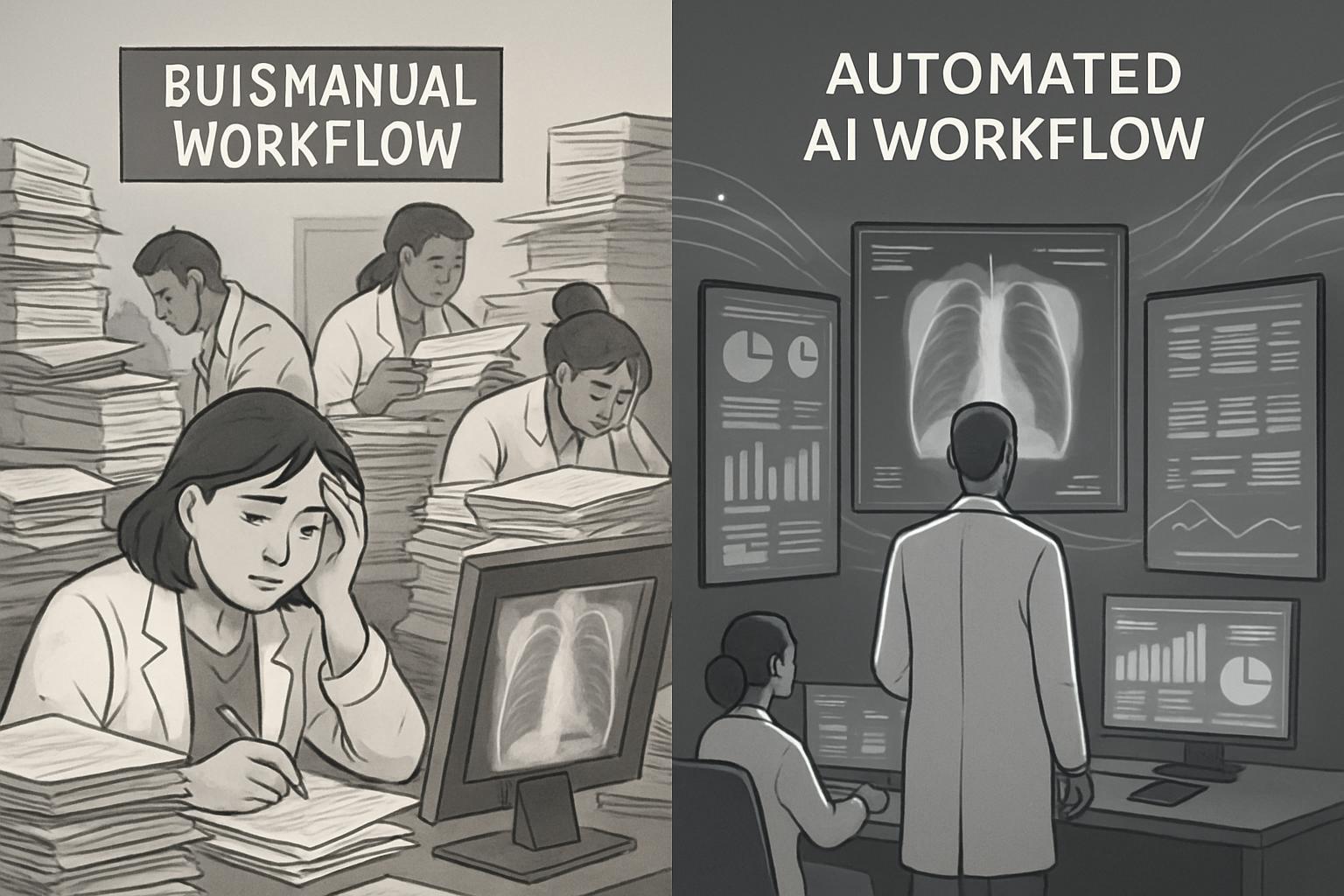
Demand pressures and growth projections fuel board-level urgency. Consequently, vendors that demonstrate operational impact win attention. Against that backdrop, Siemens positions AI-Rad as a turnkey accelerator.
AI-Rad Companion Details
The AI-Rad Companion family spans chest CT, brain MR, prostate MR, chest X-ray, and Organs RT modules. Each module executes image analysis tasks such as organ segmentation and quantitative measurement. Moreover, structured DICOM SR outputs flow into PACS, RIS, or syngo carbon archives. Quantitative reports include aortic diameters, coronary calcium scores, and lung nodule volumes. Peter Shen, head of Digital and Automation for Siemens North America, emphasizes time savings. He notes that complex contouring, previously hours, now finishes within seconds on Xeon-powered servers. Radiologists then verify contours rather than perform manual tracing, accelerating the Radiology AI Workflow.
Broad modality coverage and tight reporting integration distinguish AI-Rad. Nevertheless, deployment architecture determines real-world speed. Therefore, the next section explores cloud and edge strategies.
Cloud And Edge Deployment
Siemens offers both cloud processing on its Teamplay platform and on-premise inference optimized with Intel OpenVINO. Health systems choose architecture based on latency, data-sovereignty, and capital planning constraints. Additionally, edge nodes support sites with limited bandwidth, ensuring uninterrupted Radiology AI Workflow even during outages. Meanwhile, multi-site organizations route heavy research reconstruction jobs to elastic cloud clusters overnight. Seamless Radiology AI Workflow handoff between edge and cloud prevents duplicated studies. Syngo carbon integration allows consolidated visualization across modalities and vendors via a single viewer. Consequently, radiologists access AI results beside original images, reducing context switching. Early pilots report up to 60 percent reading time reduction for thoracic CT studies.
Hybrid architectures align with diverse hospital infrastructures. However, rigorous validation must precede scaled deployments. That requirement leads directly to evidence considerations.
Evidence And Validation Landscape
Independent reviews praise AI-Rad accuracy yet caution about heterogeneous study designs. For example, lung nodule sensitivity reaches 93 percent at roughly one false positive per case. Moreover, heart segmentation scores approach a 0.93 DICE coefficient, supporting reliable cardiac morphology tracking. However, many evaluations remain retrospective and vendor funded, limiting generalizability across scanner fleets. Robust metrics alone cannot guarantee Radiology AI Workflow safety across diverse populations. Prospective, multicenter Radiology AI Workflow trials remain scarce, although several are recruiting. Regulators now request Predetermined Change Control Plans and post-market monitoring to mitigate drift.
Key Performance Metrics Data
- Lung nodule sensitivity: 93 percent at 1 FP/case
- Aorta diameter error: 1.6 mm mean absolute
- Coronary calcium correlation: 0.96 logarithmic score
- Contour time reduction: up to 63 percent
Peer reviewers benchmarked image analysis speed as well as accuracy. These numbers illustrate strong baseline performance. Nevertheless, clinicians insist on local validation before routine use.
Evidence suggests meaningful accuracy and speed benefits. Still, transparent, prospective trials will cement trust. Integration challenges further influence adoption decisions.
Integration Challenges And Risks
Technical integration extends beyond DICOM connectivity. Moreover, workflow redesign is essential because new alerts can overwhelm radiologists. Legal teams debate liability when automation misclassifies urgent findings. In contrast, payers have not finalized reimbursement codes for many AI services. Therefore, hospitals often launch limited RSNA show-inspired pilots before enterprise rollouts. Syngo carbon viewers and Smart Reporting templates help standardize outputs, yet local IT effort remains. Subsequently, training programs teach clinicians to confirm AI suggestions and document overrides. Hospitals also monitor Radiology AI Workflow metrics, such as reporting lag, to quantify return. New APIs forward image analysis results into oncology dashboards automatically.
Integration challenges underline the importance of governance frameworks. Consequently, leadership sponsorship accelerates cultural alignment. Competitive dynamics add further pressure to move quickly.
Competitive Market Outlook Ahead
GE HealthCare, Philips, Canon, and startups like Aidoc offer overlapping tools. Nevertheless, Siemens leverages hardware presence and service contracts to bundle AI-Rad at scale. MarketsandMarkets expects automation revenue to exceed USD 2.27 billion by 2030 with 24 percent CAGR. Furthermore, health systems sign decade-long digital partnerships, exemplified by the 2025 Geisinger agreement. Competitive positioning now hinges on complete Radiology AI Workflow orchestration rather than isolated algorithms. Professionals can enhance their expertise with the AI Prompt Engineer™ certification. Certification holders gain structured prompt design skills that accelerate imaging automation research.
Competitive forces will intensify as platforms converge. Therefore, strategic certification can differentiate individual talent. The following conclusion consolidates key insights.
Conclusion And Next Steps
Radiology departments confront mounting volume, cost, and staffing pressures. Siemens AI-Rad Companion targets these gaps with end-to-end Radiology AI Workflow support. Cloud and edge flexibility, syngo carbon viewing, and validated image analysis capabilities strengthen the offer. However, health systems must verify evidence, manage integration risks, and secure clinician trust. Regulators also demand transparent lifecycle controls and post-market monitoring for every algorithm. Nevertheless, published metrics already show substantial reading-time reduction and measurement consistency. Therefore, leadership that invests in governance, training, and certification will harness automation gains sooner. Explore emerging modules, attend RSNA updates, and consider professional credentials to stay competitive. Start piloting today and shape the next decade of data-driven patient care.
Disclaimer: Some content may be AI-generated or assisted and is provided ‘as is’ for informational purposes only, without warranties of accuracy or completeness, and does not imply endorsement or affiliation.


