

AI CERTS
6 months ago
AWS Glue Elevates Data Quality AI
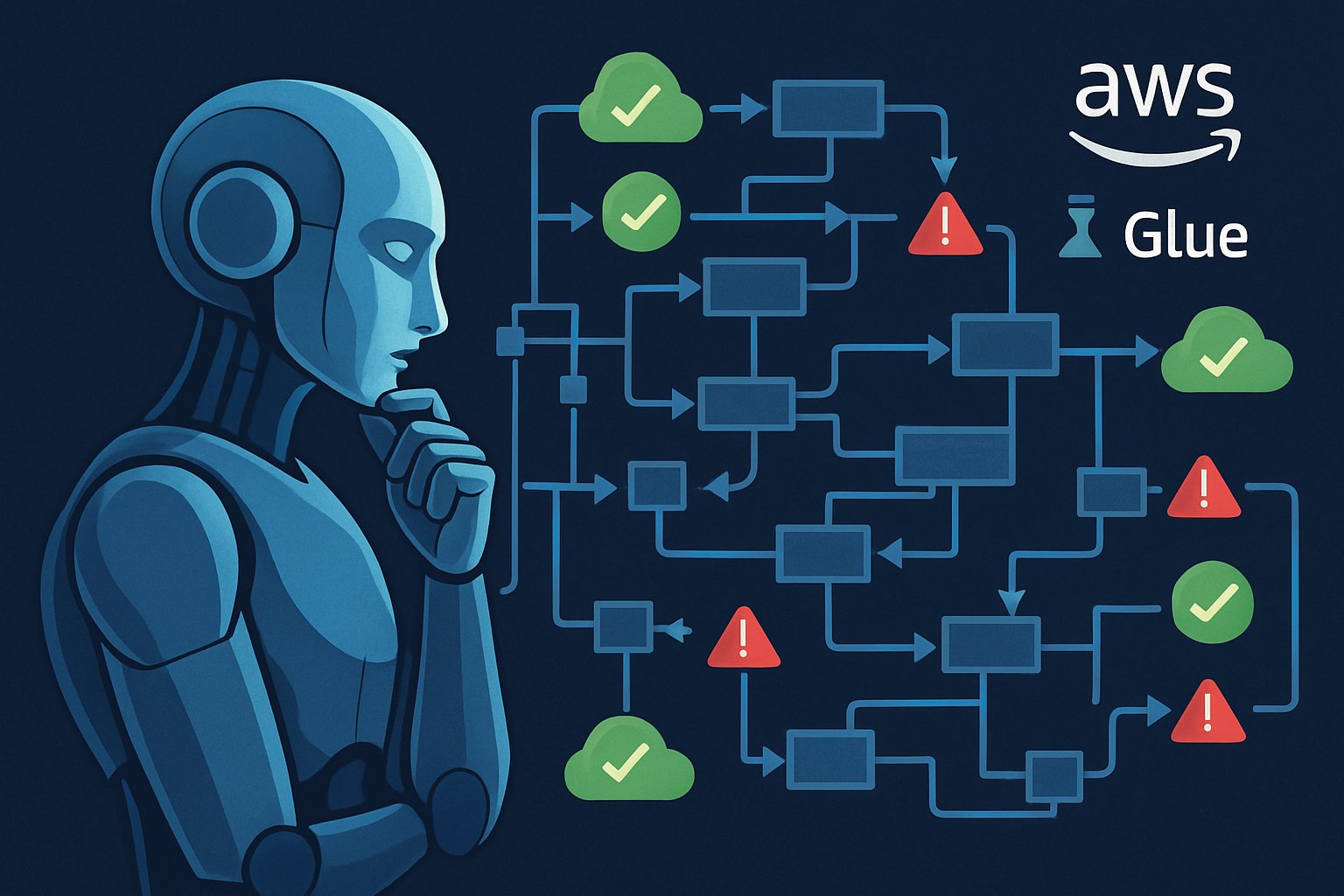
Additionally, the service integrates seamlessly with the Glue catalog, ETL pipelines, and governance features such as Amazon DataZone. Therefore, teams can embed consistent quality gates without deploying extra infrastructure or managing clusters.
Why Data Quality Matters
Reliable information underpins every AI initiative, yet datasets decay due to schema drift, late arrivals, or hidden duplicates. Consequently, engineers waste hours firefighting production incidents and explaining mispredictions to executives.
In contrast, proactive validation improves trust, accelerates releases, and reduces compliance risk. Data Quality AI brings automation, ensuring checks evolve with data volume and variety.
Sound quality management underpins data-driven value. Subsequently, AWS Glue embeds the process within its native workflow.
AWS Glue DQ Overview
AWS Glue Data Quality launched in 2023 as a serverless extension of the Glue platform. It leverages Deequ to profile tables and evaluate declarative rules written in DQDL.
Furthermore, analysts can author rulesets in the catalog UI or generate suggestions automatically. Each evaluation returns a score and, percentage of rules passed that downstream services can consume.
Meanwhile, engineers use Glue ETL pipelines to invoke evaluations inline and drop or quarantine failing records. Data Quality AI enriches those pipelines by learning normal statistical ranges over time.
Consequently, Glue provides one console, one API, and shared metadata for quality, lineage, and governance. However, features continue to expand, as the next section outlines.
AWS Recent Feature Timeline
AWS iterates aggressively, shipping multiple enhancements through 2025. Key milestones include June 2023 general availability, April 2024 DataZone integration, and August 2024 ML anomaly detection GA.
- July 2025: Support for S3 and managed Iceberg catalog tables.
- November 2025: Rule labeling and preprocessing queries for complex datasets.
Moreover, DQDL gained NOT, WHERE, and composite rules, plus file-centric checks for freshness and uniqueness. These additions broaden coverage beyond simple column constraints.
Subsequently, customers receive richer insights without rewriting code. Let us now examine how ML anomaly detection functions under the hood.
Inside ML Anomaly Detection
Anomaly detection in Glue uses Data Quality AI with time-series forecasting to predict future statistic ranges. Therefore, it flags deviations caused by seasonality shifts or unexpected surges.
The algorithm trains automatically on historical profiles captured during prior runs. Consequently, no hyper-parameter tuning or SageMaker expertise is required.
Additionally, detections trigger EventBridge events, allowing teams to page on-call engineers or pause ETL pipelines. Data Quality AI further translates observations into suggested DQDL rules for recurring patterns.
Glue’s ML capabilities close blind spots left by static rules. Nevertheless, operating cost and service limits remain critical considerations.
Cost And Service Limits
Glue bills per Data Processing Unit consumed during evaluations. Standard rates average around $0.44 per DPU hour, while Flex jobs cost less.
However, anomaly detection consumes roughly one DPU per statistic analyzed. Therefore, tables with thousands of metrics can amplify spend if unchecked.
Statistics storage also caps at 100,000 entries per account with two-year retention. Moreover, each ruleset may hold 2,000 rules within a 65-kilobyte limit.
- Monitor rule count to avoid hitting 2,000 limit.
- Archive old statistics to manage the 100,000 ceiling.
- Estimate anomaly detection cost before enabling on large datasets.
Consequently, financial governance should pair technical governance to sustain scale.
Prudent cost management unlocks sustainable growth. In contrast, vendor selection also influences long-term observability maturity, as the market context shows next.
Consequently, Data Quality AI users must budget carefully to sustain production workloads.
Broader Observability Market Context
The data-observability sector features vendors like Monte Carlo, Bigeye, and Great Expectations. These platforms highlight multi-engine support, root-cause analysis, and rich dashboards.
Barr Moses from Monte Carlo stated that practitioners need rapid rule operationalization, a goal shared by Data Quality AI.
Nevertheless, AWS’s native service appeals to organizations standardized on Glue, Lake Formation, and the catalog. Governance alignment and lower integration effort outweigh cross-cloud coverage for such teams.
Meanwhile, independent tools may suit companies running hybrid clouds or bespoke streaming architectures. Additionally, they often integrate with incident management and SLA tracking out-of-box.
Ultimately, choice hinges on existing stack, compliance requirements, and skills. Subsequently, implementing best practices maximizes any investment.
Glue Implementation Best Practices
Start with profiling to understand distributions before writing rules. Moreover, accept default rule recommendations, then refine thresholds gradually.
Integrate catalog rules with CI pipelines to block schema violations early. Additionally, attach rule labels to separate privacy checks from freshness checks.
Enable anomaly detection only for high-value tables with stable loads. Consequently, you avoid unnecessary compute charges while still catching critical drifts.
Professionals can deepen skills via the AI Developer™ certification, mastering Data Quality AI concepts and Spark-based ETL pipelines.
Consistent processes, tooling, and education create a virtuous quality cycle. Therefore, teams safeguard AI outcomes and regulatory standing.
Glue’s integration of Data Quality AI unites profiling, rule enforcement, and anomaly detection in one serverless package. Consequently, AWS customers can raise trust scores without heavy DevOps burden.
Moreover, cost controls, service limits, and governance alignment demand deliberate planning. Nevertheless, teams that pair best practices with ongoing education will unlock resilient AI pipelines.
The linked certification offers an accessible starting point.
Disclaimer: Some content may be AI-generated or assisted and is provided ‘as is’ for informational purposes only, without warranties of accuracy or completeness, and does not imply endorsement or affiliation.


