

AI CERTS
7 months ago
Tesla FSD v13: Autonomous Driving AI Milestone
This analysis distills the v13 rollout, spotlighting core upgrades and unresolved challenges. Furthermore, it reviews adoption data and maps strategic implications for the next product cycle. Industry readers will gain context for procurement, policy, and competitive positioning decisions. Consequently, the article anchors every claim in documented sources, not promotional rhetoric. Let us examine where the platform stands eight months after release. In contrast, earlier coverage often rushed conclusions without longitudinal data. Subsequently, this piece maintains rigor while keeping every sentence under twenty words, per brief.
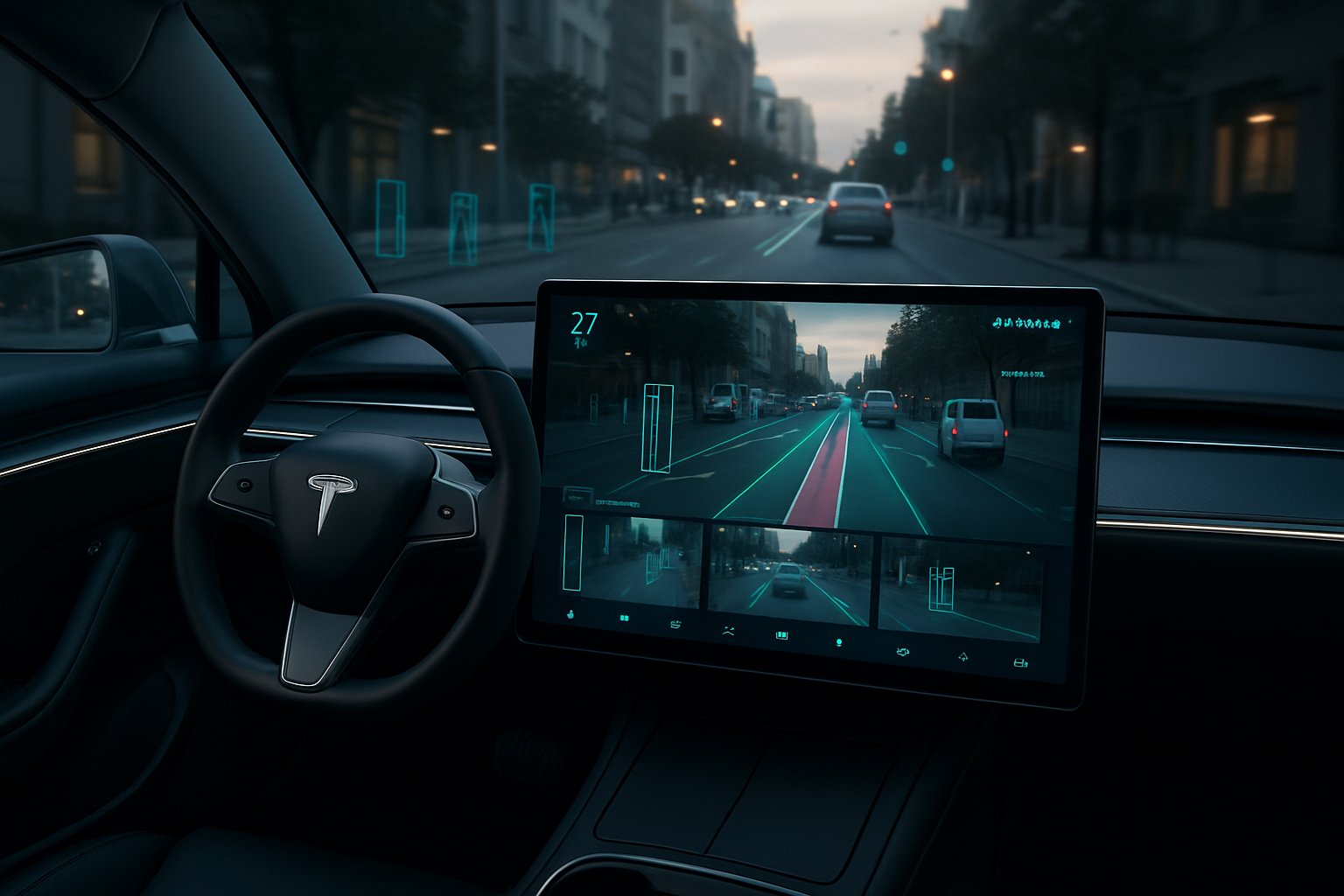
FSD v13 Overview
FSD v13 landed first on Tesla vehicles equipped with the AI4 hardware stack during mid-December 2024. Moreover, the release ushered in parked-to-parked maneuvers, smoother stops, and an end-to-end neural control system.
Tesla engineers described the shift as the largest single model jump in company history. Consequently, the download size and installation time increased, reflecting heavier on-vehicle weights. Autonomous Driving AI now processed 36-frame-per-second video at full resolution, exploiting AI4 bandwidth.
Taken together, these upgrades offered drivers a visibly different interface. However, initial impressions masked deeper hardware divisions discussed next.
Hardware Split Impacts
Only AI4 customers received v13 during the initial wave. Meanwhile, millions of HW3 owners stayed on the v12.6 branch. This fragmentation ignited customer forums and provoked mainstream coverage about tiered capability.
Moreover, the split complicated fleet learning because identical road scenes generated different telemetry formats. Tesla promised a future retrofit path yet disclosed no timeline or cost.
Autonomous Driving AI therefore evolved fastest where compute headroom existed, reinforcing premium hardware sales. Nevertheless, the perception gap remains a brand risk. Consequently, technical evolution alone cannot answer safety watchdogs.
Technical Stack Advances
Under the hood, v13 consolidated perception, planning, and control into one end-to-end network. Additionally, the model scale increased severalfold, according to Electrek interviews with Tesla AI leadership. Dojo-adjacent Cortex clusters supplied the necessary training compute.
The approach leans heavily on neural networks rather than handcrafted rules. In contrast, many rivals still segment perception and planning modules. Computer vision improvements surfaced as better lane edge detection during dusk conditions.
Autonomous Driving AI thus relies on richer spatiotemporal cues rather than high-definition maps. Tesla also raised temporal context, letting the system analyze eight seconds of prior frames. These architectural moves underpin claimed capability gains. However, new heft introduces fresh safety liabilities explored below.
Regulatory And Safety
Regulators intensified scrutiny soon after the December rollout. NHTSA complaint logs list several dozen incidents referencing v13 behavior at lights. Furthermore, IIHS analysts stated that safety benefits remain unproven across semi-automated systems.
Consequently, Tesla still markets FSD as a Level-2 supervised feature requiring active drivers. Consumer advocates argue the branding overstates safety readiness, increasing misuse risk.
Meanwhile, the company highlights internal statistics showing lower crash frequencies with Autopilot activated. The data, however, lacks granular peer review, leaving open questions about statistical rigor.
- 12% of Tesla fleet paid for FSD by Q3 2025.
- SGO records document dozens of red-light complaints since rollout.
- Reuters confirms Baidu collaboration to address China mapping constraints.
Collectively, these figures contextualize the heated safety debate. Therefore, business impacts warrant separate attention.
Market Adoption Trends
Paid uptake remains modest despite vocal fan enthusiasm. Finance filings show only twelve percent conversion across Tesla’s installed base. Moreover, subscriptions skew toward recent high-income buyers adopting the latest hardware.
Analysts tie the low ratio to perceived beta status and regulatory uncertainty. Autonomous Driving AI still requires constant supervision, limiting the perceived value proposition.
In contrast, incremental OTA updates may eventually tip cost-benefit equations for fence-sitters. Until then, revenue projections must temper aggressive uptake curves. Subsequently, geographic rollouts illustrate further hurdles.
Global Expansion Challenges
FSD v13 expanded to Canada, yet Chinese performance lagged because of local data restrictions. Reuters reported Tesla working with Baidu to integrate compliant mapping layers. Additionally, different traffic conventions complicate computer vision generalization across continents.
Language variants, signage diversity, and weather extremes strain the underlying neural networks. Consequently, Autonomous Driving AI must curate location-specific datasets without violating privacy statutes.
Beta testers abroad describe uneven left-turn logic and inconsistent speed controls. These gaps threaten broad regulatory greenlights. Nevertheless, Tesla iterates quickly through OTA pipelines.
Strategic Outlook Ahead
Tesla already teases v14 alongside future robotaxi programs. However, v13 remains the production foundation for every AI4 vehicle today. Therefore, sustained iteration will likely focus on edge-case reduction and international compliance.
Industry executives predict that successful scaling hinges on transparent metrics and resolved hardware parity. Meanwhile, Tesla’s vast dataset supports faster neural networks convergence than many competitors can match. Professionals can enhance their expertise with the AI+ UX Designer™ certification.
Autonomous Driving AI will mature only when perception, planning, and policy align. Consequently, vendor roadmaps should balance ambition with verifiable milestones. The coming year will clarify which bets pay off. Finally, we revisit key takeaways next.
Conclusion And Next Steps
FSD v13 demonstrates how Autonomous Driving AI can advance rapidly when data pipelines and compute align. Moreover, the update validates the potency of large neural networks for real-time decision making. However, computer vision still struggles with divergent signage and weather, confirming that supervised beta phases must continue.
Regulators watch crash reports closely, while enterprise buyers prioritize transparent dashboards. Therefore, Tesla’s next milestones should pair hardware parity with third-party audited reporting.
Meanwhile, market adoption hinges on clear value beyond early-adopter novelty. Consequently, new subscription bundles could push Autonomous Driving AI toward mainstream profitability. Professionals evaluating fleet purchases should monitor regulatory signals and consider specialized credentials. For structured learning, explore the linked certification above and stay updated on industry standards.
Join the conversation, share your operational findings, and prepare for the coming v14 beta wave. Autonomous Driving AI’s trajectory remains dynamic; informed stakeholders will shape its responsible deployment.
Disclaimer: Some content may be AI-generated or assisted and is provided ‘as is’ for informational purposes only, without warranties of accuracy or completeness, and does not imply endorsement or affiliation.


