

AI CERTS
3 months ago
ServiceNow’s IT Operations AI Revolution Gains Momentum
This article unpacks the evolving toolset, market traction, and practical guardrails shaping ServiceNow’s AI journey. Additionally, readers will learn how strategic certifications boost adoption skills and career prospects. Consequently, teams can benchmark benefits against risks before scaling pilots. In contrast, ignoring governance could invite costly threats spotlighted by recent research. Therefore, informed leadership remains critical during this next phase of digital transformation. Let’s explore the details driving boardroom debate.
Agentic Evolution Accelerates Rapidly
The Xanadu update in September 2024 expanded Now Assist into security, procurement, and developer tooling. Moreover, it introduced AI Agents able to break complex incidents into discrete steps. Subsequently, the Zurich release layered RaptorDB and Workflow Data Fabric for faster context retrieval. Therefore, IT Operations AI gained the real-time awareness required for autonomous resolution loops.
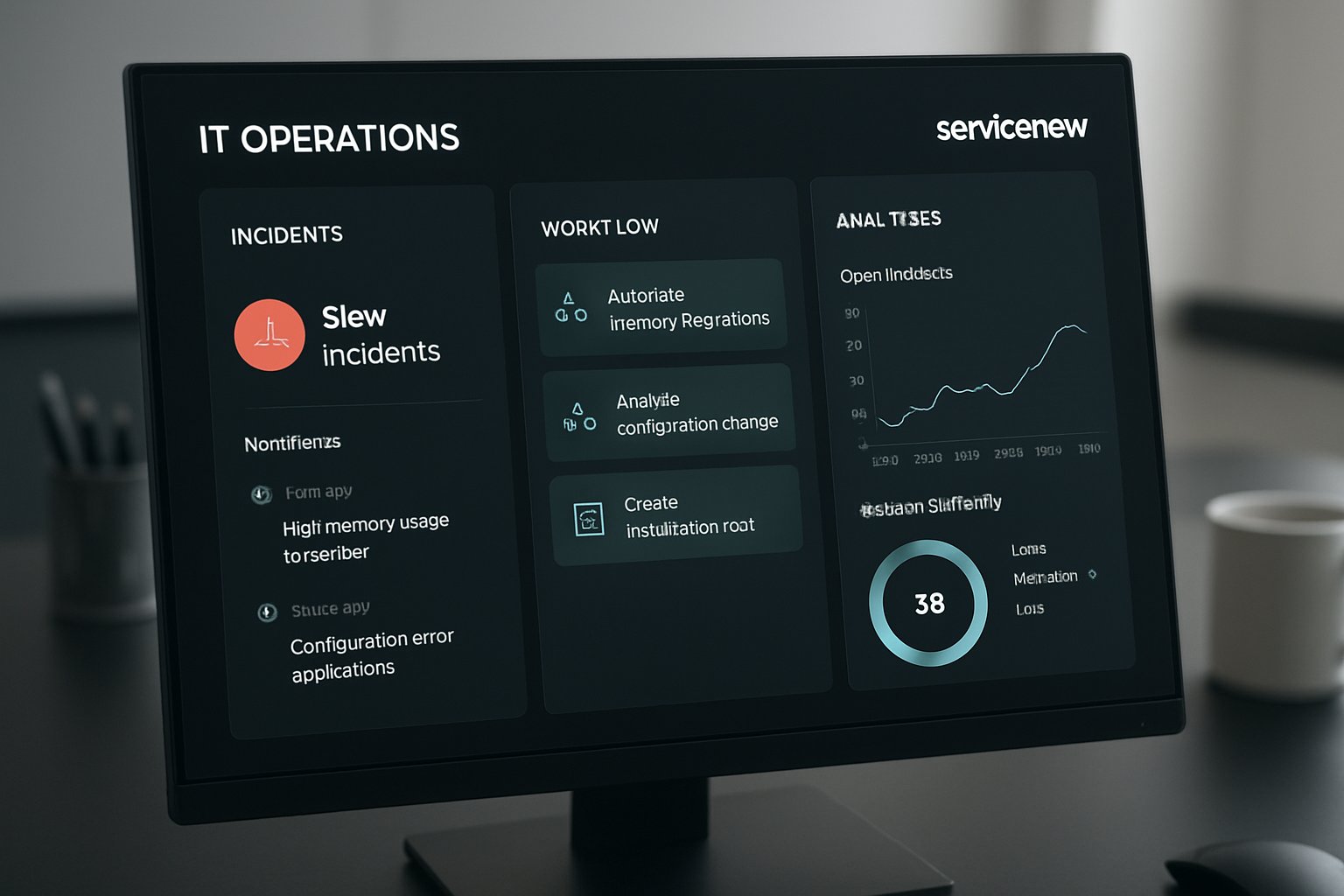
March 2025 brought the $2.85 billion Moveworks acquisition, signaling a push toward conversational universality. Consequently, millions of employees using Moveworks assistants will converge with ServiceNow’s orchestration backbone. Bill McDermott called the move the biggest breakthrough in enterprise technology in decades. Nevertheless, analysts stress that real value depends on measurable productivity outcomes.
Gartner projects $3 trillion in AI spending by 2027, with generative features dominating growth. Furthermore, ServiceNow positions its agentic stack as a turnkey path to capture that wave. IT Operations AI therefore sits at the intersection of platform revenue and boardroom urgency. Meanwhile, competitors like Salesforce and Microsoft race to package similar capabilities.
ServiceNow’s rapid iteration illustrates a clear commitment to autonomous workflows. However, accelerated feature velocity raises equal parts excitement and caution. These developments define the agentic foundation. Next, we examine the supporting platform components and partnerships.
Platform Components And Partnerships
Now Assist houses the platform’s generative skills, including summarization, flow drafting, and data visualization. Additionally, Skill Kit lets developers craft custom prompts without deep model expertise. The Workflow Data Fabric unifies records across enterprise silos, reducing hallucination risk. Consequently, agents reference precise context rather than brittle scraped snippets.
RaptorDB boosts query performance, enabling sub-second responses within IT Operations AI runbooks. Moreover, AI Experience delivers a multimodal interface that surfaces agent recommendations at the right moment. AI Control Tower centralizes policy, audit, and model routing for compliant operations. Therefore, platform completeness differentiates ServiceNow from point tool rivals.
Model-provider flexibility lets administrators pick internal, Azure OpenAI, or third-party models per workflow. Additionally, this granularity helps align reasoning strength, data residency, and cost. Consequently, customers can start with default domain models then iterate without vendor lock-in. Such freedom appeals to regulated industries that guard sensitive records closely.
NVIDIA collaborates on model acceleration and security blueprints for incident response agents. Meanwhile, Microsoft integrates Copilot hand-offs, letting users escalate Microsoft 365 chats into ServiceNow workflows. Moveworks expands reach to every employee, merging search with structured orchestration. Collectively, these alliances aim to maximize productivity across the digital transformation journey.
The component stack and ecosystem enable powerful automation building blocks. However, every new component also widens the attack surface. Understanding governance and security priorities becomes essential now. The following section details those imperatives.
Governance And Security Priorities
AppOmni’s November 2025 research uncovered second-order prompt injection within agent discovery defaults. In contrast, ServiceNow argues the behavior is configurable and documented. Nevertheless, misconfigured agents could exfiltrate data or escalate privileges silently. Therefore, security teams must apply layered controls before broad deployment of IT Operations AI.
Experts advise disabling unrestricted autonomous overrides unless business value demands it. Additionally, segment agents by privilege and monitor interactions through AI Control Tower logs. Subsequently, enforce supervised modes for operations that create, read, update, or delete critical records. These steps align with zero-trust principles already familiar to enterprise architects.
Mitigation Checklist For Leaders
- Confirm clear ROI and pilot scope before scaling agents.
- Select optimal model provider per workflow for cost and compliance.
- Enable real-time alerts for anomalous agent collaboration patterns.
- Track spend and outcomes using platform console metrics.
- Audit agent logs and IT Operations AI outputs for policy violations.
Governance diligence mitigates emerging threats without stalling innovation. However, leaders also watch financial indicators to justify ongoing investment. Consequently, adoption metrics and economics warrant close inspection.
Adoption Metrics And Economics
ServiceNow reported Q3 2025 subscription revenue growth of 21.5 percent year over year. Furthermore, nearly 1,000 customers pay for Pro Plus AI capabilities, generating over $200 million ACV. Moveworks adds about five million employee users to that base. Consequently, boardrooms see validation that IT Operations AI is more than a slideware promise.
- 103 net-new deals exceeded $1 million ACV in Q3 2025.
- 553 customers now surpass $5 million ACV thresholds.
- Gartner forecasts generative AI to represent 36 percent of AI spending by 2027.
Moreover, customers report incident resolution times dropping by double digits after implementing Now Assist powered flows. Independent analyst notes tie these savings to higher employee productivity and faster digital transformation milestones. Nevertheless, buyers remain sensitive to premium database tiers and model-usage costs. Therefore, cost governance becomes as vital as security governance.
Wall Street watches whether subscription growth offsets acquisition costs like the Moveworks deal. Moreover, analysts speculate that agentic licensing could expand average contract values further. Nevertheless, price elasticity will hinge on demonstrated performance improvements. Quarterly disclosures will provide the clearest signal.
ITSM Use Cases Expanded
Incident triage gains auto-generated summaries and root-cause hypotheses within IT Operations AI dashboards. Additionally, AI Agents open change requests, schedule patches, and coordinate approvals across DevOps pipelines. Subsequently, Now Assist can translate policy text into low-code flow diagrams, accelerating governance updates.
Field service teams leverage generative replies to guide technicians through complex asset repairs. Moreover, procurement departments route vendor questions to agents that draft compliant responses automatically. These examples reinforce broader productivity gains across adjacent functions.
Expanded scenarios highlight the platform flexibility. Nevertheless, success hinges on workforce capability development. Certification paths address that gap.
Skills And Certification Path
Technical talent must master prompt design, data fabric mapping, and agent supervision fundamentals. Additionally, leaders require cross-functional insight spanning security, finance, and change management. Professionals can enhance their expertise with the AI Cloud Certification. Moreover, ServiceNow offers role-based paths for administrators, developers, and architects.
Gaining credentials builds credibility during funding discussions for IT Operations AI programs. Consequently, certified staff accelerate project kickoffs and reduce external consulting spend. That advantage strengthens the business case amid budget scrutiny.
Hiring alone will not close the skills gap; culture change remains equally vital. Therefore, leaders should incentivize experimentation, reward measured risk taking, and share success stories widely. Subsequently, internal communities of practice can accelerate knowledge diffusion. These soft factors often decide whether emerging technology thrives or stalls.
Upskilled teams close the adoption gap while safeguarding governance. The final section distills critical insights and next steps.
ServiceNow’s agentic roadmap merges domain models, unified data, and strategic alliances into a compelling value proposition. However, recent security findings underscore the importance of disciplined configuration and oversight. When implemented responsibly, IT Operations AI delivers faster resolution, richer context, and measurable productivity improvements. Furthermore, financial metrics indicate growing customer confidence and sizable market headroom. Therefore, leaders should couple rigorous governance with continuous skill development to sustain momentum. Explore the suggested certification to deepen expertise and drive digital transformation initiatives today. Act now to position your enterprise at the forefront of autonomous operations.


