

AI CERTS
6 months ago
Search Engine Wars: OpenAI SearchGPT Versus Google
Meanwhile, user behavior appears poised to shift as generative search gains mainstream access within ChatGPT. Consequently, stakeholders across media and technology must understand the timeline, partnerships, and technical foundations driving this upheaval. This article unpacks critical milestones, competitive stakes, and future monetization scenarios shaping the contest. Moreover, it evaluates opportunities for professionals seeking expertise through specialized AI certifications. Stay with us as we explore every angle of this transformative rivalry.
Timeline And Key Milestones
OpenAI revealed SearchGPT on 25 July 2024, limiting access to 10,000 testers for validation. Subsequently, the company merged the feature into ChatGPT and announced general availability on 5 February 2025. Google answered with expanded Gemini AI Overviews, signaling an escalating technological sprint. The July disclosure ignited another front in the Search Engine Wars, drawing immediate headlines. Additionally, publisher licensing deals emerged between October and December 2024, covering Reuters, Condé Nast, Le Monde, and others. Nevertheless, several holdouts, including The New York Times, blocked the OAI-SearchBot crawler during the same quarter. Consequently, coverage gaps surfaced within initial search results.
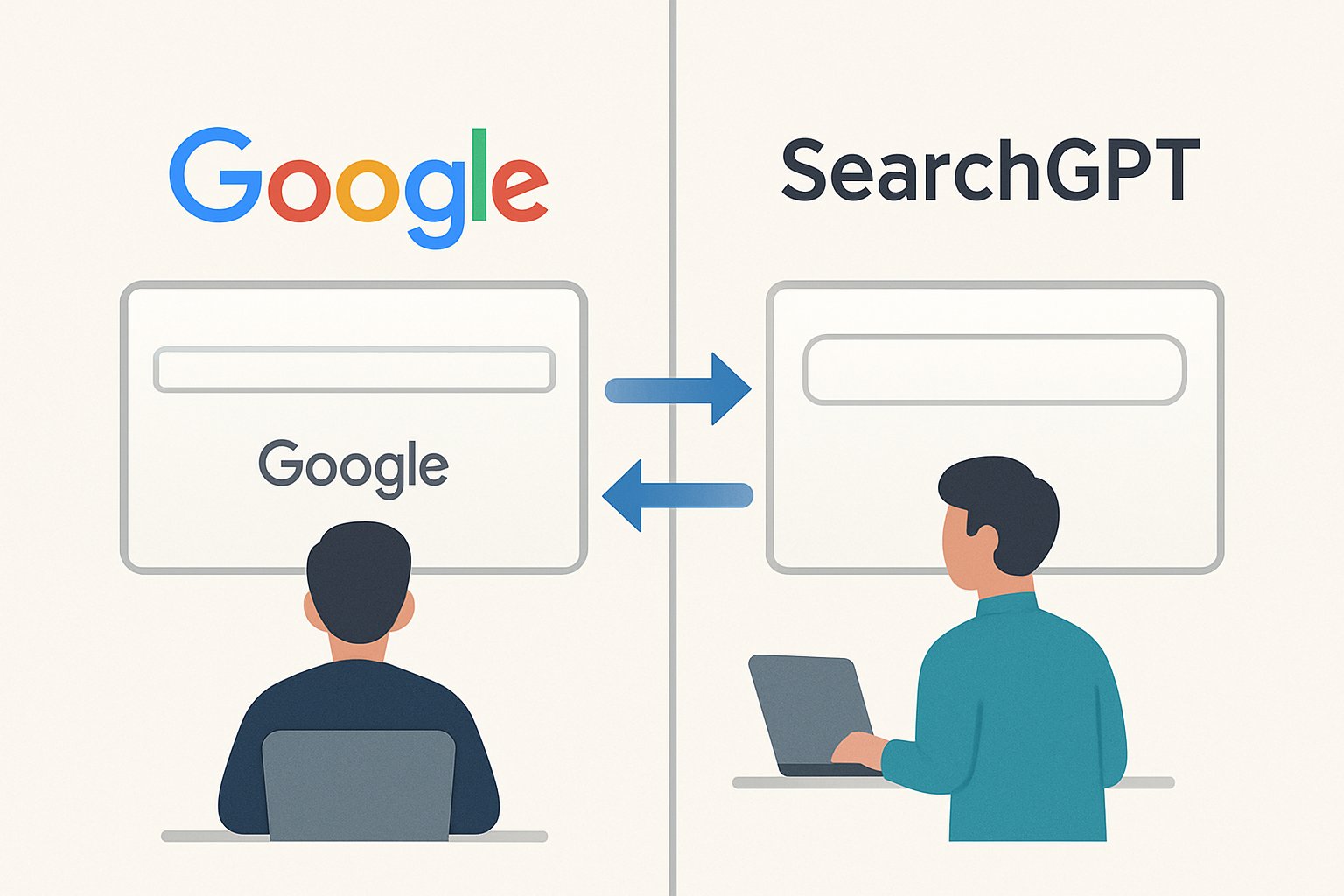
By February, product rollout elevated the Search Engine Wars from prototype skirmish to mainstream confrontation. Market reaction remained cautious. Bank of America analysts stated the launch posed minimal near-term risk to Google’s search revenue. These milestones illustrate rapid iteration but also structural resistance. The evolving schedule shows OpenAI’s agility alongside publisher friction. Furthermore, the stage is set for deeper competitive moves. Let us now examine how content owners are responding.
Publisher Reactions And Deals
Publishers face existential questions about referral traffic and content rights. In contrast, partners like Vox Media praise guaranteed attribution and revenue sharing. Le Monde’s Louis Dreyfus said the alliance places his newsroom at innovation’s forefront. However, blocking actions by Wired, Vanity Fair, and the New York Times highlight outstanding legal friction. Moreover, these blocks limit information retrieval breadth, potentially harming answer completeness. OpenAI counters that retrieval-augmented generation can still cite diverse sources even with partial indexes.
These mixed reactions create a patchwork supply landscape. Consequently, Search Engine Wars stakeholders must monitor ongoing contract negotiations for clarity. Publisher strategies remain fluid yet crucial for ecosystem trust. Meanwhile, we need to explore technical foundations driving retrieval.
Technical Product Foundations Explained
At its core, ChatGPT Search relies on retrieval-augmented generation. The model first performs information retrieval, then synthesizes answers with linked citations. Additionally, OpenAI differentiates web crawling from model training, addressing IP concerns. OAI-SearchBot indexes documents in near real time, yet its coverage still trails Google’s comprehensive graph. Nevertheless, conversational context retention enables multi-step queries without repeating keywords. Such architecture forms a critical weapon in the ongoing Search Engine Wars.
Professionals seeking deeper skills can pursue the AI+ Quantum Robotics™ certification. Technical design choices balance freshness with accuracy. Consequently, competitive dynamics deserve specific attention.
Competitive Industry Dynamics Today
Google remains dominant, yet its defensive AI Overviews reveal strategic anxiety. Meanwhile, Microsoft views OpenAI as both partner and rival, extending Bing’s Copilot integrations. Moreover, AI-native players like Perplexity and Anthropic intensify competition within specialised niches. Investors value Google’s ad network moat, estimating limited revenue erosion despite rising query substitution. In contrast, OpenAI presently monetizes through subscriptions, not large-scale ads. Therefore, the company must eventually build advertiser trust or craft alternative incentives for publishers.
By December, reports suggested OpenAI considered launching a dedicated browser to embed ChatGPT Search defaults. Such a browser could bypass existing search defaults and influence user behavior at scale. Consequently, boardrooms now treat each feature update as ammunition in the Search Engine Wars. Analysts caution that winners of the Search Engine Wars will hinge on sustainable business models. Current dynamics show formidable incumbents guarding revenue strongholds. Next, we examine how these shifts affect real users.
Impact On User Behavior
Early telemetry from ChatGPT shows longer session times but fewer external link clicks. Subsequently, some power users report switching away from Google for research and coding prompts. However, transactional queries like “shoe stores near me” still return to Google, maintaining place-based traffic. Information retrieval quality remains uneven for niche local data, reinforcing that dual-engine usage persists. Moreover, a potential OpenAI browser could accelerate change by altering default search settings overnight. User behavior shifts gradually, yet defaults wield immense power.
Data suggests adoption centers on research tasks rather than commerce. Consequently, monetization strategies deserve closer inspection. These patterns may decide eventual victors in the Search Engine Wars.
Monetization And Future Outlook
Google’s ads fund vast ecosystems, while OpenAI currently relies on ChatGPT Plus subscriptions. Therefore, publisher partners seek proof that licensed snippets can still drive measurable traffic. OpenAI promises prominent source links and prospective revenue-share experiments. Consequently, analysts predict modest shifts until ad products, micropayments, or affiliate layers emerge. In contrast, a bundled browser could offer lucrative placement fees similar to historic default arrangements. Moreover, regulators watch closely, wary of new gatekeepers controlling information retrieval pathways. Success may hinge on governance transparency and constant accuracy improvements. Strategists argue the Search Engine Wars will likely extend through several product cycles.
Revenue questions remain the hardest to answer. Finally, we extract practical lessons for technology leaders.
Strategic Takeaways For Leaders
Executives must prepare for simultaneous search channels. Firstly, diversify acquisition budgets to avoid sudden traffic shocks. Secondly, audit content schemas to optimize information retrieval across conversational platforms. Thirdly, monitor user behavior dashboards for emerging shifts in query volume.
- Map critical keywords affected by AI summaries.
- Negotiate licensing or block crawlers strategically.
- Experiment with schema markup for improved citations.
- Upskill teams through targeted AI credentials.
Moreover, professionals can strengthen credentials via the AI+ Quantum Robotics™ course referenced earlier. Preparation, not panic, will determine winners in the Search Engine Wars. These actions build resilience against rapid algorithmic disruption. Consequently, leaders stay ahead of evolving competitive tides.
Conclusion
OpenAI’s push into conversational search has accelerated competitive innovation, publisher negotiations, and monetization debates. However, Google’s scale, ad dominance, and data depth continue to set a formidable benchmark. Meanwhile, early user behavior indicates selective adoption focused on research and coding, not everyday shopping. Therefore, the next year will hinge on product accuracy, partnership breadth, and browser distribution strategies. Organizations that monitor referral trends and adjust content pipelines will navigate uncertainty with confidence. Consequently, executives should invest in talent development alongside technical experimentation. Explore advanced learning paths, including the linked AI certification, to future-proof strategic roadmaps. Ultimately, methodical preparation beats speculative headline watching.
Disclaimer: Some content may be AI-generated or assisted and is provided ‘as is’ for informational purposes only, without warranties of accuracy or completeness, and does not imply endorsement or affiliation.


