

AI CERTS
3 hours ago
London Tech Week 2026 Signals a New Era of AI Innovation and the Growing Need for AI Training
The speech highlighted how technology is reshaping industries and communities, emphasizing that AI is not simply about technological advancement but about creating a future-ready workforce and economy.
As governments, businesses, and institutions accelerate their AI adoption efforts, one message is becoming increasingly clear: technology investments alone are not enough. To fully realize the benefits of AI, organizations need professionals equipped with the knowledge and skills to implement, manage, and innovate with these technologies. This is where AI training becomes a critical component of future success.
AI at the Center of Economic Transformation
One of the strongest themes from the Prime Minister's speech was the role of AI in transforming communities and industries. The example of a former industrial site being redeveloped into an AI data center illustrated how technological innovation can create investment opportunities, skilled employment, and economic growth for future generations. Rather than viewing AI as a distant concept, the speech presented it as a practical driver of local and national prosperity.
This reflects a broader global trend. Governments worldwide are investing heavily in AI infrastructure, computing capabilities, and innovation ecosystems. The United Kingdom has announced significant investments in AI infrastructure, including funding for advanced computing resources and support for the country's growing AI sector. These initiatives demonstrate how nations are competing to establish leadership positions in the AI economy.
However, infrastructure and investment can only deliver results when supported by a workforce capable of leveraging these technologies effectively.
Why AI Skills Are Becoming Essential
The rapid growth of AI adoption is creating demand for professionals across virtually every industry. Organizations are integrating AI into healthcare, finance, manufacturing, education, cybersecurity, logistics, retail, and government operations. As AI systems become more sophisticated, companies require employees who understand how to work alongside intelligent technologies, interpret AI-generated insights, and make informed decisions using AI-powered tools.
London Tech Week discussions consistently emphasized the importance of skills development as organizations prepare for the next phase of AI-driven transformation. Industry leaders and policymakers recognize that talent development will be one of the most important factors determining which organizations and countries succeed in the AI era.
AI training enables professionals to move beyond basic awareness and develop practical capabilities in areas such as machine learning, generative AI, prompt engineering, data analytics, automation, AI governance, and ethical AI implementation. These competencies are becoming increasingly valuable as organizations seek to maximize the return on their AI investments.
Lessons Organizations Can Learn from London Tech Week 2026
The key lesson from this year's event is that AI adoption should be viewed as a people-first transformation rather than a technology-first initiative. Many organizations focus heavily on acquiring new AI tools while overlooking workforce readiness. This often leads to slower adoption, reduced productivity gains, and missed opportunities for innovation.
Another important lesson is that AI will continue creating new job categories while reshaping existing roles. Governments and business leaders are increasingly focusing on workforce preparation to ensure employees can adapt to evolving technological environments. AI literacy is becoming as important as digital literacy was during previous waves of technological change.
The discussions at London Tech Week also highlighted the importance of continuous learning. AI technologies are evolving rapidly, making ongoing education essential for professionals who want to remain competitive in the job market. Organizations that invest in continuous AI upskilling will be better positioned to innovate, improve efficiency, and maintain a competitive advantage.
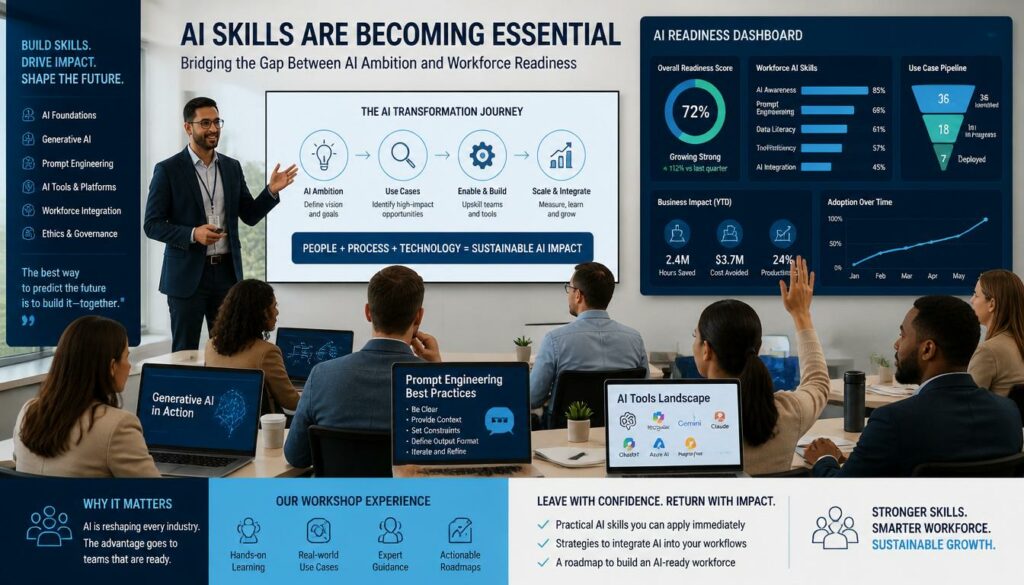
Bridging the Gap Between AI Ambition and Workforce Readiness
The vision presented at London Tech Week 2026 demonstrates that AI has the potential to transform economies, industries, and communities. Yet there remains a significant gap between AI ambition and workforce readiness. While investments in infrastructure, research, and innovation continue to accelerate, the shortage of skilled AI professionals remains a challenge for many organizations.
Closing this gap requires a strategic commitment to AI education and certification. Businesses need structured learning pathways that help employees develop practical AI competencies. Professionals need recognized credentials that validate their expertise and prepare them for AI-driven roles. Educational institutions and training providers also play a crucial role in ensuring learners acquire skills that align with industry needs.
The future of AI will belong to organizations that successfully combine technological innovation with workforce development. The companies that invest in both areas will be better equipped to drive growth, improve decision-making, and create lasting value.
Conclusion
As AI continues to reshape industries and economies, the demand for skilled professionals will only increase. Working with an Authorized Training Partner (ATP) from AI CERTs can help organizations and individuals build the practical AI knowledge, industry-recognized certifications, and real-world skills needed to thrive in an increasingly AI-driven world. Learn more through the Authorized Training Partner program at https://www.aicerts.ai/authorized-training-partner/.
FAQs
What was the main AI message from London Tech Week 2026?
The event emphasized AI's role in driving economic growth, creating skilled jobs, attracting investment, and transforming industries through innovation and technology adoption.
Why is AI training becoming more important?
Organizations need skilled professionals who can effectively implement, manage, and optimize AI technologies to maximize business value and maintain competitiveness.
Which industries are most affected by AI adoption?
Healthcare, finance, manufacturing, cybersecurity, education, logistics, retail, government, and professional services are among the sectors experiencing significant AI-driven transformation.
How can businesses prepare for AI transformation?
Businesses can prepare by investing in workforce upskilling, AI certifications, continuous learning programs, and practical AI implementation strategies.
How can an Authorized Training Partner help with AI readiness?
Authorized Training Partners provide structured learning programs, industry-recognized certifications, and practical AI training that help professionals and organizations develop the skills required for successful AI adoption.
Disclaimer: Some content may be AI-generated or assisted and is provided ‘as is’ for informational purposes only, without warranties of accuracy or completeness, and does not imply endorsement or affiliation.


