

AI CERTs
4 hours ago
Federal AI Oversight: Inside NIST’s Generative Risk Playbook
Generative AI now powers search, design, and policy decisions across industries. However, rising capabilities bring complex safety questions that demand coordinated answers. Enter the National Institute of Standards and Technology's latest guidance for generative models. The July 2024 Generative AI Profile extends NIST's flagship AI Risk Management Framework. Consequently, government teams and vendors finally share a common playbook. Yet voluntary status means adoption hinges on stakeholder trust and transparency. Federal AI Oversight now advances through measurement driven, evidence based practices, not prescriptive regulation. Moreover, the Profile links concrete actions to lifecycle stages, giving practitioners actionable clarity. This article unpacks the document's core themes, expert reactions, and next steps for industry. Additionally, we analyze measurement pilots, community critiques, and resource implications for small teams. Prepare for a concise, practitioner focused tour of the nation's most detailed generative safety blueprint.
Why NIST Profile Matters
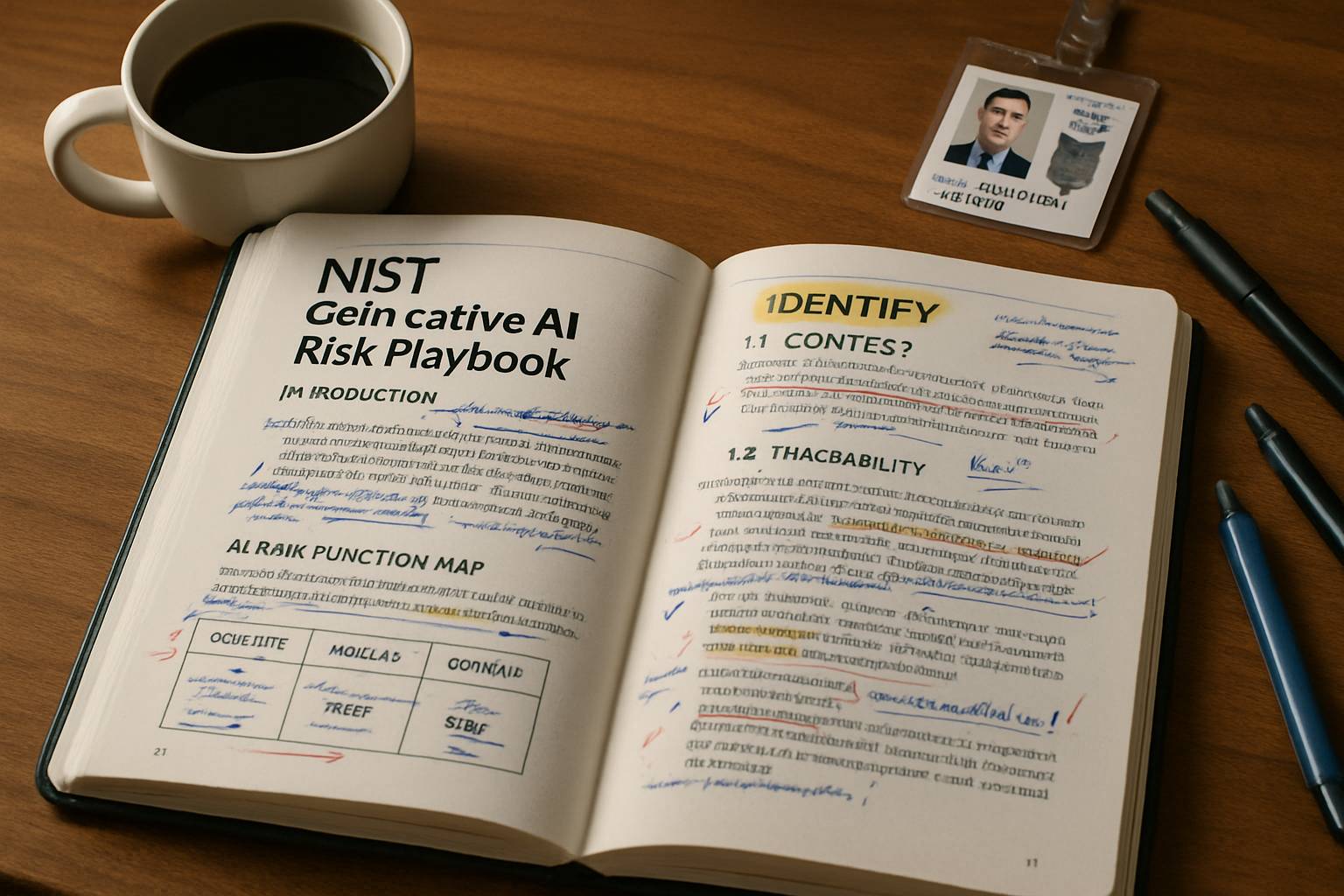
NIST created the Generative AI Profile to translate abstract principles into field ready actions. Therefore, each suggested action carries an identifier, lifecycle mapping, and quick implementation note. Policy makers appreciate this granularity because it supports contract clauses and procurement scoring. Meanwhile, developers finally see how system design, data governance, and monitoring connect. Independent researchers also gain a shared vocabulary for replication studies and benchmarks. Critically, every risk is framed within its broader sociotechnical context to avoid narrow technical fixes. Consequently, alignment discussions shift toward measurable user harm rather than abstract catastrophe narratives. Federal AI Oversight integrates seamlessly because NIST already underpins many government acquisition rules. These attributes explain the Profile's rapid traction across agencies and vendors. However, understanding the specific risk categories reveals why adoption still requires prioritization. Let us examine those categories next.
Core GAI Risk Taxonomy
Section Two of AI 600-1 lists twelve distinct generative hazards. Moreover, the list stretches from confabulation to supply-chain vulnerabilities. For clarity, we group them here:
- Confabulation and information integrity
- Obscene or degrading outputs
- Intellectual property leakage
- Dangerous instructions for violence
- CBRN and biosecurity content
- Environmental resource consumption
Each risk is paired with controls spanning governance, technical mitigations, and market disclosure. Furthermore, sociotechnical context frames every control, ensuring cultural and legal nuances receive attention. Watermarking standards appear repeatedly as preferred provenance safeguards for information integrity. AI impact assessments are mandated for high-risk deployments, mirroring environmental review logic. Red-teaming receives equal spotlight, especially where dual-use misuse might occur. Federal AI Oversight depends on consistent articulation of these hazards across agencies and vendors. The taxonomy clarifies threat surfaces for every stakeholder. Consequently, the next question concerns how actions map to lifecycle functions.
Govern Map Measure Manage
NIST retains the four AI RMF functions to structure mitigation activities. Govern sets policies, Map catalogs risks, Measure quantifies performance, and Manage operationalizes controls. Moreover, action IDs like GV-1.2-001 give auditors precise cross references. During Federal AI Oversight reviews, auditors often request evidence tied to these IDs. Sociotechnical context again surfaces under Map, where stakeholder harms and cultural factors are documented. Watermarking standards populate the Measure column, anchoring reproducible integrity metrics. Meanwhile, Red-teaming activities dominate Manage, closing the loop between findings and remediation. AI impact assessments also align here, giving executives consolidated dashboards for risk posture. These structured tables reduce ambiguity. Nevertheless, measurement quality ultimately decides control effectiveness, a theme explored in the next section.
Measurement And TEVV Programs
NIST pairs guidance with empirical programs like ARIA and the open-source Dioptra suite. Consequently, organizations can benchmark generator robustness and detector recall using shared protocols. The agency reports pilot results through 2025, covering text, image, and code modalities. Watermarking standards feature in several challenges that test detector accuracy under compression attacks. Moreover, Red-teaming scenarios stress test models against jailbreak prompts, disallowed content, and covert channels. AI impact assessments receive quantitative input from these pilots, improving comparative scoring across vendors. Contextual metrics, including demographic parity, are also evaluated where data permit. Federal AI Oversight benefits when agencies base procurement on such verified scores rather than marketing claims. These pilots signal NIST’s commitment to evidence. However, community feedback suggests broader coverage is still necessary.
Community Feedback And Critique
Academics and civil society supplied extensive comments during public review periods. UC Berkeley's CLTC praised operational clarity but requested deeper labor displacement analysis. In contrast, the Center for AI Policy urged tighter timelines for dual-use mitigation. Industry stakeholders welcomed voluntary status yet feared inconsistent adoption might create patchwork obligations. Moreover, several commenters demanded stronger linkage between watermarking standards and legal provenance requirements. They also highlighted gaps in stress testing coverage for non-English prompts. Risk evaluations were viewed as essential but resource intensive for smaller suppliers. Nevertheless, most agreed that Federal AI Oversight should remain adaptive rather than rigid. These perspectives frame the economic and ethical stakes. Consequently, implementers must weigh cost against reputational risk, a theme examined next.
Implementation Challenges Still Ahead
Executing hundreds of action items strains budgets and skill sets. Small agencies lack dedicated AI risk staff and toolchains. Therefore, NIST encourages tailoring based on mission criticality and available evidence. However, inconsistency complicates cross agency audits under Federal AI Oversight regimes. Context mapping often requires ethnographic research, something many engineering teams overlook. Provenance protocols demand cross vendor coordination over codec support and cryptographic keys. AI impact assessments need ongoing data refreshes, not one-off documents. Meanwhile, Red-teaming exercises can overwhelm product roadmaps when threat surfaces shift weekly. Professionals can validate skills via the AI Sales™ certification. Such credentials reassure buyers and auditors during framework adoption. These operational hurdles remain solvable with strategic planning. Next, we outline those strategies.
Strategic Steps For Leaders
Executives should first assign clear ownership for framework alignment. Subsequently, teams must map existing controls to RMF action IDs. Third, establish periodic risk assessments that feed dashboards and board reports. Moreover, integrate automated provenance checks that enforce content origin labels at publishing time. Schedule quarterly security testing sprints, rotating focus across modalities and threat categories. Meanwhile, embed context reviews into product discovery to capture emerging cultural risks. Finally, document progress for future Federal AI Oversight audits and public transparency. These steps convert paper guidance into living processes. Therefore, organizations stay ahead of evolving standards and market expectations.
NIST's Generative AI Profile offers the most detailed blueprint yet for responsible innovation. Moreover, its voluntary status fosters collaboration without slowing progress. Still, consistent Federal AI Oversight will determine whether guidance becomes everyday practice. Organizations that embrace sociotechnical context, watermarking standards, AI impact assessments, and rigorous Red-teaming gain competitive trust. Consequently, risk incidents fall while compliance costs remain predictable. Meanwhile, measurement pilots like ARIA continue to sharpen metrics and tooling. Therefore, leaders should act now, embed controls, and upskill teams. Federal AI Oversight soon may shift from voluntary guidance to procurement mandate, rewarding early movers. Take the next step by exploring specialized credentials and aligning roadmaps with NIST action IDs. Your proactive approach will safeguard users, accelerate adoption, and demonstrate market leadership today.


