

AI CERTS
3 hours ago
Humanoid Gaze Awareness Robots Enter Commercial Deployments
Moreover, its CES stage showed two robots debating unscripted, thrilling investors and critics alike. This article unpacks the vision system, market data, ethical debates, and skill paths for leaders. Readers will learn how Humanoid Gaze Awareness reshapes service robotics strategy.
Why Gaze Matters Now
Mutual gaze remains a primal cue for attention. Therefore, observers quickly judge whether an agent understands context based on eye movement. Humanoid Gaze Awareness delivers that cue through fine motor eye servos and on-board vision. In contrast, older service robots often stare blankly, reducing perceived intelligence.
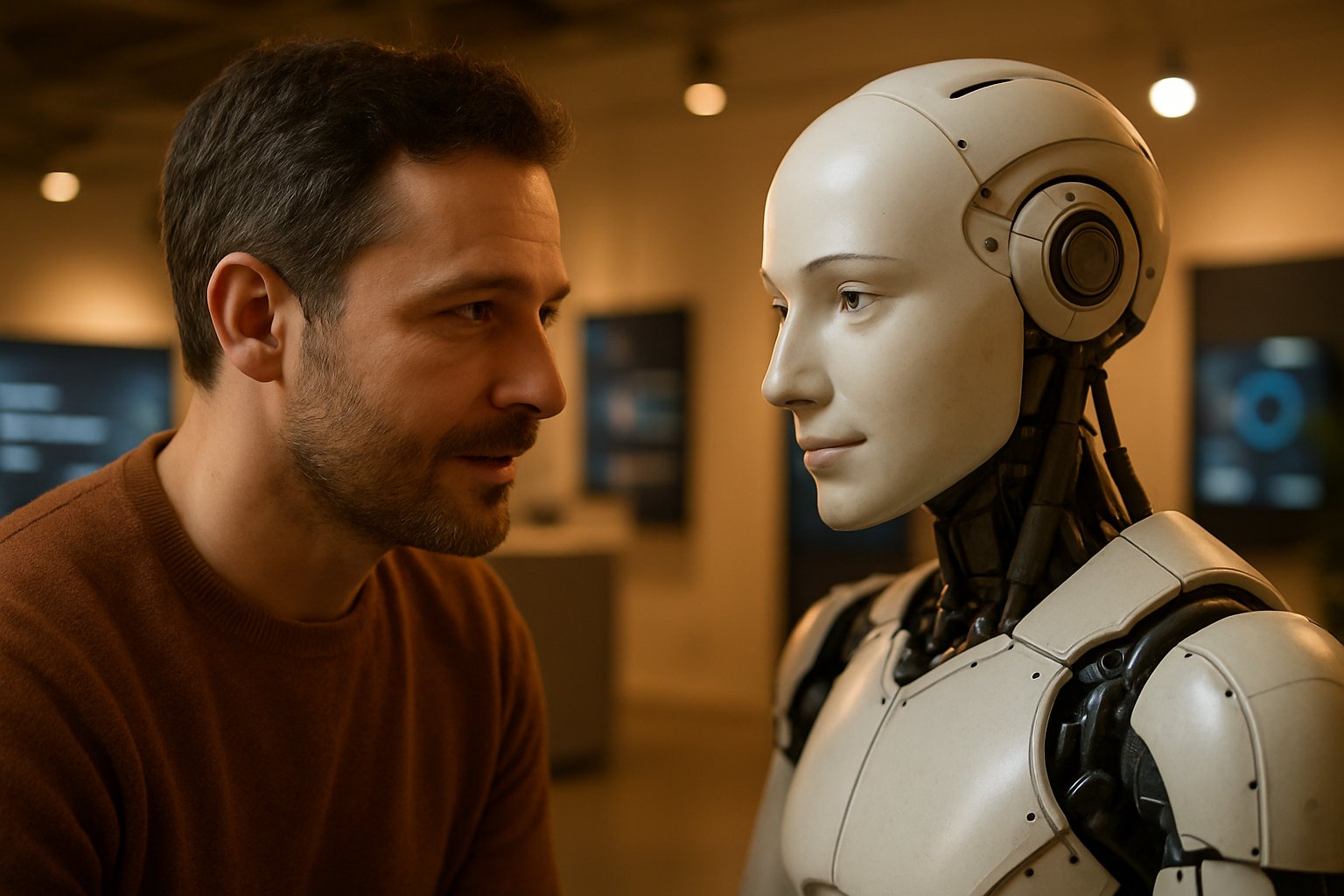
Researchers show responsive gaze can double task completion rates during customer interactions. Additionally, gaze synchrony boosts user recall and emotional connection during training simulations. Such gains explain why Realbotix integrated eye-tracking cameras directly inside both pupils. Signals captured feed multimodal models that align speech, lip movement, and head turns in real time.
Responsive gaze elevates trust, recall, and sales metrics. Hence, enterprises view it as a differentiator. Next, we examine the hardware turning theory into practice.
Inside Realbotix Vision System
Realbotix brands its optical stack the Robotic AI Vision System. Subsequently, twin 4K cameras embedded behind corneas capture depth, identity, and gaze direction. Edge NVIDIA modules run detection, while cloud LLMs analyze scene semantics. Moreover, an event bus fuses speech, gestures, and lip-sync for coherent delivery.
The architecture stays AI-agnostic, supporting ChatGPT, Gemini, and open-source weights. Humanoid Gaze Awareness integrates here, mapping detected pupils to servo targets within 30 milliseconds. Consequently, the robot maintains eye contact even under shifting light. Engineers can disable identifiable templates to calm privacy fears.
Eye-tracking session logs remain local by default, according to Realbotix documentation. Nevertheless, customers may offload data for analytics, raising regulatory questions. The trade-off between latency and compliance needs careful governance.
The Vision System unites optics, AI, and motion for seamless Humanoid Gaze Awareness. However, privacy settings still demand scrutiny. We now shift to concrete deployments and pricing realities.
Current Deployments Pricing Data
Realbotix shifted from prototypes to paying customers across 2025 and 2026. Ericsson’s Imagine Studio in Texas will host a humanoid concierge greeting visitors. Andrew Kiguel claims the deal proves commercial readiness. Independent confirmation from Ericsson remains pending, though planning documents appear credible.
A delivery roadmap published April lists 19 units scheduled between March and May 2026. Therefore, analysts will watch serial numbers and site photos for validation. Pricing spans roughly $20,000 for torso models and $95,000 for full bodies. In contrast, Agility Robotics targets logistics, not front-of-house engagement.
- Up to 10 hours battery runtime
- 4K binocular cameras with eye-tracking analytics
- Service robotics market forecast: US$86B by 2026
- Humanoid shipments: 19 units planned Q2 2026
Consequently, CFOs must weigh capital cost against experiential marketing returns. Humanoid Gaze Awareness promises richer upsell moments than static kiosks.
Deliveries and pricing show early traction yet small volumes. Verification will determine momentum. The broader market context offers further clues.
Market Outlook And Competition
Service robotics could exceed US$200 billion by 2031, though definitions differ widely. Meanwhile, humanoid subsets remain single-digit billions today. Market forecasts vary because component costs and use cases shift quickly. Humanoid Gaze Awareness gives premium vendors a differentiation angle before price erosion arrives.
Competitors like Figure, Tesla, and Unitree focus on mobility first. Conversely, Realbotix stresses social presence, eye-tracking precision, and lifelike faces. Companion device lineage grants unmatched soft-tissue articulation. However, that background also fuels ethical critiques, which we cover next.
Forecasts support growth, yet positioning will decide winners. Differentiated gaze stands out for now. Still, challenges could derail adoption quickly.
Challenges Ethics And Safety
Privacy looms largest because facial recognition collects biometric data. Therefore, compliance with GDPR, CCPA, and sector rules becomes mandatory. Realbotix allows local processing, nevertheless remote analytics tempt executives. Clear consent flows and data retention policies are essential.
The uncanny valley effect triggers discomfort when appearance nears human but misses subtle cues. Humanoid Gaze Awareness mitigates some unease by aligning eyes and speech. Yet hyper-realism can heighten emotional misattribution among vulnerable users. Academic reviewers urge rigorous user testing across ages and cultures.
Ethicists also critique the product’s companion roots, noting potential objectification. Future sex-tech collaborations amplify scrutiny, although corporate messaging now centers on enterprise service. Consequently, transparent design guidelines and kill switches remain non-negotiable.
Safety and ethics demand equal focus with technical specs. Ignoring them risks public backlash. Industry talent must understand these nuances, which leads to skills development.
Skills And Certification Path
Engineers, designers, and product owners increasingly need multimodal robotics literacy. Moreover, hiring managers prioritize staff who grasp eye-tracking algorithms and user psychology. Professionals can upskill through the AI+ UX Designer™ certification. Consequently, verified credentials help teams justify premium robot budgets to finance chiefs.
Soft skills matter too. Conversely, staff must handle emotional interactions and manage customer expectations. Blended technical and interpersonal training creates resilient deployment crews. Humanoid Gaze Awareness workshops now appear at robotics conferences and online academies.
Targeted learning accelerates safe, profitable rollouts. Therefore, leaders should invest early. The following conclusion recaps strategic imperatives.
Humanoid Gaze Awareness has moved from lab novelty to boardroom agenda within two short years. Realbotix proved the viability through live CES demos, early shipments, and Ericsson’s forthcoming showcase. However, privacy, safety, and cost factors still decide whether pilots scale beyond showcase corners. Consequently, leaders must blend rigorous testing, ethical frameworks, and certified talent. Those steps unlock engaging, companion service experiences that justify six-figure investments. Meanwhile, continuous training ensures tomorrow’s teams exploit Humanoid Gaze Awareness without triggering backlash. Act now: review deployment policies, audit vision pipelines, and pursue accredited learning to stay competitive.


