

AI CERTs
1 week ago
Judicial Hallucination Crisis Rocks Legal Tech
Sirens rarely wail inside court chambers, yet digital echoes now pierce the marble. However, the Judicial Hallucination Crisis shows that silent AI code can mislead powerful judges. Generative models have begun inventing statutes, fictional precedents, and persuasive quotes out of statistical thin air. Consequently, attorneys unwittingly file briefs laced with nonexistent authority, threatening client interests and institutional legitimacy. Regulators, bar associations, and courts scramble to restore trust before fabricated text corrodes public confidence. Meanwhile, vendors promote safer architectures, and professional education tries to keep pace with technical evolution. This article maps the escalating problem, outlines emerging safeguards, and offers actionable guidance for legal teams worldwide. Moreover, it examines data and sanctions that define the crisis and previews solutions under active development.
Hallucinations Enter Courtrooms Now
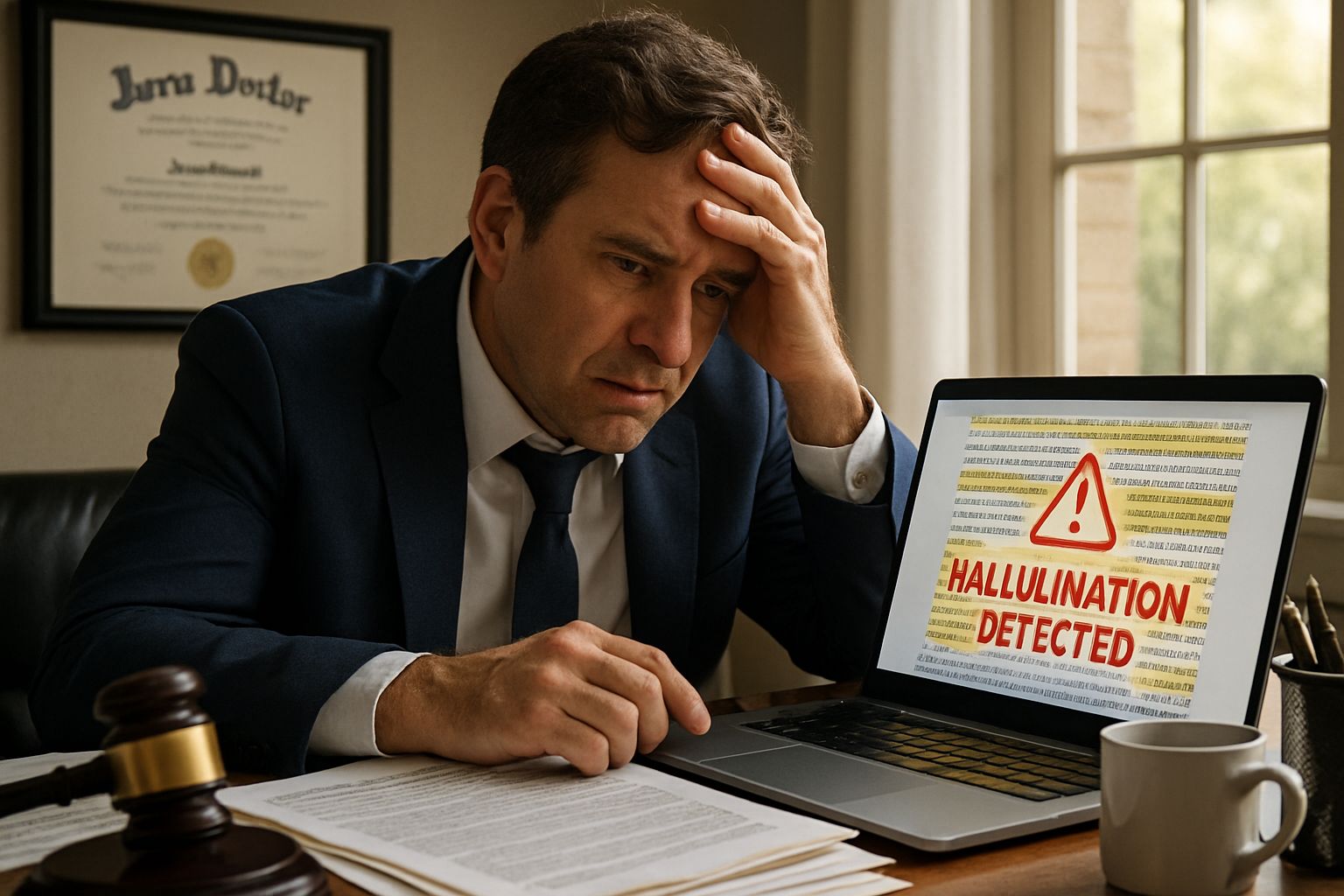
First warnings surfaced in 2023 when Mata v. Avianca revealed AI-generated fictitious appellate opinions. Subsequently, similar episodes multiplied across jurisdictions and continents. Researchers documented more than 900 filings containing invented cases, statutes, or rules by early 2026. Charlotin’s public tracker records incidents spanning trial, appellate, and administrative fora. In contrast, early commentators believed hallucinations were isolated anomalies, not systemic failures. Courts now see the pattern as a genuine threat, because fabricated sources waste judicial time and distort precedent. Therefore, judges increasingly demand independent verification of every citation before accepting electronic filings. The data confirm that unverified AI research already stains the legal record. However, escalating awareness sets the stage for firm institutional responses discussed next. The Judicial Hallucination Crisis continues to widen each month.
Judicial Sanctions Escalate Rapidly
Monetary and reputational penalties now accompany careless reliance on hallucinated authority. For example, an Alabama federal court fined counsel after citing a phantom sentencing precedent. Furthermore, a February 2026 Southern District of New York default judgment followed repeated fabricated citations. Public orders list fines ranging from small amounts to an $86,000 peak. Consequently, malpractice insurers query firms about AI governance before renewing coverage. Law remains rooted in verifiable texts, so AI speculation cannot substitute primary sources. Several Courts now require certifications that lawyers personally checked every statute, rule, and quote. Florida’s Eleventh Judicial Circuit order 26-10 even mandates disclosure of any generative AI contribution. These sanctions illustrate real costs when diligence lapses. Moreover, regulatory agencies compound the pressure through consumer-protection enforcement. Every sanction order fuels public awareness of the Judicial Hallucination Crisis.
Regulators Target Deceptive Bots
The Federal Trade Commission has entered the fray against exaggerated "AI lawyer" claims. In 2025 the agency finalized an order forcing DoNotPay to refund $193,000 and revise marketing. Additionally, the order prohibits future assertions that software can replace licensed counsel without empirical substantiation. State bar investigators also pursue unauthorized practice of Law fueled by consumer chatbots. Consequently, startups now consult counsel early to avoid crossing regulatory lines. Courts coordinate with regulators by sharing complaint data and disciplinary referrals. Nevertheless, enforcement remains reactive, leaving room for proactive industry standards discussed below. Regulatory sticks are growing sharper and more frequent. Therefore, professional guidance gains importance for every practitioner. Marketing regulators now treat the Judicial Hallucination Crisis as a consumer protection emergency.
Ethics Guidance Gains Momentum
The American Bar Association issued Formal Opinion 512 stressing competence, candor, and confidentiality. Meanwhile, California, Florida, New York, and Pennsylvania released companion opinions echoing similar duties. Furthermore, the National Center for State Courts published a "never trust, always verify" checklist. Ethics committees advise lawyers to test tools, document processes, and warn clients about residual risks. In contrast, some vendors argue that retrieval-augmented generation reduces hallucinations enough for routine drafting. However, empirical studies still report 17–33% error rates, underscoring persistent Accuracy challenges. Ethics boards frame the Judicial Hallucination Crisis as a competence and candor challenge. Such authorities prioritize human oversight as the non-negotiable safeguard. Subsequently, vendors have stepped forward with technical promises.
Vendors Promise Fewer Errors
LexisNexis, Thomson Reuters, and Casetext tout retrieval pipelines, citation checkers, and audit logs. Moreover, product roadmaps emphasize inline source links and automatic case validation warnings. OpenAI and Anthropic showcase enterprise modes that restrict training on user data for better confidentiality. Google advertises Gemini as trained with legal benchmarks that boost factual Accuracy. Nevertheless, independent academics find substantial hallucination rates even within specialized tools. Therefore, human verification remains mandatory despite technological strides. Vendor marketing often references the Judicial Hallucination Crisis to justify premium compliance features. Such innovation narrows risk yet cannot eliminate it today. Consequently, practitioners must adopt layered safeguards rather than blind trust.
Mitigation Strategies For Practitioners
Firms now embed multi-step review pipelines before filing AI-assisted documents. Additionally, they deploy citation cross-checking software and require junior associates to replicate research manually.
- Enable automatic citation checkers on every draft
- Require two human reviewers before filing
- Log AI prompts for later audits
- Insert disclosure language explaining AI assistance
Professionals may boost expertise through the AI Legal™ certification. In contrast, some boutiques mandate that no generative text enters pleadings without partner sign-off. Consequently, incident rates decline where layered controls exist and culture rewards meticulous Accuracy. Internal policies must explicitly mention the Judicial Hallucination Crisis to remind teams of verification duty. These controls reduce risk without forfeiting speed. However, strategic outlook matters for long-term resilience.
Outlook And Next Steps
The Judicial Hallucination Crisis will not vanish overnight because statistical models lack native truth filters. Nevertheless, combined pressure from regulators, vendors, and insurers is driving safer defaults. Furthermore, legislative committees study mandatory disclosure bills that could codify verification practices across jurisdictions. Ethics educators update curricula to include prompt engineering, citation auditing, and bias testing. Meanwhile, empirical researchers refine benchmarks to measure real-world Accuracy, enabling transparent product comparisons. Judicial Hallucination Crisis coverage will thus shift from shock toward solution engineering. Consequently, firms that act now can convert compliance into competitive advantage. The path ahead favors teams that combine disciplined process with selective automation. However, decisive leadership remains essential, as the following conclusion underscores.
The Judicial Hallucination Crisis has exposed critical vulnerabilities across modern legal workflows. Yet, data also reveal that structured governance, verified sources, and thoughtful technology can curb damage. Judges, regulators, and vendors are aligning incentives toward transparent processes and measurable Accuracy. Furthermore, growing Ethics education signals cultural commitment to integrity over convenience. Consequently, firms that act early will protect clients, avoid sanctions, and secure reputational gains. Act now and earn the AI Legal™ certification to position yourself as a responsible AI trailblazer. Prepared leaders will guide their organizations beyond crisis toward reliable, equitable, AI-enhanced Law.


