

AI CERTs
3 hours ago
Global Shift: Online Encyclopedia Policy Blocks AI Articles
Editors are rewriting rules after machine prose flooded the web. Consequently, the Online Encyclopedia Policy now dominates community debates across volunteer platforms. Meanwhile, stakeholders worry automation may erode Accuracy within the trusted reference resource. In contrast, some technologists argue synthetic drafts can accelerate scholarship when supervised. However, recent votes and enforcement waves reveal a sharper shift toward preventive measures. The Online Encyclopedia Policy increasingly shapes how each language community evaluates submitted Content. Furthermore, new data, foundation strategy documents, and enterprise partnerships add financial pressure to decide quickly. Therefore, this report maps the timeline, statistics, and tensions behind the developing framework. Professionals overseeing knowledge platforms will gain clear insights. Additionally, they will learn why balanced governance matters for long-term public trust.
German Vote Sets Precedent
February 15, 2026 marked a milestone. Moreover, the German-language Wikipedia community approved a sweeping Ban on large language model prose. Voters backed the proposal 208 to 108 after weeks of heated arguments. Supporters said the Online Encyclopedia Policy must protect human voice and verifiable sources. Opponents warned detection remains unreliable and could punish legitimate editors. Nevertheless, compromise clauses allow machine translation or spelling fixes when humans review every change. Consequently, administrators can block violators only with clear evidence, reducing wrongful sanctions.
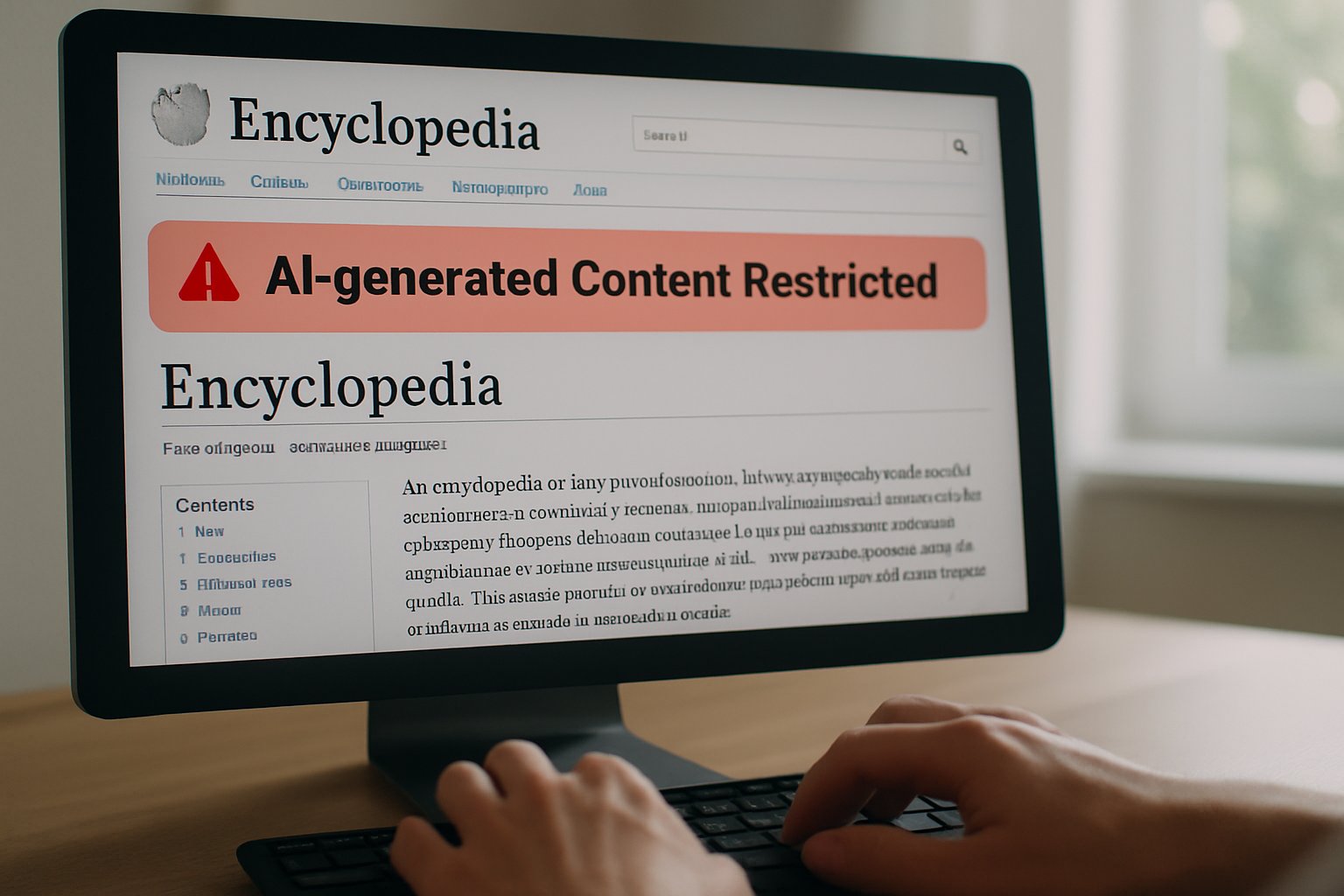
These votes illustrate firm resolve to preserve Accuracy despite tooling limits. However, enforcement patterns differ elsewhere, as the next section shows.
English Enforcement Gains Momentum
During August 2025, English Wikipedia adopted a targeted pathway instead of a full Ban. Specifically, criterion G15 lets moderators delete pages displaying unmistakable machine fingerprints within minutes. Additionally, volunteers launched WikiProject AI Cleanup to catalog suspect drafts and coordinate reviews. Marshall Miller compared these editors to an immune system straining under synthetic load. Meanwhile, the Princeton detection study had already flagged five percent of August 2024 English pages as likely machine authored. Consequently, speedy deletions rose sharply, yet false positive fears linger.
Targeted removal balances speed with risk, aligning with the broader Online Encyclopedia Policy mandate. Next, we examine how the nonprofit host reconciles community caution with commercial opportunity.
Foundation Balances AI Interests
April 2025 saw the Wikimedia Foundation unveil its “Humans-First” AI strategy. Furthermore, leadership stressed tools should assist, not replace, volunteer judgment. Jimmy Wales later told reporters that AI companies must pay for infrastructure they heavily exploit. Subsequently, the foundation paused an experimental summary generator after editors protested quality concerns. Therefore, strategic messaging now references the Online Encyclopedia Policy when outlining any machine assistance.
Enterprise Deals Spark Questions
Simultaneously, the foundation licensed high-volume access to Microsoft, Meta, and others. Consequently, some contributors fear commercial ties may dilute enforcement rigor. In contrast, executives argue revenue offsets an eight percent traffic decline driven by chatbots quoting the site. Nevertheless, the policy documents promise transparent attribution and ongoing community veto power.
Monetization complicates purity goals yet funds essential servers. Detection metrics now guide those tense conversations, as the following section details.
Detection Data Drives Decisions
Reliable numbers anchor the debate. Moreover, the Princeton cohort employed GPTZero and an open detector, estimating five percent synthetic Content among new pages. Researchers kept false positives near one percent, providing communities with defensible evidence. Additionally, volunteers track daily suspect drafts, often citing fabricated citations or duplicated prose. Consequently, cleanup lists regularly show hundreds of flagged articles.
- 5% new English pages in August 2024 flagged as AI generated (Princeton study).
- Hundreds of drafts listed by WikiProject AI Cleanup each month.
- 8% decline in human pageviews, linked to chatbot reuse.
Volunteer Cleanup Efforts Expand
Volunteers steadily refine detection playbooks and share suspicious titles on public dashboards. Additionally, quick learner guides teach pattern recognition within fifteen minutes. Consequently, new editors engage productively without overwhelming mentors.
Meanwhile, German administrators note fewer incidents since the Ban vote, though longitudinal data remain sparse. In contrast, English moderators still rely on speed and judgment.
Quantitative signals inform evolving Enforcement within the Online Encyclopedia Policy. The next section explores arguments for and against stricter rules.
Pros Cons Ongoing Debate
Voices across language editions present thoughtful cases. Proponents say strong limits preserve Accuracy and prevent model collapse from recursive synthetic loops. Furthermore, they highlight public trust surveys ranking the encyclopedia above social networks. Critics counter that absolute bans stifle productive tools like checked translation, thereby slowing article growth. Moreover, detection remains imperfect, risking the removal of genuine Content. Subsequently, some propose a disclosure regime requiring editors to label machine assistance. Nevertheless, communities largely converge on a human review layer embedded within the Online Encyclopedia Policy.
Debate shows no universal solution, yet shared values endure. The final section offers pragmatic steps for practitioners.
Practical Guidance For Editors
Practitioners can navigate emerging norms with clear practices. First, always verify citations and numerical claims for Accuracy before publishing. Second, disclose any machine assistance to align with community transparency expectations. Third, monitor local noticeboards for policy amendments referencing the Online Encyclopedia Policy. Additionally, consider joining WikiProject AI Cleanup to gain expertise spotting stylistic tells. Professionals can enhance their expertise with the AI Everyone™ certification. Finally, appeal contested deletions calmly, providing diff evidence that proves human authorship.
Following these tips reduces friction and supports sustainable Content creation. Consequently, editors contribute confidently amid rapid automation.
Automation will keep advancing, yet stewardship remains human. Therefore, the Online Encyclopedia Policy offers an adaptable compass for multilingual Wikipedia volunteers. Moreover, formal Bans, speedy deletions, and transparency rules each reinforce Accuracy when applied judiciously. Consequently, data driven detection and community oversight create resilient safeguards against misinformation. In contrast, enterprise partnerships ensure funding without surrendering editorial independence. Subsequently, professionals should track policy updates and share lessons across platforms. The Online Encyclopedia Policy ultimately aims to balance innovation with unwavering public trust. Act now by reviewing local guidelines and pursuing specialized learning paths that future-proof your editorial skills.


