

AI CERTs
1 week ago
Google Deal Fuels Robotics Market Expansion for Industry
Industrial robotics just crossed another threshold.
On 25 February 2026, Google folded Alphabet’s Intrinsic into its core business.
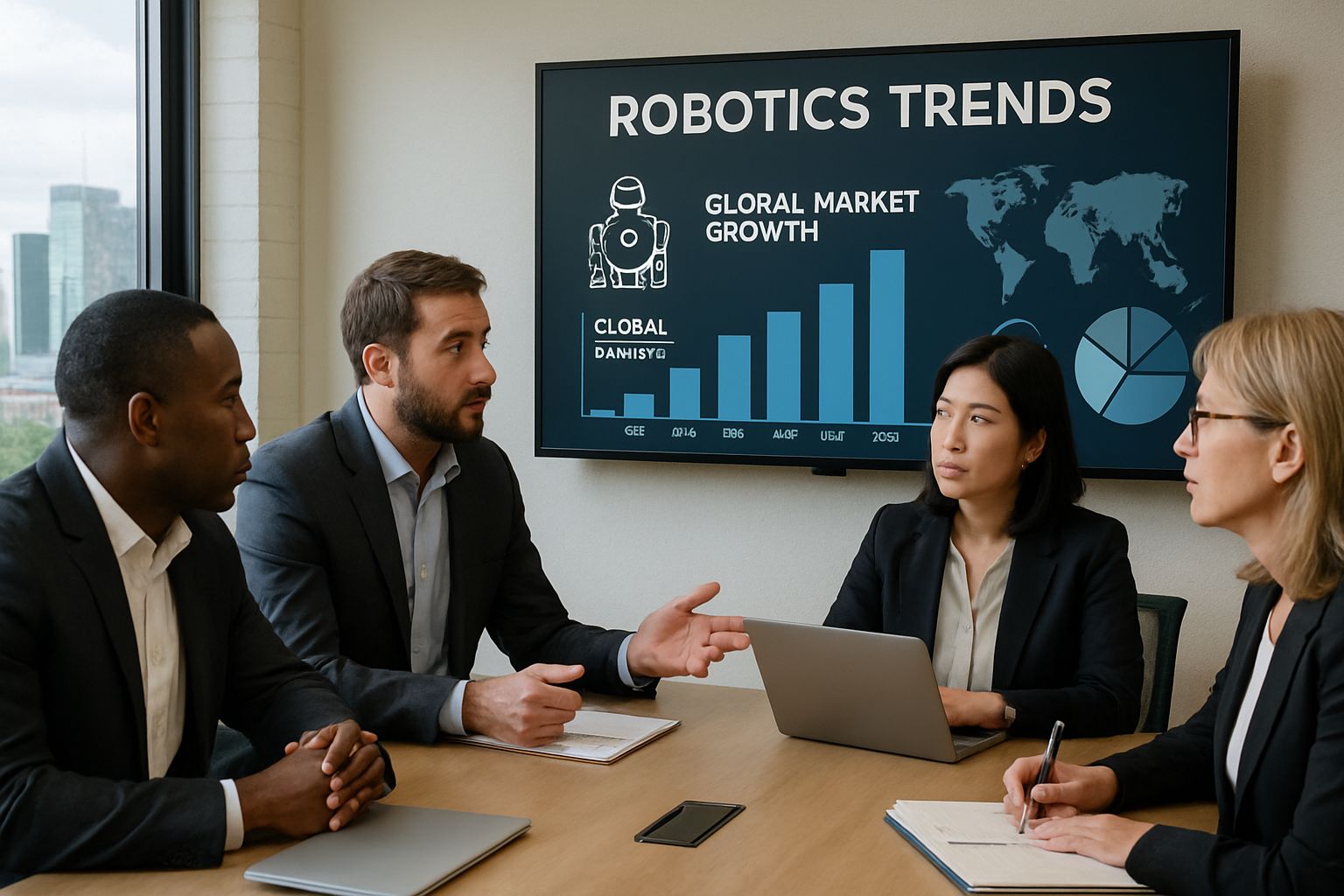
Consequently, the move aligns hardware, Gemini AI models, and Cloud services under a single roof.
This bold integration signals a major Robotics Market Expansion that resonates across global factories and logistics hubs.
Moreover, competitors now gauge how quickly Google can translate laboratory breakthroughs into shop-floor productivity.
Investors watch installation trends while policymakers consider workforce impacts.
Therefore, understanding the new landscape is vital for every manufacturing and automation leader.
The following analysis breaks down the corporate moves, market data, and open risks.
It provides actionable insight for Enterprise strategists planning their next robotics Strategy.
Driving Robotics Market Expansion
Google’s latest consolidation clarifies its commercial intent.
However, the structure still gives Intrinsic autonomy to iterate quickly with customers.
Wendy Tan White said the team spent years democratizing intelligent robotics.
She added that Google resources will accelerate that mission.
Similarly, Google CPO Hiroshi Lockheimer framed the deal as bridging digital and physical worlds.
Consequently, analysts view the integration as the second major Robotics Market Expansion signal after DeepMind’s Gemini launch.
Financial terms remained undisclosed.
Nevertheless, Alphabet’s quarterly filings already show rising capital outlays for advanced hardware.
Subsequently, Boston Dynamics linked arms with DeepMind to embed Gemini Robotics in Atlas humanoids.
That January CES announcement further amplified the Robotics Market Expansion narrative.
Meanwhile, Hyundai presented manufacturing demos that hinted at 2028 production timelines.
Google’s structural move and partner momentum confirm significant acceleration.
However, market context offers deeper perspective.
Google Consolidates Robotics Assets
The new group combines three pillars.
Firstly, DeepMind supplies Gemini Vision-Language-Action models capable of learning tasks from 50 demonstrations.
Secondly, Intrinsic contributes the Flowstate development environment and skill libraries.
Thirdly, Google Cloud delivers scalable compute, security, and data integration for Enterprise deployments.
Collectively, the stack promises faster cell commissioning than legacy Automation workflows.
Consequently, executives predict another wave of Robotics Market Expansion driven by software reusability.
Gemini Models Drive Flexibility
Gemini Robotics On-Device runs locally on compact chips.
Therefore, latency drops below 20 milliseconds, crucial for real-time safety.
In contrast, cloud-only models often exceed acceptable cycle time budgets.
Manufacturing clients also gain offline resilience when networks fail.
Furthermore, the SDK allows fine-tuning with limited proprietary data.
This capability underpins continued Robotics Market Expansion into smaller plants lacking extensive engineering staff.
Intrinsic Flowstate Platform Explained
Flowstate resembles Android for robots.
Developers drag skills onto a timeline, simulate, then deploy across mixed hardware.
Additionally, visual tools lower entry barriers for Enterprise integrators migrating from PLC ladder logic.
Foxconn’s November joint venture will test the concept at scale.
Consequently, success there could spark fresh Robotics Market Expansion across electronics Manufacturing clusters.
Google’s combined pillars create a vertically integrated stack.
Next, market statistics reveal how quickly adoption could grow.
Physical AI Market Context
Global installations already approach 600,000 new industrial units yearly, according to IFR.
Asia, especially China, commands the majority share.
Moreover, IFR projects continued double-digit growth through 2026.
Business Research Company values the industrial segment near 61 billion dollars for 2026.
These figures underpin the broader Robotics Market Expansion story beyond Google’s announcements.
- IFR: 590,000 robot installations recorded in 2023, rising each subsequent year.
- APAC captured over 70% of new units during 2025, led by China’s Manufacturing surge.
- Market forecasts range from 17 to 65 billion dollars, reflecting differing Automation scopes.
Consequently, suppliers race to differentiate on flexibility, not only speed.
Gemini’s multimodal reasoning supports that competitive edge.
Meanwhile, analysts call this shift from rigid automation to adaptable systems 'physical AI'.
Therefore, capital investments now focus on software talent as much as mechanical engineering.
Data confirms demand for smarter machines, not just more machines.
The next section explores how firms plan to seize that demand.
Opportunities For Global Manufacturers
Adaptable robots promise shorter changeover times between product variants.
Furthermore, on-device intelligence reduces costly downtime linked to connectivity loss.
Boston Dynamics believes Gemini-powered Atlas can handle strenuous palletizing without extensive reprogramming.
Similarly, Hyundai envisions Automotive final-assembly support by 2028.
Manufacturing executives expect improved first-pass yield through AI-driven inspection.
Intrinsic lists three immediate benefits for plant managers.
Firstly, reduced integration overhead lowers total cost of ownership.
Secondly, cross-robot applications avoid vendor lock-in, an Enterprise priority.
Thirdly, cloud dashboards simplify remote compliance audits.
Consequently, many pilot customers quote payback periods under two years, accelerating Robotics Market Expansion.
Leaders can upskill teams through the AI+ Human Resources™ certification.
Such programs align talent pipelines with fast-moving Automation trends.
Flexible platforms, human training, and partner ecosystems together broaden value.
However, serious risks still shadow large-scale deployments.
Risks And Open Questions
Unit economics remain uncertain for humanoid robots versus classic gantry systems.
Moreover, safety certification frameworks lag behind model complexity.
Deloitte warns governance gaps could stall Robotics Market Expansion if unresolved.
Additionally, labor groups worry about displacement across warehouse and low-skill Manufacturing roles.
Data governance presents further hurdles.
In contrast, cloud telemetry offers optimization insights yet raises liability debates about failure attribution.
Enterprises must negotiate Service Level Agreements that balance innovation with accountability.
Consequently, procurement teams scrutinize vendor roadmaps, pricing, and exit clauses.
Regulators also watch cross-border export controls for advanced actuators and embedded AI chips.
Therefore, multinationals should embed compliance checkpoints early in their Strategy cycles.
Risks highlight why transparent metrics and standards will decide winners.
Next steps point toward measurable pilots and audited results.
Conclusion And Next Steps
Google’s integration of Intrinsic, DeepMind, and Cloud resources marks a pivotal chapter.
Furthermore, related partnerships with Boston Dynamics and Foxconn demonstrate industry seriousness.
Market data already validates sustained Robotics Market Expansion worldwide.
Nevertheless, economics, safety, and governance challenges demand rigorous attention.
Manufacturers that pilot adaptable cells now will shape competitive baselines later.
Enterprise leaders should pair technical trials with structured workforce development.
Subsequently, certifications like the AI+ Human Resources™ program can support that Strategy.
Act now to evaluate pilots, upskill teams, and secure advantages in the coming decade.


