

AI CERTs
1 week ago
Inclusive Design Failure: AI UX Risks Accessibility Liability
Startups now prototype entire interfaces with one prompt. However, the speed masks a deeper problem: Inclusive Design Failure persists in AI generated experiences. Web analysts detect tens of millions of accessibility errors each year. Consequently, lawsuits and regulators are closing in. The Federal Trade Commission recently fined an overlay vendor $1 million for deceptive claims. Meanwhile, UsableNet predicts a record 4,000 digital accessibility suits for 2025. Developers relying on generative tools risk repeating past mistakes without realizing the legal stakes. Moreover, state websites face new deadlines under DOJ Title II, which mandates WCAG 2.1 Level AA. Therefore, Compliance officers must track AI outputs closely. This article unpacks the causes, evidence, and remedies behind the growing crisis. Along the way, we show how teams can avoid repeat Inclusive Design Failure while embracing responsible AI.
Legal Heat Intensifies Rapidly
Litigation offers the clearest metric of accessibility risk. Additionally, UsableNet logged 2,019 ADA web suits in just six months of 2025. Plaintiffs target retailers, banks, and media brands alike. In contrast, 2020 saw only half that volume.
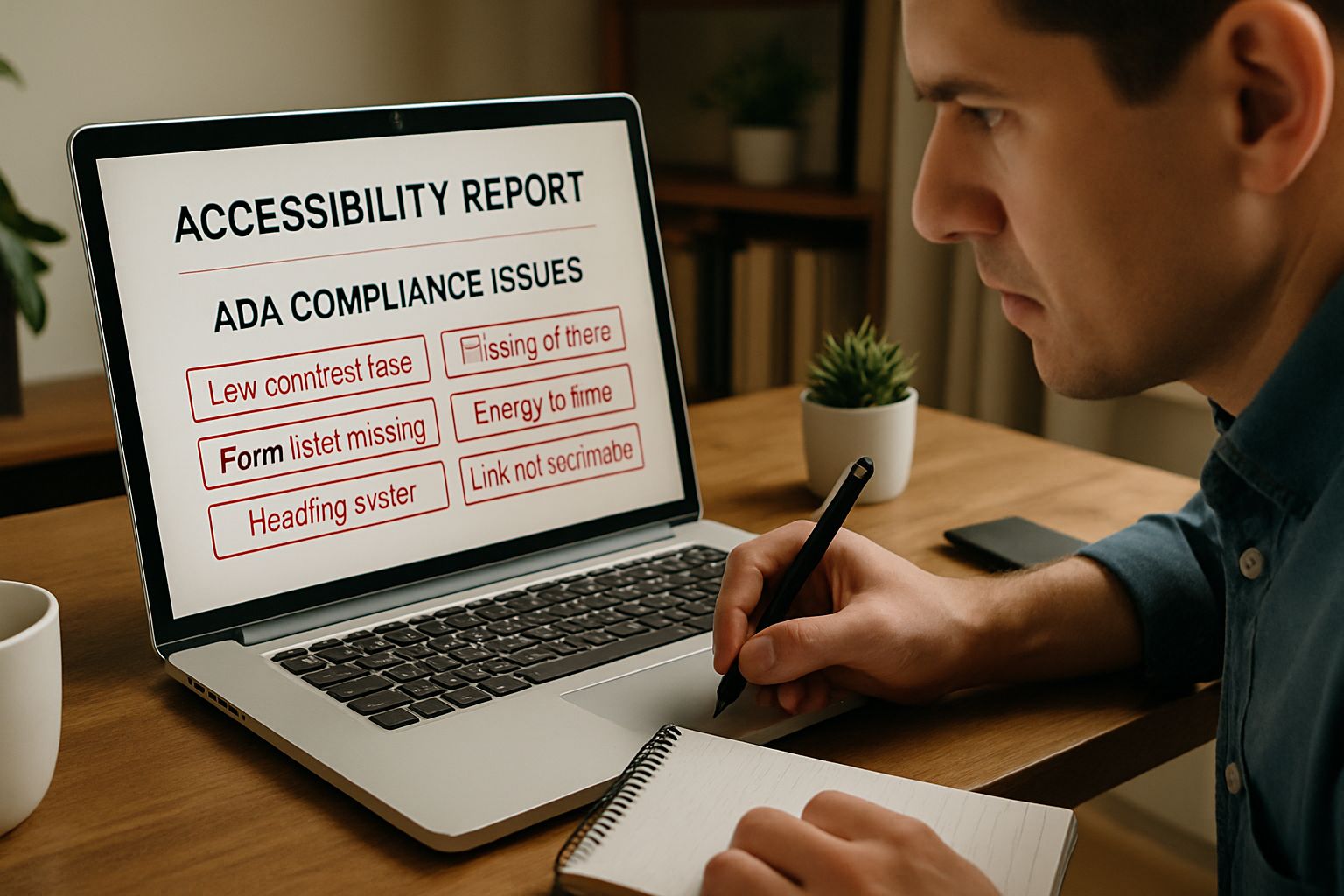
Most complaints cite missing alt text, poor contrast, or unusable forms. Consequently, each defect signals Inclusive Design Failure and triggers expensive settlements. Legal fees often dwarf the modest cost of prevention.
These numbers prove the courtroom stakes. However, data alone does not reveal the full scope, which the next section quantifies.
Data Reveals Massive Gaps
WebAIM’s February 2025 crawl analyzed one million homepages. The scan surfaced 50,960,288 detectable errors. Moreover, 94.8% of pages failed at least one WCAG criterion. Low contrast text appeared on 79% of sampled sites.
Missing alternative text affected 55.5% of images. Meanwhile, unlabeled form fields plagued 48.2% of pages. Such statistics capture systemic Inclusive Design Failure across industries.
- Low contrast text: 79.1%
- Missing alt text: 55.5%
- Unlabeled forms: 48.2%
- Empty links or buttons: 32%
- Missing language attribute: 24%
The repeated issues cluster around six basic patterns. Therefore, automated generation tools that ignore semantics amplify those patterns, as the next section shows.
AI Workflows Miss Basics
Generative UX platforms optimise visual polish over semantic depth. For example, AI prototypes often export stylish CSS without proper heading structures. Consequently, screen readers cannot interpret the hierarchy.
The CodeA11y study documented three recurring AI assistant failures. First, placeholders remain where alt text belongs. Second, improperly mapped labels break form navigation. Third, color suggestions ignore contrast ratios.
Furthermore, many prompts exclude accessibility requirements entirely. Developers assume post-processing will fix gaps, yet that assumption fuels another Inclusive Design Failure.
Technical shortcuts sacrifice user equity. Next, we examine how regulators respond to such shortcuts.
Regulators Tighten Accessibility Rules
Policy bodies increasingly codify digital duties. The Department of Justice finalized a Title II web rule in April 2024. Consequently, state and local sites must reach WCAG 2.1 AA by 2026.
Courts still apply ADA Title III to private websites, planting further uncertainty. Meanwhile, the Federal Trade Commission acted against exaggerated overlay marketing. Its April 2025 order forced accessiBe to pay $1 million and modify claims. Moreover, the order signals that deceptive AI hype is a consumer protection issue.
W3C guidance also warns that fully automated Compliance remains unreliable without human checks. Therefore, vendors promoting “hands-free” fixes face heightened scrutiny.
Regulators now pair standards with enforcement. The message sets expectations that influence corporate roadmaps, which the next section explores.
Human Oversight Remains Vital
Academic and industry experts converge on the same recommendation. Noé Barrell from Deque states that humans must retain ultimate control. Likewise, W3C researchers endorse human-in-the-loop verification.
Manual screen-reader walkthroughs catch context issues automation misses. Additionally, keyboard testing uncovers focus traps enraging users with disabilities. Consequently, blended testing reduces Inclusive Design Failure incidence.
Professionals can deepen skills through the AI+ UX Designer™ certification.
Augmenting tools with trained people balances speed and quality. Next, we outline concrete steps teams can follow.
Mitigation Strategies For Teams
Product leaders should embed accessibility acceptance criteria within all AI prompts. Furthermore, design tokens can encode contrast and spacing constraints upfront.
Teams ought to integrate automated scans into continuous integration pipelines. In contrast, overlay scripts should never replace source code remediation. Regular audits by disabled testers close feedback loops.
- Add WCAG success criteria to design briefs.
- Run axe or WAVE scans on every commit.
- Schedule quarterly manual audits with assistive tech users.
- Negotiate indemnity clauses with AI tool vendors.
Following these steps curbs Inclusive Design Failure while supporting rapid iteration.
Structured processes convert requirements into routine habits. The business implications of those habits appear next.
Business Case For Inclusion
Accessibility aligns with market growth, investor expectations, and brand reputation. Morgan Stanley research links accessible sites to wider customer reach and loyalty. Moreover, inclusive products reduce refund requests and support calls.
Conversely, each publicized lawsuit dents share prices. Investors view recurring Inclusive Design Failure as operational risk. Therefore, proactive Compliance becomes a strategic differentiator.
Hiring certified specialists signals commitment to stakeholders. UX teams that advertise the AI+ UX Designer™ credential attract diverse talent.
Financial incentives reinforce ethical motives. Consequently, organisations that act now will outpace slower rivals.
Conclusion And Next Steps
AI promises efficiency, yet it often delivers Inclusive Design Failure when unchecked. However, data, litigation, and regulation now converge to force better practice. Teams that embed accessibility early, verify through humans, and pursue relevant certifications can transform risk into advantage. Moreover, transparent metrics prove progress and reassure regulators. Inclusive Design Failure is not inevitable; disciplined processes can eliminate it. Consequently, organizations that address it today secure market trust, protect against ADA actions, and build resilient UX. Avoid repeating Inclusive Design Failure by enrolling your creators in the AI+ UX Designer™ program. Act now: audit each sprint, test with users, and release accessible products.


