

AI CERTs
1 week ago
Closing the Digital Education Crisis: Bridging AI Literacy Gaps
Classrooms and boardrooms now buzz with generative chatbots, yet confusion runs equally loud.
However, experts warn that insufficient AI understanding threatens productivity, ethics, and democratic decision making.
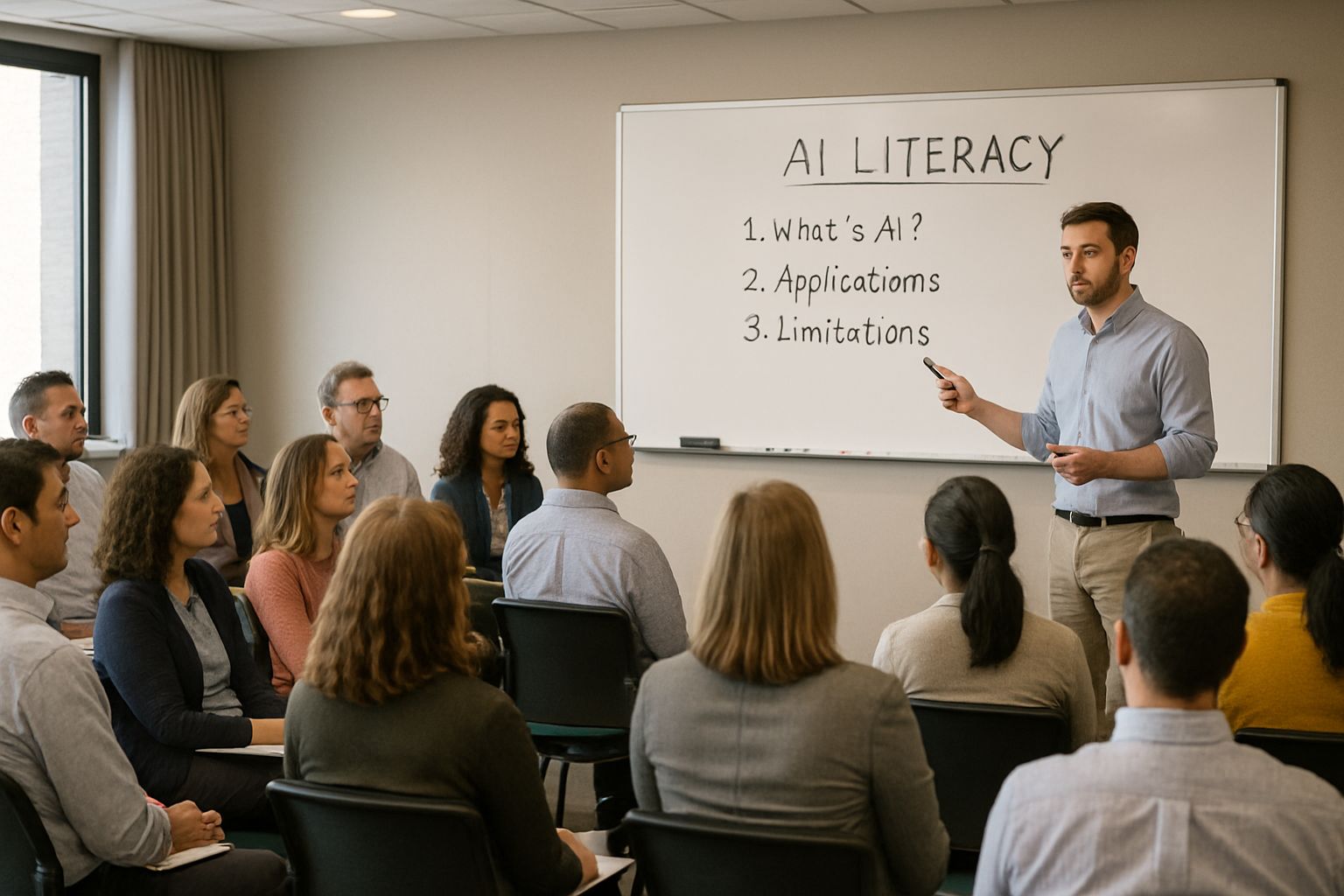
This widening gap is no longer abstract; it represents a true Digital Education Crisis across sectors.
Consequently, leaders scramble to design training, certification, and governance before misinformation erodes trust completely.
The following analysis untangles drivers, evidence, and solutions, guiding professionals who must navigate the shifting terrain.
Digital Education Crisis Deepens
Microsoft's 2025 classroom study found 86% of schools deploy generative AI tools.
However, fewer than half of students claim strong AI Knowledge, and many educators lack formal instruction.
Moreover, 45% of teachers worldwide report zero AI training, confirming a core Skills deficit.
Therefore, policymakers hail this mismatch as evidence of a Digital Education Crisis requiring urgent intervention.
These numbers signal urgent reform across curricula.
Consequently, the gap grows wider every quarter.
Next, we examine public trust erosion.
Hallucinations Shake Public Trust
Courts have sanctioned lawyers who cited AI-fabricated cases, illustrating tangible harm.
Furthermore, newsroom errors spread invented quotes, souring media credibility.
Pew data shows half of adults feel concerned, not excited, about expanding AI Access.
In contrast, one third interact with AI several times daily, underscoring dependence without parallel Literacy growth.
Consequently, the Digital Education Crisis magnifies misinformation risks across professions.
Low trust stalls innovative deployments.
However, better verification workflows can rebuild confidence.
We now explore equity dimensions.
Unequal Access Deepens Divide
UNESCO frames AI literacy as the latest digital divide threatening marginalized communities.
Moreover, rural schools often lack reliable connectivity, constraining Access and practice opportunities.
Therefore, students in wealthier districts accumulate Skills faster, widening achievement gaps.
The Digital Education Crisis thus intersects with socioeconomic inequality, compounding systemic disadvantages.
Equity must anchor future training agendas.
Next, we assess current pedagogy limits.
Why Short Lessons Fail
A 2025 randomized study tested a brief AI module for high schoolers.
Nevertheless, overreliance on faulty chatbot advice persisted at 52% after instruction.
Researchers concluded that enduring Knowledge requires iterative, contextualized practice, not checkbox webinars.
Consequently, organizations relying on microlearning sustain the Digital Education Crisis instead of solving it.
Quick tutorials lift awareness but not judgment.
Therefore, longer experiential models appear essential.
Governance frameworks provide complementary support.
Policy Gaps And Opportunities
McKinsey links strong governance with higher AI returns and lower risk exposure.
Meanwhile, inconsistent disclosure rules confuse employees and parents, hampering Knowledge transfer.
Additionally, UNESCO urges localized curricula that blend technical Skills with ethical reflection.
Embedding verification checkpoints across workflows could ease the Digital Education Crisis over time.
- Mandatory AI source disclosure in schools and media.
- Continuous teacher coaching cycles every semester.
- Open data dashboards tracking regional Access to training.
- Incentives for certified AI mentors in organizations.
Clear policy aligns incentives and expectations.
Subsequently, workforce certifications accelerate adoption.
Effective programs illustrate that path.
Building Robust Literacy Programs
Successful pilots combine project-based challenges, peer review, and reflection cycles.
For example, some districts task students with debunking chatbot hallucinations before grading.
Moreover, professionals can enhance their expertise with the AI for Everyone™ certification.
Such stackable credentials reinforce Skills and signal readiness to employers.
Consequently, layered training pathways chip away at the Digital Education Crisis steadily.
Iterative, certified learning fosters durable mastery.
In contrast, ad-hoc exposure leaves gaps.
The final section synthesizes insights.
Conclusion And Call-To-Action
AI adoption will only accelerate, yet human judgment remains the decisive variable.
Therefore, stakeholders must bridge fluency, Access, and ethical Literacy before errors erode trust irreparably.
This article showed how policy, pedagogy, and certification converge to shrink the Digital Education Crisis.
Moreover, continuous assessment ensures Knowledge and Skills translate into safe, creative practice.
Act now: enroll in accredited courses and pursue the linked certification to combat the Digital Education Crisis together.


