

AI CERTs
3 months ago
Alibaba RISC-V Chip Drives Agentic AI Infrastructure
The Alibaba RISC-V Chip entered headlines at Alibaba's Apsara Conference 2025. Industry leaders saw the launch as a pivotal step toward autonomy in cloud compute. Consequently, expectations rose for open instruction architectures in China’s fast-growing data centers. Meanwhile, agentic AI workloads demanded flexible, efficient processors from edge to server racks. Alibaba positioned the platform as the missing link connecting models, Infrastructure, and adaptive agents. This introduction unpacks technical highlights, market forces, and unresolved questions facing the program. Furthermore, the article shows how professionals can prepare for emerging opportunities in the agentic era. By the end, readers will grasp the Alibaba RISC-V Chip strategy and its broader implications. Moreover, key data points and quotes give context on performance, financing, and ecosystem traction. Each section builds logically, ensuring clarity for engineers, investors, and policy watchers. Prepare to explore silicon, software, and strategy through a concise yet comprehensive lens.
Agentic Era Demands Silicon
Agentic AI describes autonomous systems that plan, act, and learn across multiple steps. Therefore, workloads move beyond single inference calls toward persistent reasoning loops accessing tools and memory. Such behavior strains conventional CPUs built for transactional queries.
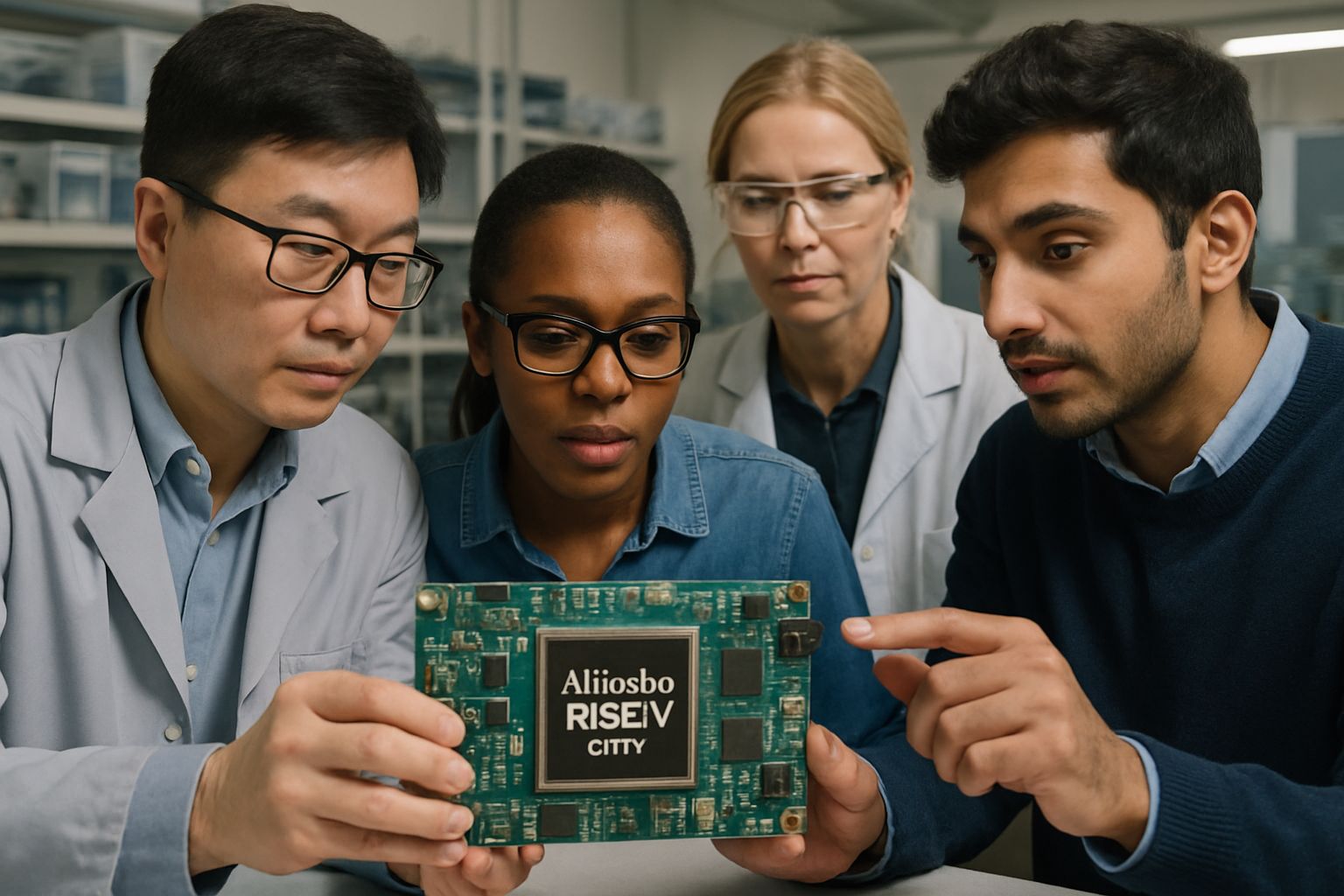
Moreover, latency spikes break agent chains, while energy inefficiency hampers edge deployments. Developers need configurable instruction sets and domain extensions targeting tensor, vector, and security tasks. The open RISC-V ecosystem answers that requirement with modularity and royalty-free licensing.
Consequently, Alibaba integrated the philosophy into its broader Infrastructure vision. The Alibaba RISC-V Chip family now sits beside GPUs, NPUs, and memory platforms within Apsara. These placements highlight management’s belief that custom compute underpins the next growth curve.
Agentic AI thus redefines performance, efficiency, and openness targets for hyperscalers. However, meeting those targets requires silicon tailored for emerging patterns; the following section examines C930.
Inside XuanTie C930 CPU
XuanTie C930 marks Alibaba’s first server-grade RISC-V processor. Designed by DAMO Academy and T-Head, the Alibaba RISC-V Chip targets data centers, HPC clusters, and automotive platforms. Furthermore, an out-of-order microarchitecture boosts integer and floating workloads while keeping power envelopes competitive.
Key public specifications include:
- Up to 64 cores leveraging 5 nm process, according to vendor slides.
- Integrated vector extension for AI math and cryptographic acceleration.
- Support for CXL 2.0 memory expansion and 800 Gbps HPN8.0 networking.
Independent SPEC or MLPerf numbers remain scarce; analysts await silicon samples for verification. Nevertheless, ecosystem partners already integrate the design into reference SoCs, shortening time to market. The Alibaba RISC-V Chip therefore advances beyond lab status and enters limited production. Moreover, Arteris provides validated NoC IP, easing connectivity for third-party accelerators.
These technical claims signal serious intent, yet hardware alone cannot guarantee adoption. Consequently, partnerships and ecosystem moves become decisive, as explored next.
Ecosystem Partnerships Accelerate Adoption
Hardware lacks impact without software and design allies. Therefore, Alibaba broadened alliances with Arteris, toolchain maintainers, and RISC-V International to mature compilers. T-Head released reference boards so developers can benchmark, debug, and optimize early.
Moreover, Alibaba Cloud integrated Qwen3-Max services, Vector Bucket storage, and PolarDB CXL memory into one Infrastructure stack. That stack runs natively on the Alibaba RISC-V Chip and companion GPUs. Consequently, agents trained in Model Studio can deploy from cloud to edge without rewrites.
In contrast, rivals like Huawei Ascend still depend heavily on proprietary ISAs. Ecosystem openness may sway developers seeking flexibility amid geopolitical uncertainty.
Open-source maintainers ported NumPy wheels to RISC-V, yet optimized BLAS kernels remain experimental. Consequently, Alibaba funds compiler sprints to upstream vector and tensor extensions for community benefit.
Partnership breadth reduces friction and boosts confidence among early adopters. However, policy and financial factors equally influence momentum, as the following analysis shows.
Market Forces And Policy
Global Semiconductor demand keeps surging despite supply chain turbulence. Acumen Research values the emerging RISC-V Semiconductor market at about USD 1.6 billion for 2025. Moreover, annual growth could exceed 30 percent through the decade.
Meanwhile, Washington’s export controls push Chinese hyperscalers toward sovereign compute stacks. Therefore, the Alibaba RISC-V Chip aligns with national priorities for technological self-reliance. Reports suggest Alibaba may spin off T-Head, unlocking capital for aggressive expansion.
Subsequently, investors will scrutinize revenue contributions from semiconductor sales versus cloud services. Nevertheless, early shipments and ecosystem downloads, exceeding 600 million, indicate healthy interest. The Alibaba RISC-V Chip could therefore catalyze domestic server procurement if benchmarks confirm parity.
Policy tailwinds and market growth strengthen Alibaba’s hand. Consequently, remaining challenges deserve closer inspection next.
Opportunities And Remaining Gaps
Open architectures present vast upside, yet execution risks persist. Software tooling around RISC-V still trails x86, ARM, and CUDA. In contrast, cross-compilation, profiling, and optimized libraries remain early-stage for many Agentic AI frameworks.
Moreover, independent MLPerf submissions for C930 silicon are not yet public. Without transparent numbers, performance claims risk skepticism among cloud architects. Many architects will withhold large deployments until the Alibaba RISC-V Chip proves repeatable advantages.
Talent readiness forms another gap. Professionals can enhance expertise with the AI Prompt Engineer™ certification. Such programs teach prompt design, safety, and evaluation skills essential for Agentic AI deployment.
Gaps center on tooling, benchmarks, and talent, yet each has a clear remediation path. Subsequently, Alibaba’s roadmap outlines next milestones, reviewed in the final section.
What Comes Next Roadmap
Alibaba Cloud pledged RMB 380 billion over three years for AI Infrastructure upgrades. Upcoming releases include Qwen3-Max production, Model Studio AgentOne runtime, and wider C930 availability. Furthermore, T-Head intends to license the design to external Semiconductor vendors, encouraging broader fabrication.
IPO rumors suggest fundraising may accelerate roadmap execution. Nevertheless, leadership emphasizes open governance of the Alibaba RISC-V Chip to reassure partners. Therefore, stakeholders expect frequent firmware updates, toolchain patches, and academy courses over 2026.
Near-term deliverables will test execution discipline and community engagement. However, success could cement RISC-V as a pillar of global agentic compute.
Conclusion
Alibaba’s gamble on open compute is ambitious yet grounded in clear technical and market signals. The Alibaba RISC-V Chip, paired with an expansive Infrastructure stack, positions the firm for the agentic shift. However, software maturity, Semiconductor benchmarks, and talent pipelines still need acceleration. Fortunately, ecosystem collaborations and certifications can close gaps quickly. Consequently, professionals should track toolchain releases and pursue the AI Prompt Engineer™ credential to stay competitive. Adoption momentum will solidify once transparent C930 results reach public databases. Meanwhile, management must deliver promised roadmaps and sustain community trust. Readers seeking deeper skills should explore the linked certification and monitor upcoming benchmark disclosures. Early engagement today can translate into strategic advantage tomorrow.
Disclaimer: Some content may be AI-generated or assisted and is provided ‘as is’ for informational purposes only, without warranties of accuracy or completeness, and does not imply endorsement or affiliation.


