

AI CERTS
3 hours ago
Hardware Chip Diplomacy Shapes Nvidia H200 China Deal
However, March comments from Nvidia's Jensen Huang revealed new licenses and dormant factories restarting. The story now sits at the intersection of export controls, tariffs, and corporate survival. Moreover, investors want clarity on revenue timing and political durability. This article dissects the mechanics, market signals, and strategic stakes shaping the debate. Therefore, technical leaders can prepare for compliance while positioning competitively within a contested landscape. We close with actionable guidance plus certification resources for continued mastery.
Hardware Chip Diplomacy Stakes
Initially, Washington framed the January shift as balancing innovation against national security. However, the practical stakes extend far beyond regulatory fine print. Every H200 sold to China represents premium gross margin for Nvidia. Conversely, each chip also provides Beijing valuable compute capacity for civilian and military AI. Consequently, Hardware Chip Diplomacy becomes a revenue lever, a deterrence tool, and a diplomatic message. The phrase captures an unprecedented fusion of factory floor economics and foreign policy choreography.
In contrast, earlier commodity tariffs rarely demanded end-to-end technical oversight. Now, third-party testing, aggregate capacity caps, and routing rules amplify scrutiny on every die. Moreover, the policy deliberately keeps U.S. firms inside Chinese data centers, avoiding total decoupling. These intertwined motives raise complex questions that ripple through boards, fabs, and ministries.
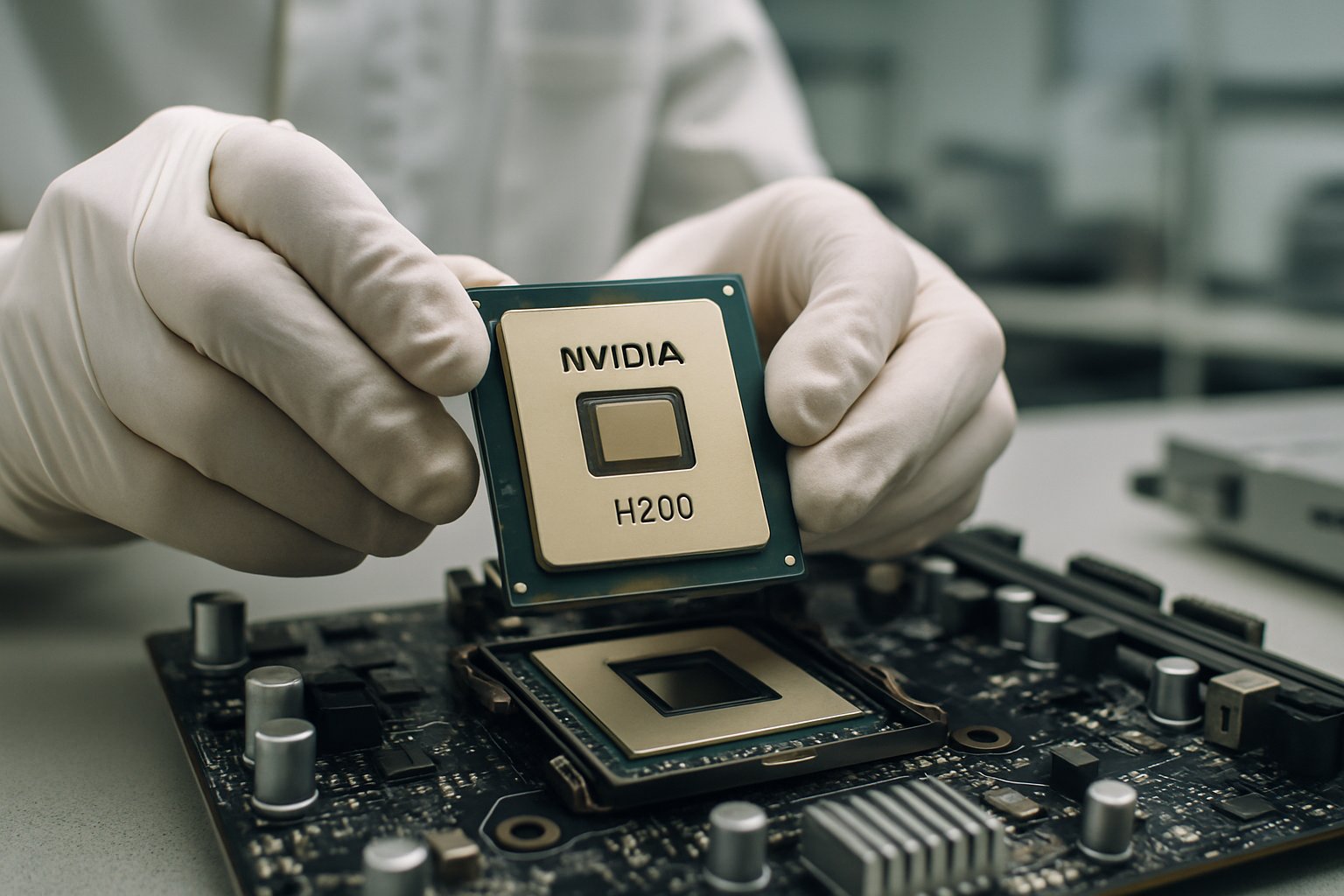
The stakes mix profit, security, and influence in equal measure. Therefore, this fragile Hardware Chip Diplomacy demands careful legal and operational alignment. Next, we unpack how export controls evolved to enable conditional sales.
Export Controls Policy Shift
Historically, BIS treated top AI accelerators with a presumption of denial. However, the January final rule carved out a narrow discretionary lane. Applicants must prove shipment volumes, end-use safeguards, and non-diversion commitments. Moreover, chips must stay below 21,000 TPP and 6,500 GB/s bandwidth thresholds. The rule explicitly cites Nvidia H200 and AMD MI325X as qualifying examples. Consequently, firms can now file license requests instead of accepting automatic rejection. Nevertheless, BIS reserves authority to revoke permissions if certifications fail. In contrast, Chinese exporters enjoy no reciprocal pathway for equivalent silicon.
This asymmetry underscores Hardware Chip Diplomacy as Washington's instrument of strategic leverage. BIS further requires exporters to cap Chinese aggregate capacity at half U.S. volumes. These safeguards intend to prevent rapid Chinese scaling while retaining some market share. Ultimately, mastery of the review process defines winners and laggards. Meanwhile, a separate tariff regime complicates cost calculations, discussed in the next section.
Tariff Mechanics Fully Unpacked
The Presidential Proclamation introduced a 25% ad-valorem duty on covered advanced chips. Consequently, every licensed H200 unit must clear U.S. Customs and Border Protection. That routing arises because BIS insists on domestic third-party testing before re-export. Therefore, the shipment touches U.S. soil and triggers the tariffs. Exemptions exist for domestic R&D, repairs, and defined data center categories. However, commercial exports to China rarely escape the new tariffs. Nvidia's SEC filing warns it may not pass the duty to final buyers.
Moreover, analysts calculate the duty could divert hundreds of millions into Treasury. Critics label the arrangement a hidden revenue split masquerading as security policy. Supporters answer that Hardware Chip Diplomacy monetizes unavoidable risk while funding domestic capacity. These contrasting views fuel legislative debate and shareholder uncertainty. Subsequently, cost visibility becomes crucial for contract negotiations now underway. The following section examines the testing step that activates these charges.
Mandatory U.S. Testing Process
Before any export, chips face independent verification inside accredited American laboratories. BIS designates labs and can revoke status upon compliance failures. Consequently, capacity at qualifying facilities becomes a potential choke point. Moreover, exporters must supply performance samples for each production lot.
Turnaround times influence Nvidia's delivery schedules and China deployment roadmaps. In contrast, earlier consumer GPUs shipped directly from assembly lines to customers. Now, logistical loops add weeks and considerable overhead. Therefore, buyers must forecast demand earlier and secure test slots.
- Submit license request with detailed end-use affidavits.
- Reserve accredited lab capacity four weeks before production.
- Route chips through U.S. bonded warehouse for inspection.
- Pay 25% tariff upon re-export clearance.
Furthermore, exporters must track aggregate capacity to avoid breaching the 50% rule. Failure to comply risks license suspension and financial penalties. Hardware Chip Diplomacy therefore depends on seamless coordination across legal, logistics, and engineering teams. These operational hurdles influence how the market perceives supply certainty. The next section surveys real-time reactions from both sides of the Pacific.
Market Reactions Globally Evolve
Initial headlines suggested China blocked H200 imports at customs checkpoints. Reuters and Financial Times highlighted suppliers pausing production amid confusion. Meanwhile, Nvidia disclosed zero licensing revenue through February, calming speculation about windfalls. However, March remarks from Jensen Huang confirmed new purchase orders from licensed Chinese customers. In contrast, Beijing still has not issued public guidance enabling smooth clearance. Consequently, cloud majors like Alibaba and Tencent weigh domestic accelerator alternatives. Moreover, investors watch per-customer caps rumored at 75,000 units.
Analysts project three scenarios for 2026 shipments. Scenario one assumes partial approvals yielding 300,000 units, boosting company revenue modestly. Alternatively, the second scenario anticipates strict quota enforcement and minimal Chinese uptake. Scenario three foresees Beijing softening to maintain AI competitiveness despite tariffs. Each scenario affects global supply planning and valuation models. Consequently, Hardware Chip Diplomacy remains the central lens for forecasting outcomes. These market signals frame the upcoming debate among vocal stakeholders. Next, we chart those arguments to clarify decision-maker priorities.
Stakeholder Argument Snapshot Today
Technology firms champion controlled sales to sustain research budgets and shareholder returns. Moreover, U.S. officials argue limited exports preserve leverage over China's AI trajectory. Conversely, security hawks warn any advanced silicon strengthens potential military applications. In Congress, some lawmakers question whether tariffs resemble profit-sharing rather than defense funding. Meanwhile, Chinese regulators promote domestic GPU projects as strategic alternatives. Industry lawyers describe the rules as a "mixed bag" combining risk, opportunity, and paperwork.
Consequently, boardrooms must weigh ethical optics against quarterly earnings pressure. Hardware Chip Diplomacy therefore operates both as policy doctrine and investor relations narrative. Two key benefits often convince hesitant directors. First, ongoing engagement secures visibility into China demand patterns. Second, tariff proceeds may underwrite American semiconductor incentives. Nevertheless, persistent uncertainty hampers long-term manufacturing commitments. These divergent views set the stage for pragmatic operational planning. The next section converts debate into actionable steps.
Operational Playbook Forward Checklist
Executives must translate policy text into practical workflows immediately. Therefore, start by mapping every supply node against BIS certification checkpoints. Next, create cross-functional teams aligning legal, finance, and engineering responsibilities. Moreover, secure letters of intent from accredited labs to guarantee throughput. Negotiate Incoterms that allocate tariff liability transparently between seller and buyer. Consequently, pricing models should incorporate the 25% duty plus testing fees for China shipments. Include contingency clauses addressing possible China import pauses or quota shifts. Professionals can deepen expertise through the AI Product Manager™ certification.
Furthermore, regularly brief investors on Hardware Chip Diplomacy metrics to maintain confidence. Finally, monitor Federal Register notices for any threshold or quota adjustments. These tactics convert abstract regulation into repeatable corporate muscle memory. Consequently, prepared firms can navigate export controls, seize permitted revenue, and mitigate geopolitical shocks. The concluding section distills the narrative into core insights and next actions.
Conclusion And Next Steps
The H200 saga showcases how technology, security, and economics converge. Moreover, export controls, tariffs, and uncertain customs clearance create a labyrinth for any participant. Nevertheless, disciplined planning can unlock licensed revenue streams without breaching policy limits. Hardware Chip Diplomacy will likely evolve, yet its core message remains stable: oversight buys influence.
Consequently, enterprises must maintain agile compliance systems and transparent pricing frameworks. Leaders should also cultivate government relationships to anticipate threshold shifts early. For continuous skill building, explore the certification link provided above. Take action now and turn regulation into competitive advantage.


