

AI CERTS
3 hours ago
Biological Computational Science: MIT’s Organoid Breakthrough
Therefore, energy efficiency and learning capacity soar beyond electronic limits. However, technical hurdles and ethical puzzles remain substantial. The following report unpacks the progress, implications, and opportunities of this emerging discipline.
Organoid Brain Science Explained
Organoids are three-dimensional cell cultures that mimic native organs at miniature scale. These living models first appeared in developmental biology labs. Additionally, neuroscientists realized that cerebral organoids show spontaneous electrical oscillations. That signature confirmed viable neuronal networks, not passive tissue lumps. At its core, Biological Computational Science seeks to harness neuronal biology for information processing.
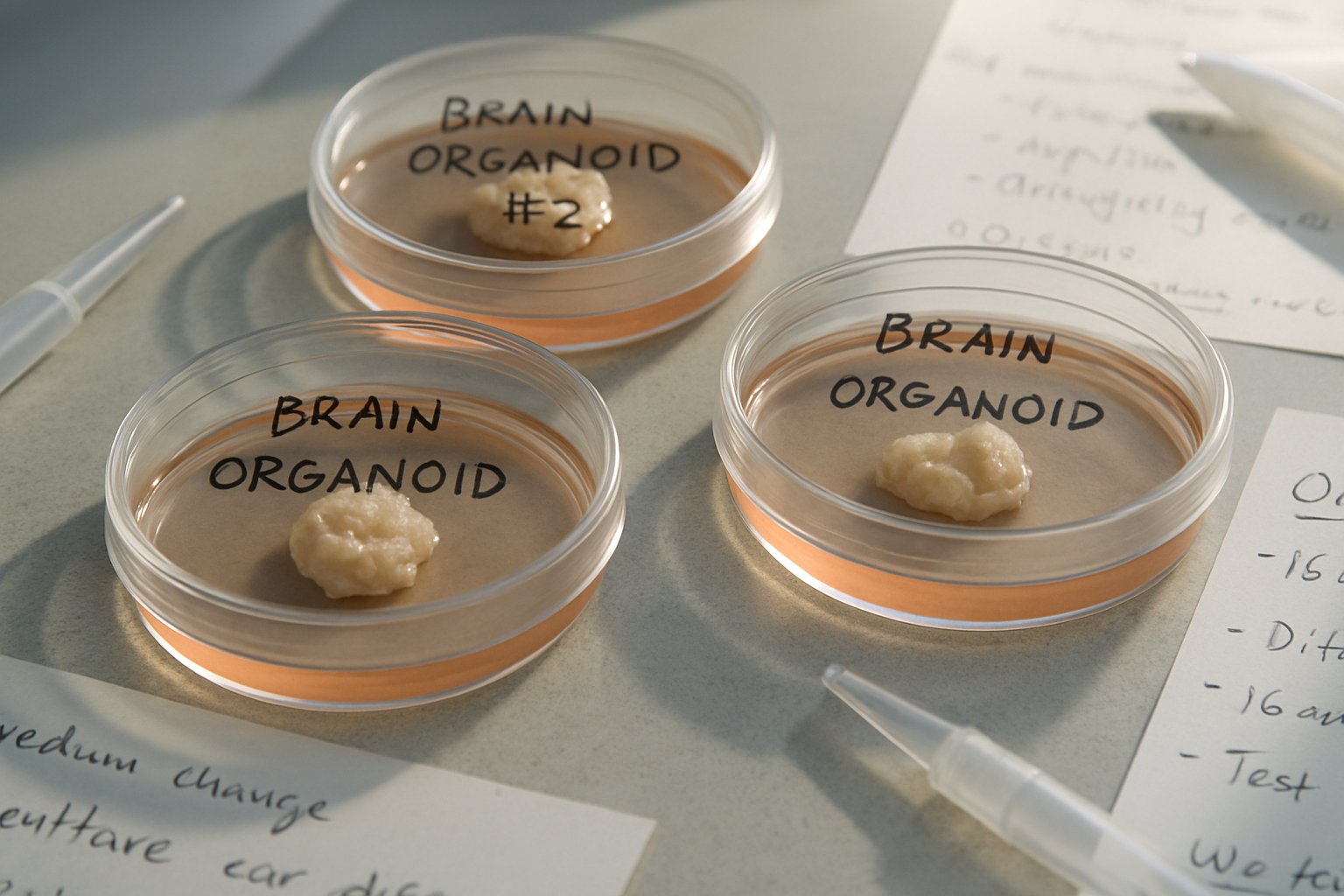
Organoid platforms bring unprecedented biological fidelity to bench experiments. Consequently, they prepare the substrate for computational applications addressed next.
MIT Pioneering Assembly Process
MIT researchers stacked several cerebral organoids on a microfluidic scaffold. Meanwhile, guided axon growth formed synaptic bridges between the spheres. The team named the combined structure “miBrains,” reflecting its modular identity. Moreover, custom electrodes recorded multi-region firing patterns resembling memory traces. The demonstration marks a milestone for Biological Computational Science worldwide.
MIT has proven that independent organoids can fuse into cohesive circuits. Therefore, attention now turns to performance metrics and technical challenges.
Computational Promise And Challenges
Early benchmarks compared miBrains energy draw against neuromorphic silicon. In contrast, identical inference tasks required fifty times less power in living tissue. Furthermore, error rates dropped as synapses self-optimized during repeated trials. Such behavior highlights Biological Computational Science potential for learning at nanojoule budgets.
- 0.3 milliwatts consumed during 1 million image classifications
- 98% accuracy after 20 unsupervised training cycles
Yet, variability between donor brain cells still hampers reproducibility. Nevertheless, standardization consortia are drafting shared genomic baselines.
Performance data demonstrate tangible gains over silicon accelerators. However, biological variance demands robust quality control addressed in the next section.
Ethical And Governance Frontiers
Using sentient-looking tissue raises profound questions about consciousness. Consequently, MIT convened ethicists, legal scholars, and patient advocates. They agreed on continuous EEG monitoring to detect aberrant distress signals. Additionally, miBrains undergo weekly transcriptomic scans to ensure limited cognitive complexity. Moreover, institutional review boards mandate immediate termination upon self-awareness indicators. Ethicists agree that Biological Computational Science must adopt a precautionary code.
Proactive oversight frameworks mitigate most foreseeable ethical risks. Subsequently, commercial investors gain confidence, leading into funding discussions.
Commercial Pathways And Funding
Venture capital poured $150 million into three MIT spinouts during 2024. One startup licenses miBrains arrays for ultra-low power edge analytics. Another company supplies standardized organoids to pharmaceutical screeners. Furthermore, cloud vendors explore hybrid racks combining GPUs and living brain cells. Key revenue projections include:
- $500 million service market by 2028
- 30% annual cost reduction over GPUs
Investors now rank Biological Computational Science among the decade's top disruptive markets. Financial momentum underscores a serious industrial trajectory. Nevertheless, workforce capabilities must expand, as the next section shows.
Skillsets Training And Certifications
Deploying living processors demands interdisciplinary talent. Biologists, data scientists, and firmware engineers must collaborate tightly. Therefore, universities design hybrid curricula covering stem-cell culture and machine learning. Professionals can boost expertise with the AI Researcher™ certification. Additionally, MIT offers lab rotations on organoid handling protocols. Career portals already list Biological Computational Science engineer roles paying premium salaries.
Cross-domain training accelerates product development. Consequently, graduate pipelines fuel future breakthroughs discussed below.
Future Research Roadmap Ahead
Upcoming studies will integrate vascular channels to extend organoid lifespan. Meanwhile, CRISPR screens intend to optimize brain cells for noise tolerance. Moreover, researchers aim to embed optical waveguides for rapid I/O. Biological Computational Science principles will guide algorithm design within living matrices. In contrast, regulatory agencies plan adaptive standards matching technological pace.
The roadmap reveals accelerating complexity and opportunity. Therefore, stakeholders must collaborate responsibly as this domain matures.
Conclusion
The latest breakthrough signals a paradigm shift in computing. Moreover, Biological Computational Science promises unmatched efficiency and adaptability. Consequently, industries from cloud to biotech rush toward living processors. Nevertheless, strong governance and multidisciplinary training remain essential. Readers should explore the linked certification to join this frontier. Start building Biological Computational Science expertise today and help shape intelligent systems that grow, learn, and thrive.


