

AI CERTS
3 hours ago
Semtech Showcases AI Interconnect Tech for 1.6T Copper Links
Moreover, it clarifies competitive positions across copper, optical, and DSP solutions. Readers will gain actionable insight into deployment considerations and market trajectory. Therefore, decision makers can optimize upcoming rack designs with confidence. The discussion integrates industry data, expert quotes, and certification pathways. Consequently, you will finish fully briefed on next-wave AI Interconnect Tech options.
Market Demand Surge Now
Everywhere machine learning clusters expand, east-west traffic outpaces historical fabrics. Consequently, hyperscalers seek links exceeding 200G per lane without painful power spikes. Analyst Bob Wheeler projects rapid 224G adoption beginning 2025. In contrast, legacy Networking equipment struggles to keep pace. Furthermore, market studies forecast ACC revenue surpassing USD 17 billion by 2031. Mordor Intelligence attributes much of that growth to AI infrastructure refresh cycles. Therefore, AI Interconnect Tech sits at the commercial heart of upcoming server investments.
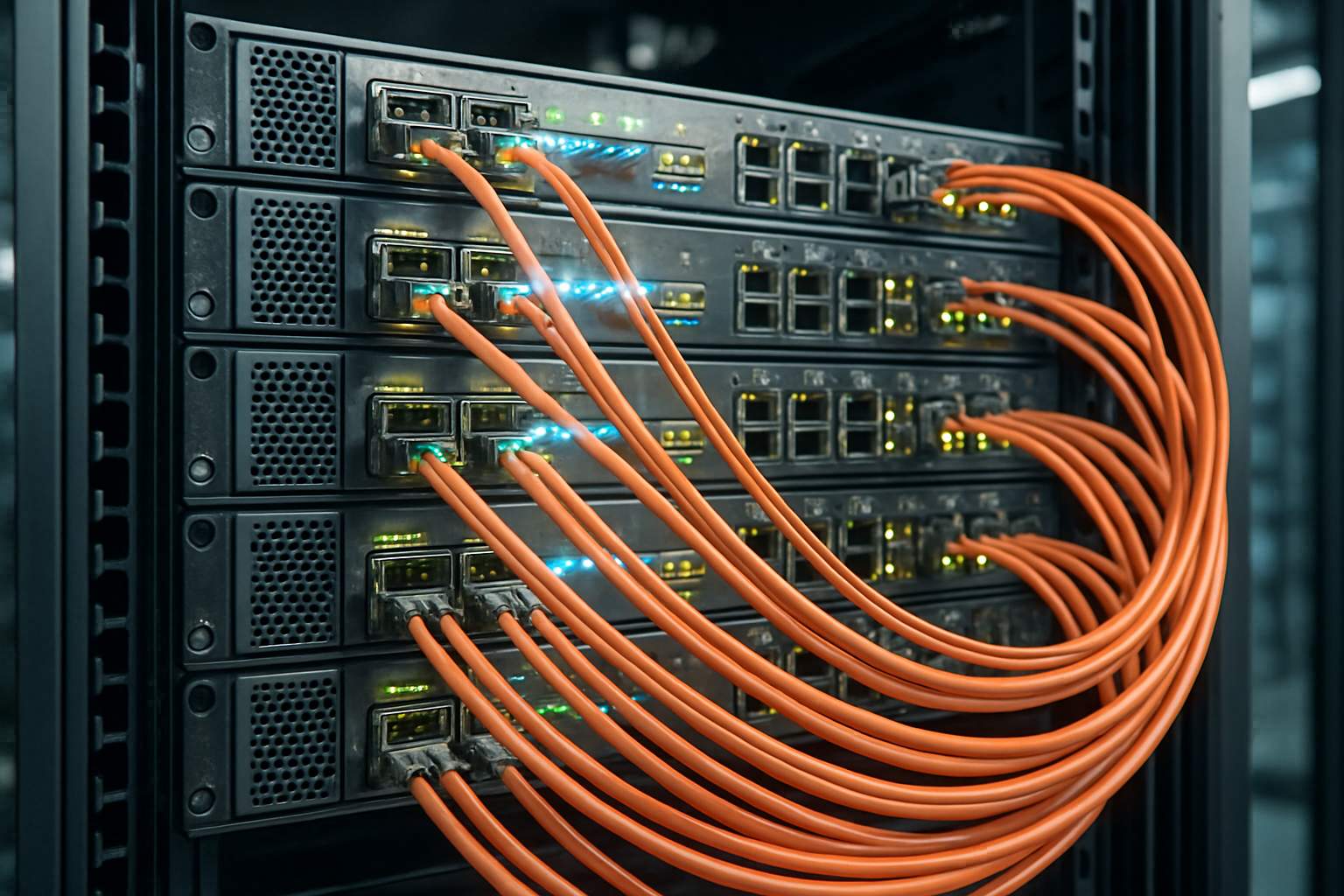
The vendor positions CopperEdge silicon squarely within this surge. Additionally, partner Amphenol displayed a 1.6T OSFP active copper cable leveraging the GN8234. The live setup transmitted 224G PAM4 lanes across three meters without errors. In contrast, comparable DSP cables consumed nearly ten watts per end under similar conditions. Such efficiency advantages reinforce buyer interest and accelerate qualification efforts.
CopperEdge momentum mirrors escalating bandwidth demand across AI clusters. However, engineers must grasp underlying signal techniques before deploying. Consequently, the next section dissects the CopperEdge technology fundamentals.
CopperEdge Linear Tech Fundamentals
Redrivers amplify attenuated signals and apply equalization but skip full clock recovery. Therefore, latency stays far below retimer alternatives. Semtech’s GN8214 services four 112G lanes, enabling 800G active copper cables. Meanwhile, GN8224 and GN8234 double lane speed to 224G for 1.6T products. Power remains under two watts per cable end, drastically lowering rack thermals. Consequently, the devices underpin next-generation AI Interconnect Tech without DSP overhead.
Moreover, measured latency sits below 100 picoseconds, supporting tightly synchronized AI model training. CopperEdge integrates continuous-time linear equalizers and feed-forward filters to restore eye openings. Additionally, simple I2C controls allow firmware teams quick margin tuning. The absence of DSP blocks eliminates complex adaptation algorithms. Nevertheless, designers must validate channel insertion loss budgets carefully.
CopperEdge combines analog simplicity with performance suitable for AI fabrics. Consequently, power and latency metrics remain unmatched among short-reach electrical links. The following section explains workload benefits and operational savings.
Benefits For AI Workloads
Distributed training relies on rapid gradient exchanges across accelerator pods. Therefore, every nanosecond trimmed from interconnect latency accelerates convergence. Sub-100 picosecond delay from CopperEdge surpasses optical modules exceeding several nanoseconds. Additionally, reduced latency benefits inference pipelines needing tight service-level agreements.
Power margins often constrain AI server density more than silicon availability. CopperEdge consumes roughly 90% less power than DSP based AEC alternatives. Consequently, facilities can allocate extra watts toward GPUs instead of cabling overhead. Moreover, cooler cables ease airflow planning within dense OCP-style racks.
Cost factors also influence deployment choices. Active copper cables remain cheaper than optical transceivers at lengths below five meters. In contrast, optics dominate beyond those distances because attenuation grows rapidly. Nevertheless, many AI clusters place accelerators in adjacent racks, keeping runs short.
Lower power, minimal latency, and competitive cost give AI Interconnect Tech compelling workload value. However, competitive forces continue shaping the segment. Next, we assess shifting rival positions.
Competitive Landscape Overview Today
DSP based AEC vendors showcase adaptive equalization and longer reach. However, additional circuitry increases energy draw and latency. Co-packaged optics promise extreme bandwidth but demand board redesigns and new thermal strategies. Traditional Networking stacks often miss tuning options for 224G lanes. Moreover, linear pluggable optics attempt to balance simplicity with distance yet remain emergent.
The supplier emphasizes cooperation rather than confrontation. Furthermore, interop testing with Broadcom and Marvell switch silicon demonstrated clean eyes at 224G. Analyst coverage views such showcases as early but encouraging signs. Nevertheless, designers will insist on multi-vendor compliance reports before large procurement.
Market analysts view AI Interconnect Tech as an essential complement to optical rollouts. Competitive options each trade power, reach, and ecosystem maturity. Consequently, careful workload mapping informs optimal link selection. The deployment considerations section now explores integration details.
Deployment And Ecosystem Dynamics
Implementation starts with channel modelling to verify insertion loss under 28 dB. Additionally, designers should reserve space for OSFP heat-sink envelopes inside leaf switches. CopperEdge pinout aligns with popular host reference boards, simplifying layout. Meanwhile, cable vendors like Amphenol and Luxshare pre-qualify assemblies, easing inventory planning.
Power budgeting remains straightforward because each cable end peaks below two watts. Consequently, rack power models scarcely shift when swapping passive cables for active ones. Nevertheless, airflow maps should reflect connector fins and possible localized hotspots.
Moreover, several practical checkpoints streamline successful rollouts.
- Verify 112G or 224G host SerDes equalization presets
- Run pre-production BER sweeps across temperature corners
- Log power per lane during peak AI workloads
- Schedule interoperability sessions with switch vendors
Therefore, adoption of AI Interconnect Tech within hyperscaler pods progresses rapidly.
Addressing these steps minimizes surprise downtime during cluster scale-out phases. However, future standards will raise speeds again. We now examine anticipated roadmaps.
Future Roadmap Predictions Ahead
OIF and IEEE groups target 256G per lane specifications arriving later this decade. Consequently, vendors already prototype equalizers exceeding 40 GHz analogue bandwidth. Semtech engineers hint at scalable architectures compatible with upcoming SerDes rates. Moreover, ecosystem partners evaluate QSFP-DD migrations for mainstream enterprise switches.
Optical proponents argue copper will hit thermal walls beyond three meters at 256G. Nevertheless, short-reach rack connections could still benefit from linear enhancements. Additionally, cost pressure may delay ubiquitous optical adoption outside hyperscalers.
Roadmaps indicate fast, iterative innovation cycles for AI Interconnect Tech. Therefore, continual learning remains vital for infrastructure leaders. The closing section distills actionable insights.
Key Takeaways
Semtech’s CopperEdge redrivers showcase a powerful blend of simplicity, efficiency, and performance. Moreover, 1.6T active copper cables prove practical for rack-adjacent connections. Competitive DSP and optical solutions still hold advantages at longer distances. Consequently, architects should match link technology with workload locality and thermal budgets.
Additionally, professionals can enhance expertise with the AI Network Security™ certification. The curriculum covers securing high-speed fabrics alongside protocol fundamentals. In contrast, vendor whitepapers rarely address holistic governance.
Ultimately, AI Interconnect Tech success depends on measured evaluation plus sustained education. Consequently, now is the moment to audit strategies and pursue upskilling.
This discussion traced demand drivers, core technology, benefits, competition, deployment, and roadmaps. Therefore, readers should now grasp practical criteria for selecting Semtech’s CopperEdge or rival links. Nevertheless, specifications evolve quickly, warranting periodic reassessment. Meanwhile, dedicated certification study ensures teams stay ahead of compliance and security mandates. Act today and build resilient, high-performance AI fabrics that scale confidently. Consequently, embracing AI Interconnect Tech positions enterprises for data growth surges.


