

AI CERTs
13 hours ago
Resilient AI Challenge boosts Global Safety Partnership efforts
The India AI Impact Summit in New Delhi set an ambitious tone for 2026. During the opening plenary, UNESCO unveiled the Resilient AI Challenge backed by the Global Safety Partnership. Consequently, industry leaders from France, India, and beyond pledged support. Moreover, policymakers highlighted Ethics, Science, and Education as guiding pillars. The initiative seeks smaller, greener models that operate on limited hardware without severe accuracy loss. Therefore, researchers, startups, and universities now race to deliver breakthroughs that balance performance with energy use.
Stakeholders insist the programme matters. Energy costs restrict advanced AI in many regions. Nevertheless, compressed models promise lower power draw and quicker deployment. This article explains how the challenge works, why the Global Safety Partnership matters, and what teams should know before entering.
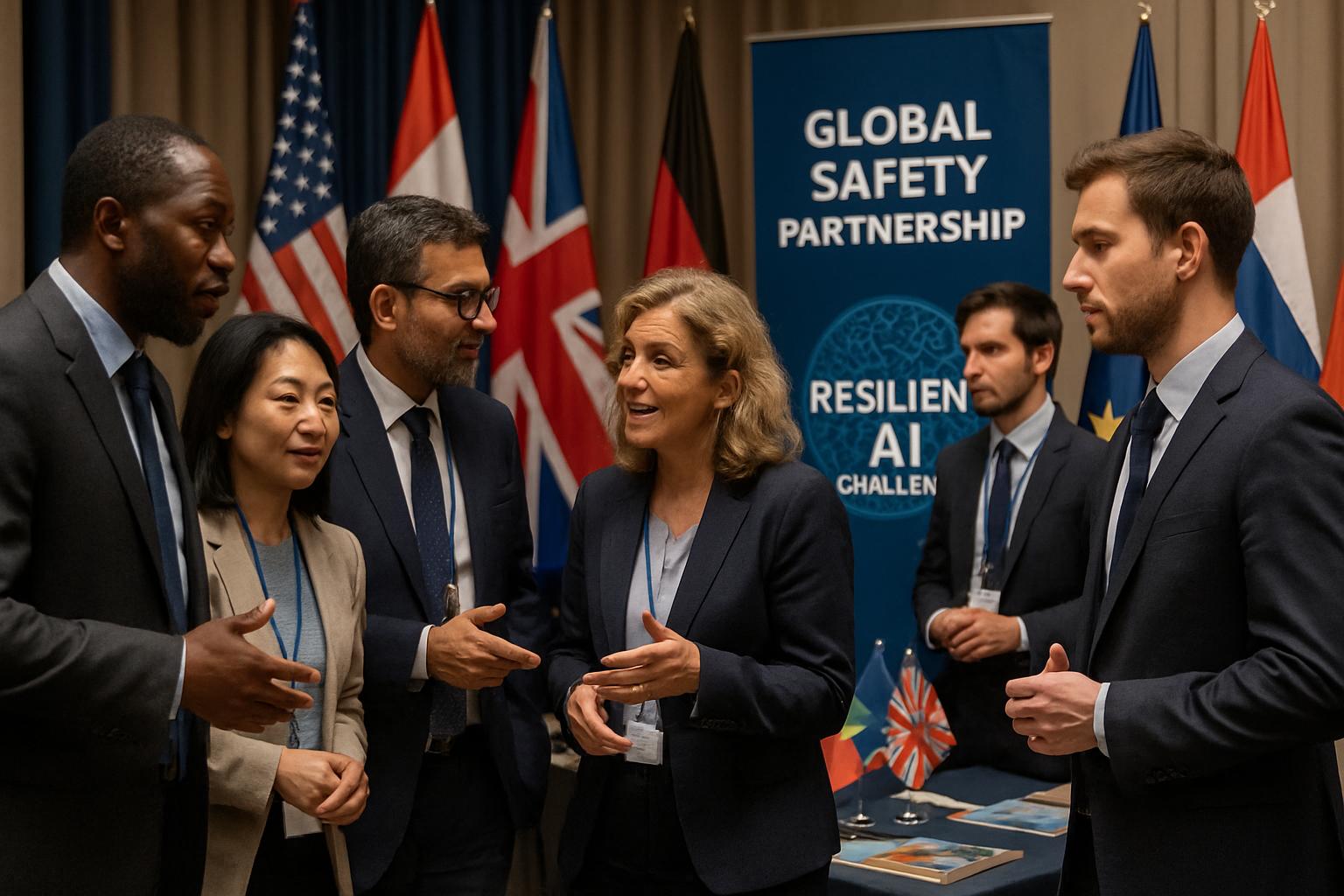
UNESCO Challenge Launch Overview
UNESCO announced the competition in February 2026 alongside the governments of India and France. Additionally, the Sustainable AI Coalition, ITU, Hugging Face, Mistral AI, and AIKOSHA signed on as technical supporters. The public slogan, “smaller footprint, bigger impact,” captured the event mood. Meanwhile, Tawfik Jelassi stressed that scale alone no longer defines progress; resilience does. Arthur Mensch echoed that sentiment, noting rising energy prices push businesses toward efficient models.
The registration window reportedly runs 20 February-20 March, with submissions due by 30 May. Winners will be honoured at the ITU AI for Good Summit in Geneva this July. However, organisers advise checking the official landing page once published.
In summary, the launch couples political backing with industry muscle. Consequently, participants gain a high-visibility stage to test ideas.
Objectives And Scope Explained
The challenge pursues two intertwined goals. First, it aims to cut inference energy dramatically through model compression. Second, it wants to keep benchmarks above predefined accuracy thresholds. Therefore, three tracks focus on distinct open-weight base models supplied by partners.
Teams must upload compressed variants under open-source terms. In contrast, many private contests allow proprietary entries. Organisers believe openness accelerates Education and reproducible Science. Furthermore, the rules prohibit marketing winners as universally “safe,” limiting any overblown claims.
Ultimately, the scope centres on measurable, task-specific performance. These boundaries keep evaluation practical yet transparent. Consequently, entrants know exactly what judges will test.
The section highlights clear, focused objectives. Nevertheless, broader issues like long-term safety live outside the contest frame.
Technical Evaluation Criteria Details
Evaluators rank submissions on two axes: accuracy and energy efficiency. Accuracy must exceed a public baseline, while energy must drop as much as possible. Moreover, organisers will release a hardware profile and power-measurement script at kickoff.
Consequently, engineering choices matter. Many teams will combine pruning, quantization, and knowledge distillation. Scientific Reports research shows these techniques can cut energy 7-32% on average. UNESCO quotes potential savings up to 90% in best-case scenarios, yet peer-reviewed data urges caution.
The Global Safety Partnership appears here as a governance umbrella. It ensures transparent scoring and aligns results with international Ethics norms.
Compression Methods In Focus
Competitors often follow a proven pipeline:
- Prune redundant parameters to induce structural sparsity.
- Apply INT8 quantization for memory and power reduction.
- Run knowledge distillation; DistilBERT retained 97% accuracy with 40% fewer weights.
- Fine-tune on challenge tasks using mixed-precision optimisers.
Professionals can deepen their risk skills with the AI Security Level 2™ certification. Moreover, certification evidence may reassure stakeholders inside the Global Safety Partnership.
These methods deliver practical, measurable gains. Consequently, evaluation will spotlight real engineering, not purely theoretical advances.
Benefits And Limitations Discussed
Efficient models bring multiple advantages. Firstly, energy savings lower carbon footprints, addressing critical Ethics concerns. Secondly, reduced latency improves user experience on edge devices. Thirdly, open licenses expand Education access, letting students study real weight files.
Nevertheless, limitations persist. The assessment covers one task per track, so generalisation remains uncertain. Moreover, open weights could enable misuse if safeguards lag. The Global Safety Partnership therefore stresses post-contest audits.
Key pros and cons stand clear after this review. However, understanding their trade-offs helps teams craft balanced submissions.
Global Equity And Access
UNESCO positions the challenge within a wider equity agenda. Many nations lack data-centre capacity, yet local problems demand tailored AI. Consequently, compressed models permit deployment on affordable hardware. Emerging researchers from France, Kenya, and Peru can thus experiment within realistic budgets.
Furthermore, Education ministries may embed lightweight models into classroom tools. Science outreach groups could run language models offline in remote labs. Meanwhile, civil-society watchdogs urge continued vigilance on bias and misuse.
This equity lens connects technical goals with social outcomes. Therefore, the Global Safety Partnership anchors efficiency within broader human priorities.
Next Steps And Deadlines
Prospective teams should monitor UNESCO’s press feed for the final ruleset. Subsequently, they must register by the March deadline and accept hosting terms on Hugging Face or AIKOSHA. During March-May, teams iterate models, log energy metrics, and prepare documentation.
After submission, an expert panel runs reproducibility checks. Consequently, winners travel to Geneva for the award ceremony. They will also pitch solutions to partner companies, including Mistral AI. However, they cannot claim broader certification beyond stated metrics.
These logistical steps close the preparation loop. Consequently, timely planning boosts each entrant’s chance of success.
Conclusion
The Resilient AI Challenge marries practical innovation with principled oversight. Moreover, its ties to the Global Safety Partnership guarantee transparent scoring and ethical framing. France, India, and UNESCO collectively spotlight Science, Education, and Ethics as non-negotiable priorities. Efficient compression techniques promise power savings without crippling accuracy, yet ongoing audits remain essential. Consequently, AI professionals should track outcomes and consider earning the linked certification to strengthen credentials. Join the conversation and help steer resilient AI toward shared benefit.


