

AI CERTs
3 hours ago
Tech Scramble: Dubai Offices Shutter as Gulf Conflict Hits Cloud
Shell fragments lit Dubai’s dawn on 1 March 2026. Consequently, regulators, employers, and cloud operators responded within hours. The sudden strikes dragged the emirate into a regional Tech Scramble, testing continuity promises. Investors watched screens blank when the capital markets halted. Meanwhile, data centre alarms confirmed a fire inside an Amazon Web Services zone. Corporate flight desks rerouted staff as Geopolitics trumped business-as-usual. Such Disruption exposed weak links across finance, retail, and cloud workloads. This article unpacks events, impacts, and early lessons for resilient leadership.
Conflict Sparks Office Exodus
On 28 February, Iranian missiles targeted Gulf cities, including Dubai. However, United Arab Emirates defences intercepted most projectiles, leaving debris hazards. UAE’s Ministry of Human Resources urged remote work from 1 to 3 March. Major banks, hedge funds, and tech firms evacuated or shifted to home offices amid the Tech Scramble. Moreover, Apple and luxury groups closed flagship stores along Sheikh Zayed Road.
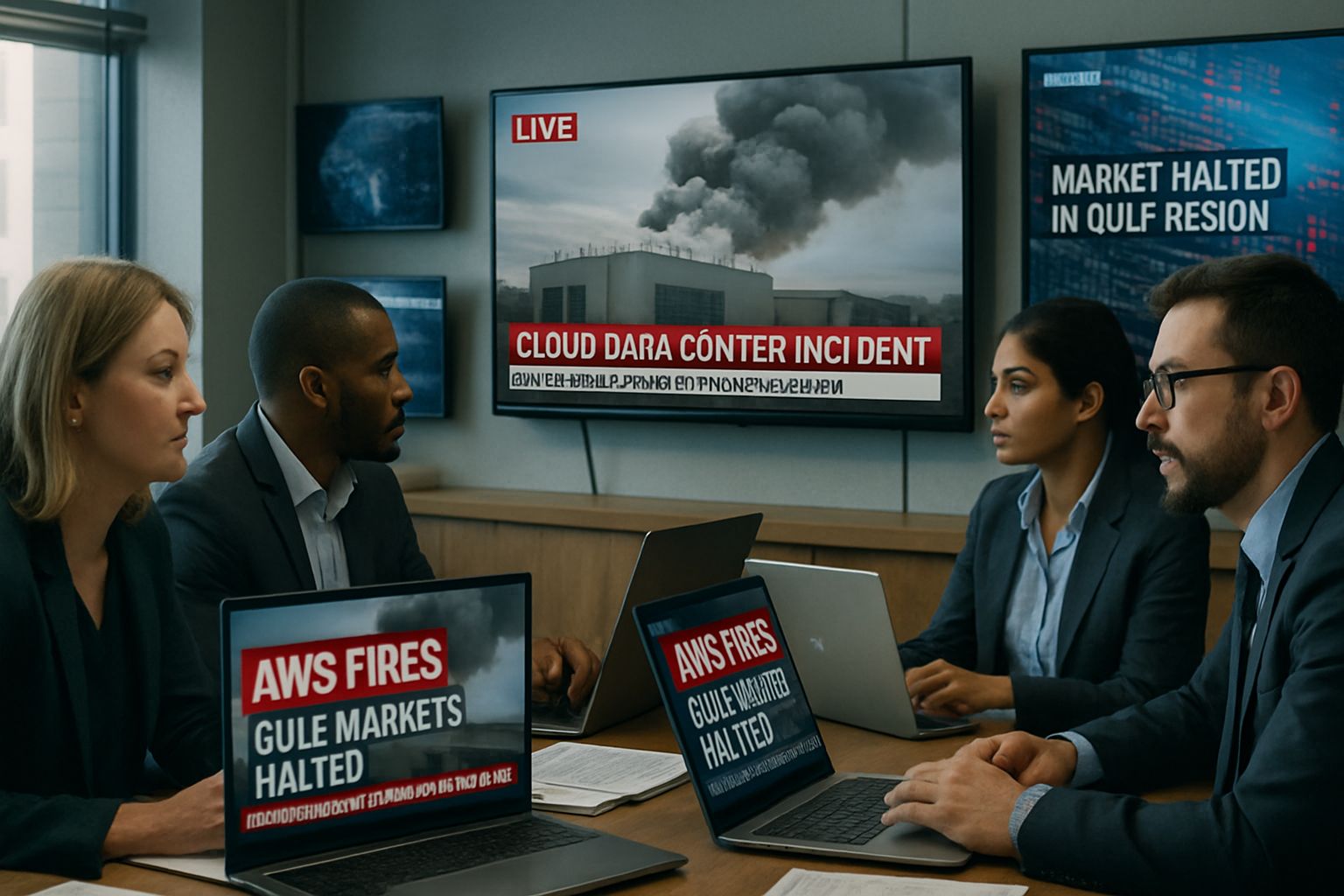
Citigroup, Goldman Sachs, and JPMorgan activated shelter protocols within DIFC towers. Nevertheless, internal memos reassured clients of uninterrupted trading via offshore desks. Brevan Howard and Millennium booked hotel floors outside exposed districts. In contrast, some local startups maintained skeleton crews for critical operations.
Companies prioritized safety over revenue during the initial shock. Consequently, remote operations proved viable under fire.
Attention soon shifted toward the wounded cloud stack.
Cloud Infrastructure Under Fire
At 04:30 PST on 1 March, objects struck AWS Availability Zone mec1-az2. Sparks ignited insulation; fire crews cut power to contain flames. Therefore, Amazon status pages warned of degraded EC2, EBS, and RDS performance. Thousands of regional workloads stalled, despite multi-AZ architectures. Moreover, latency spiked as traffic moved toward Frankfurt and Mumbai regions. This cloudfront of the Tech Scramble pushed DevOps teams into crisis rooms.
Key technical facts include:
- Interception debris damaged cooling units, according to Amazon engineers.
- Outage lasted roughly six hours before phased recovery.
- Customers without cross-region failover faced complete downtime.
- Security teams still assess hardware contamination.
Consequently, CTOs debated physical risks once considered negligible for cloud computing. Geopolitics now influences data residency decisions and insurance premiums. Nvidia GPU clusters used for AI inference also went offline, delaying model serving. Such Disruption highlighted the flaw of single-region AI pipelines.
The cloud incident turned abstract war into burnt silicon reality. Therefore, resilience planning entered board agendas immediately.
Markets mirrored this urgency the following morning.
Markets Freeze Trading Activity
The UAE Capital Market Authority suspended ADX and DFM sessions on 2 March. Regulators cited safety, liquidity, and settlement concerns. Furthermore, price limits and extended clearing windows featured in the reopening plan. BlackRock and local brokers rerouted orders through London to maintain positions. Nevertheless, volumes stayed thin because many counterparties lacked risk appetite.
ADX carried roughly AED 2.9 trillion in market cap before the pause. DFM valuations sat near AED 907 billion. Over two silent days, regional turnover lost an estimated AED 4.2 billion.
Analysts framed the pause as another chapter in the Tech Scramble narrative. In contrast, some argue the freeze boosted credibility by avoiding panic selling. Geopolitics once again intersected with circuit breakers and algorithmic liquidity. Disruption spread beyond code into investor psychology.
Trading halts bought time for stress tests. Consequently, orderly reopening became the next milestone.
Travel networks meanwhile faced their own crises.
Logistics And Travel Paralysed
Emirates and Etihad grounded flights through 3 March amid airspace uncertainty. Consequently, regional cargo volumes fell sharply, delaying Nvidia GPU deliveries for cloud expansions. Cruise missile debris struck near Jebel Ali port, forcing temporary berth closures. Moreover, five-star hotels reported occupancy drops as conference delegates cancelled stays.
Retail tourists vanished from Dubai Mall corridors during the Tech Scramble weekend. Apple and Gucci storefronts stayed dark, reducing foot traffic by 80 percent. Nevertheless, police patrols reassured remaining residents with visible checkpoints.
Transport stalls amplified supply chain pain. Therefore, companies recalibrated logistic forecasts.
Next, executives reassessed broader strategic risk.
Firms Reassess Regional Risk
Boardrooms held emergency calls evaluating Gulf exposure and insurance clauses. Furthermore, several hedge funds explored remote hubs in Oman and Qatar. Amazon teams accelerated multi-region replication of customer workloads. Nvidia partners considered alternate warehousing outside missile range. Meanwhile, family offices debated diversifying assets into Singapore shelters.
Analysts labelled this phase a deepening Tech Scramble for operational optionality. Geopolitics has reshaped cost-benefit equations once dominated by tax efficiencies. Disruption now factors into every new headcount request. Consequently, demand for crisis-tested talent is rising.
Risk committees widened scenarios beyond cyber and pandemic. Broadening scope improves preparedness yet inflates budgets.
Technology stacks must evolve with equal vigor.
Strategic Shifts And Redundancy
Cloud architects adopted multi-cloud plans combining Amazon, Microsoft, and regional providers. Moreover, containerised microservices eased quick failover across safe zones. Nvidia GPU allocation policies added redundancy by spreading clusters. In contrast, legacy monoliths struggled with stateful data migration.
Emerging best practices include:
- Store nightly snapshots outside conflict regions.
- Map critical users to alternative VPN gateways.
- Deploy real-time interception alerts into SOC dashboards.
- Run quarterly war-gaming with executive participation.
Professionals branded the initiative the Infrastructure arm of the Tech Scramble. Consequently, vendor contracts now feature explicit kinetic-risk clauses. Regional security appears in board minutes as a standing agenda item. Disruption management budgets grew by double digits year-on-year.
Operational resilience became a differentiator, not a checkbox. Therefore, talent development gained urgency.
Certification pathways offer structured upskilling.
Certification Path For Leaders
Crisis leadership hinges on cross-disciplinary fluency. Furthermore, program managers must translate risk scenarios into actionable sprints. Professionals can deepen skills with the AI Project Manager™ certification. The course covers continuity frameworks, data governance, and stakeholder communication. Meanwhile, alumni join peer networks gaining first-hand war-room insights.
Such structured learning aligns perfectly with the continuing Tech Scramble demands. Consequently, certified leaders command premium compensation in volatile markets.
Upskilling converts uncertainty into opportunity. Therefore, ambitious managers should act promptly.
The broader picture still warrants reflection.
Conclusion And Outlook
Dubai’s latest crisis fused missiles, markets, and microchips into one narrative. Consequently, the Tech Scramble exposed hidden dependencies across finance and technology. Geopolitics now informs every architectural diagram and treasury model. Amazon outages, Nvidia shortages, and trading halts delivered expensive reminders. Nevertheless, decisive action by regulators and engineers limited long-term damage. Firms embracing redundancy, talent development, and certifications will exit the Tech Scramble stronger. Act now—audit risk maps, update runbooks, and explore the highlighted certification to safeguard growth.


