

AI CERTS
4 hours ago
Military Autonomy: Generals Push for Autonomous Weapons
This article dissects their push and the guardrails shaping it. It also reviews market forces pulling in both directions. Moreover, we explore the ethical debate around lethal AI and necessary human oversight. Finally, we outline how the updated Pentagon policy attempts to balance innovation and accountability. Readers gain a structured view of emerging weapon systems, oversight trends, and critical investment signals.
Therefore, defense professionals can plan strategies, partnerships, and career paths with greater confidence. Meanwhile, certification programs can sharpen technical readiness for this accelerating domain.
Generals Demand Faster Adoption
Lt. Gen. Charlie Costanza opened the AUSA panel with stark honesty. He stated, “We’re behind,” and silence filled the auditorium. Furthermore, Brig. Gen. Travis McIntosh echoed that urgency, calling command-level drone tasking the next threshold.
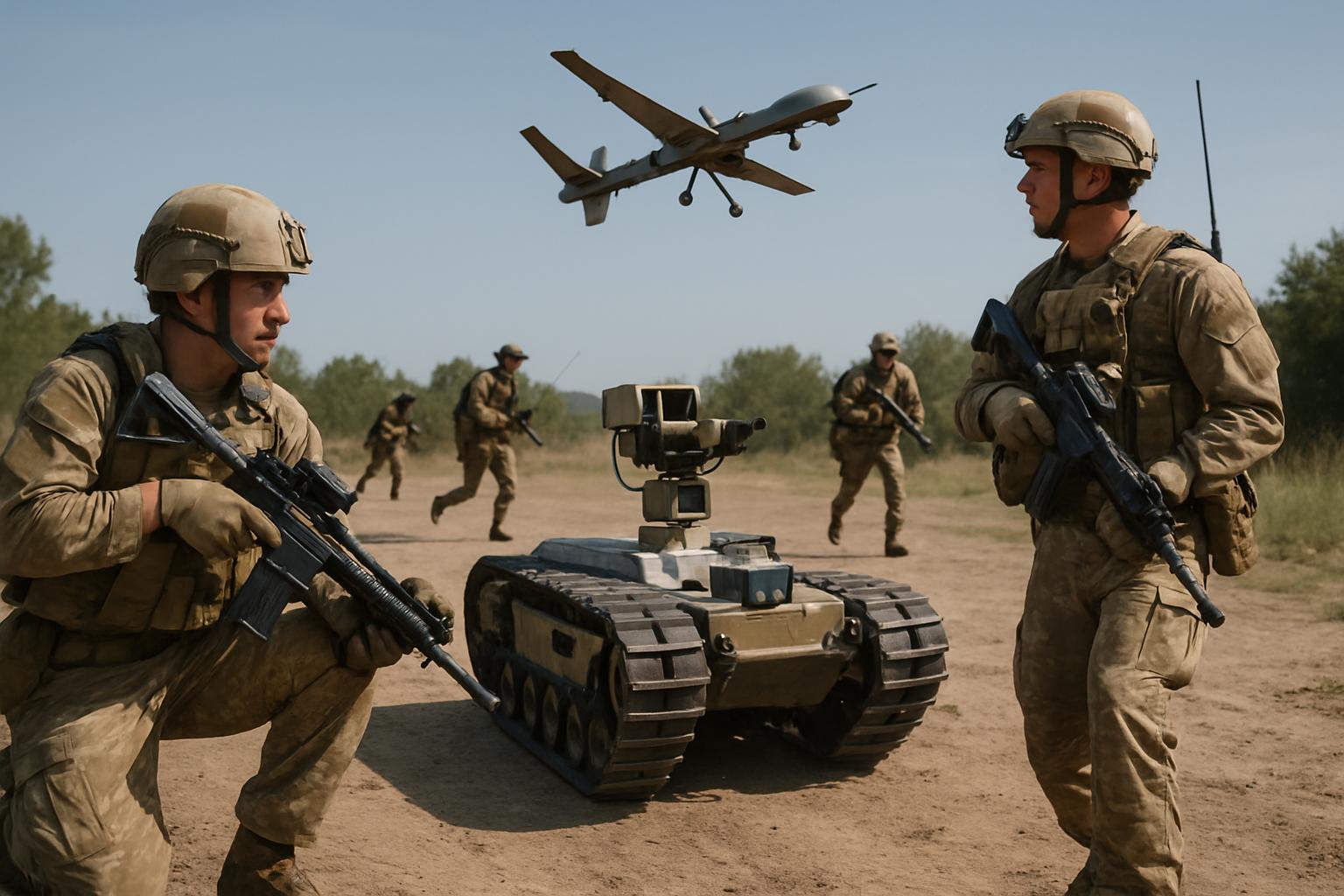
Field data supports their alarm. Current platoons require four soldiers to operate one surveillance drone. Consequently, scarce operators limit sortie rates during extended missions. Generals argue that higher Military Autonomy will collapse that ratio and release manpower for maneuver.
Commanders therefore view autonomy as both shield and sword. However, lessons learned overseas sharpen that argument for rapid fielding, which we examine next.
Ukraine Lessons Drive Urgency
The Ukraine conflict supplies vivid case studies for American planners. Small, networked swarms have destroyed armor, artillery, and logistics within minutes. In contrast, manned responses often arrive too late to matter.
Analysts note three tactical insights that dominate Army war-games:
- Cheap autonomous drones saturate defenses and overwhelm electronic warfare.
- Distributed operators survive longer when AI handles navigation and targeting suggestions.
- Attritable robots create strategic depth by absorbing early fire.
Moreover, these patterns convince generals that Military Autonomy enables both mass and resilience. Yet copying Ukraine without tailored doctrine could prove dangerous, as governance constraints remain.
Urgency thus meets regulatory friction. The following section explains how Pentagon policy moderates the rush toward lethal AI.
Governance And Review Barriers
DoD Directive 3000.09 anchors autonomy governance across the department. Updated in 2023, the directive mandates senior legal, technical, and operational reviews. Additionally, Congress now demands annual unclassified reports on approved lethal autonomous weapon systems.
Consequently, program managers must document testing rigor, fail-safes, and human oversight protocols before deployment. Approval gates slow fielding timelines, although waiver clauses permit expedited combat evaluations. Nevertheless, only top civilian leaders may grant such waivers for lethal AI.
Transparency remains partial. DefenseScoop notes that many waiver details stay classified despite new reporting rules. Therefore, external analysts struggle to track which weapon systems already operate overseas.
Governance gates are necessary, yet they frustrate Military Autonomy proponents on front lines. Industry’s stance further complicates the equation, as the next section reveals.
Industry Support And Resistance
Prime contractors, startups, and cloud giants fill today’s Military Autonomy supply chain. General Dynamics, Lockheed Martin, and Raytheon pitch modular drone brains and robotic turrets. Moreover, venture-funded firms deliver perception stacks that integrate with open mission architecture.
However, several commercial AI labs refuse unrestricted military use clauses. Anthropic’s February 2026 standoff with the Pentagon highlighted that divide. The firm rejected contractual terms it viewed as conflicting with stated safety commitments. Meanwhile, Pentagon policy insists suppliers enable lawful combat deployment when funded by defense dollars.
Consequently, some frontier models stay out of classified projects, slowing Military Autonomy integration. Professionals may validate expertise through the AI Security Level 3 certification.
Supplier alignment therefore remains uncertain. Ethical debates over human oversight intensify that uncertainty, as we explore next.
Ethics Demand Human Control
Human Rights Watch warns that autonomous strikes risk violating distinction and proportionality. In contrast, Army leadership argues that human oversight within kill chains will persist. DoD categorizes involvement as in-the-loop, on-the-loop, or out-of-the-loop.
Critics counter that algorithmic bias could still lead lethal AI toward unlawful targeting. Moreover, contested electromagnetic environments may block abort commands, removing human brakes completely.
Consequently, policy analysts recommend redundant communication links and bounded decision envelopes. Such technical measures support Pentagon policy while reassuring skeptical legislators.
Ethical guardrails thus influence engineering roadmaps. We now examine fiscal realities shaping those roadmaps.
Budget Markets And Forecasts
Funding momentum accompanies rhetoric. DoD allocated several hundred million dollars to AI acceleration pilots during FY2025. Moreover, market analysts estimate a 20-billion-dollar autonomous military weapons market this year.
Forecasts project double-digit compound growth through the 2030s. Consequently, primes and venture funds race to capture share with modular weapon systems and enabling software. However, congressional oversight could redirect budgets toward projects with verifiable human oversight metrics.
Capital flows for Military Autonomy therefore hinge on credibility and compliance. Balancing speed with responsibility becomes the decisive leadership challenge, our final section explains.
Balancing Speed And Responsibility
Army generals hope to accelerate prototypes through Human-Machine Integrated Formations. Meanwhile, OSD lawyers safeguard treaty obligations and Pentagon policy consistency. Successful programs will meet four overlapping tests:
- Deliver operational advantage over peers.
- Embed fail-safe human oversight controls.
- Pass Directive 3000.09 review boards.
- Scale within realistic budget ceilings.
Consequently, Military Autonomy advocates stress iterative field experiments paired with guarded release gates. Moreover, transparent communications with Congress should preempt future funding cuts. Therefore, joint doctrine writers are drafting updated Military Autonomy tactics for brigade training.
Strategic alignment across developers, commanders, and lawmakers will decide the pace ahead. Nevertheless, engineering brilliance alone will not answer the moral questions still looming.
Conclusion And Next Steps
Military Autonomy momentum is undeniable, yet governance remains the decisive throttle. Generals demand faster drones, technologists pursue lethal AI, and legislators refine Pentagon policy safeguards. Consequently, future programs must prove tactical value while honoring rigorous human oversight standards. Industrial partners that deliver compliant weapon systems will capture rising budgets and strategic influence.
Readers seeking advantage should pursue the linked AI Security Level 3 certification. Additionally, follow congressional reports to track approved autonomous deployments. Act now to align skills, policies, and investments with the next generation of AI-enabled defense.


