

AI CERTS
2 months ago
Burger King AI Sparks Workplace Surveillance Concerns
Yet the detail grabbing public attention is Patty’s ability to flag whether staff say "please" or "thank you". Therefore, questions about Workplace Surveillance, privacy, and labor law dominate the discussion. This article examines the pilot scope, technical design, benefits, risks, and next steps for industry leaders. Along the way, we explore how soft skills measurement intersects with fast-food competition. Consequently, ethical deployment guidance grows urgent for technology teams and franchise operators alike.
AI Headset Pilot Scope
Burger King began testing Patty in roughly 500 United States restaurants during late February 2026. Meanwhile, a smaller drive-thru Chatbot pilot runs in fewer than 100 sites. RBI plans national deployment of BK Assistant by year-end 2026, potentially touching thousands of franchises. Moreover, the parent group operates about 33,000 outlets worldwide, highlighting the experiment’s global implications.
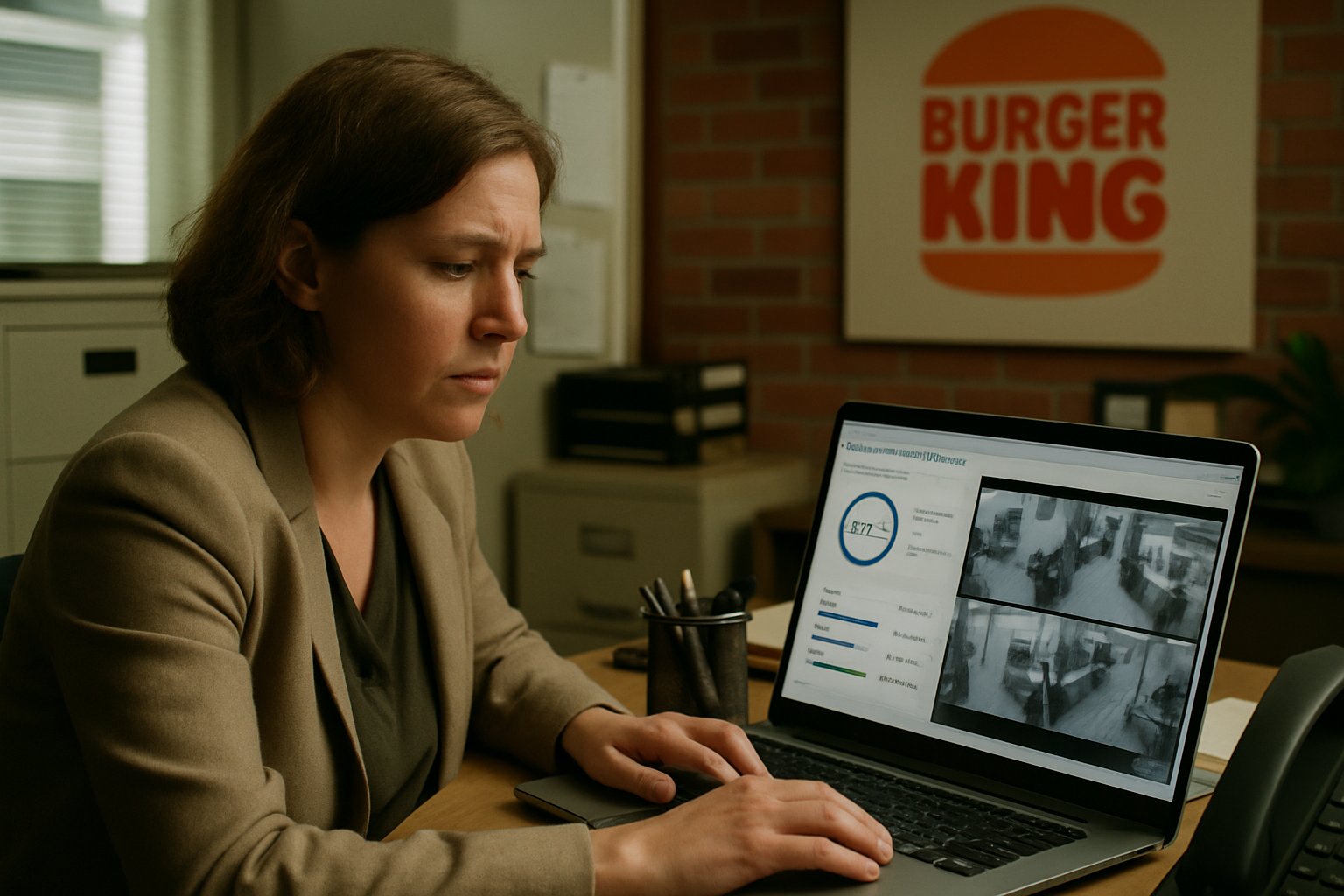
Managers receive headset hardware, cloud connectivity, and a dashboard showing live operational metrics and friendliness signals. Consequently, pilot locations supply early data on service speed, order accuracy, and keyword frequency. Initial feedback, according to RBI, remains positive from both franchisees and customers. Nevertheless, privacy advocates warn the rollout normalises Workplace Surveillance across quick-service restaurants.
The pilot already spans a significant footprint. Early numbers suggest swift scalability and strategic priority. However, understanding Patty’s technical core is essential before judging outcomes.
How Patty System Works
Patty combines speech recognition with natural language understanding to transcribe customer-crew exchanges in real time. Subsequently, keyword detectors search transcripts for hospitality phrases such as "welcome", "please", and "thank you". Detected counts feed a numeric friendliness indicator visible to managers on a cloud dashboard. In contrast, inventory alerts flow from the point-of-sale integration, removing out-of-stock items across channels within 15 minutes. The voice layer relies on an OpenAI foundation model, though Burger King has not shared retention details.
Additionally, Patty offers recipe guidance and equipment notifications, acting like a Chatbot for kitchen queries. Therefore, employees can resolve issues without leaving their stations, potentially boosting Soft Skills through faster collaboration. Monitoring noise filtering and accent diversity remains an open engineering challenge acknowledged by RBI engineers. Consequently, misclassification risks could undermine fairness if metrics ever influence HR decisions. Experts note that every transcript adds another layer of Workplace Surveillance difficult to reverse once established.
Patty’s architecture blends speech analytics with operational databases. Such linkage delivers convenience yet expands data collection breadth. Next, we weigh the promised advantages against emerging tradeoffs.
Benefits And Tradeoffs Discussed
Burger King pitches Patty as an efficiency engine. Moreover, real-time inventory syncing reduces guest frustration from unavailable items. Recipe prompts can preserve quality during turnover or staff shortages, supporting consistent Soft Skills delivery. Managers also gain aggregated friendliness trends, encouraging praise rather than reactive criticism.
Nevertheless, Workplace Surveillance worries overshadow many technical wins for worker advocates. Continuous Monitoring may heighten stress and erode trust, especially when metrics feel opaque. Bias can creep in if speech models misinterpret accents, producing unfair HR outcomes.
- Faster menu updates across mobile, kiosk, and drive-thru
- On-headset Chatbot style recipe assistance
- Shift-level friendliness dashboards for coaching
In contrast, legal scholars warn that aggregated data often migrates toward individual scoring over time. Consequently, policy design matters as much as algorithm design.
Patty could streamline service and highlight positive behavior. Yet unresolved fairness questions cloud the upside. To unpack those questions, we turn to the evolving regulatory landscape.
Legal Risk Landscape Overview
U.S. law permits audio Monitoring generally, yet multiple states impose disclosure or consent obligations. However, the National Labor Relations Board cautions that algorithmic tracking must not chill collective activity. General Counsel Jennifer Abruzzo’s 2022 memo explicitly flags overly broad Workplace Surveillance as a potential unfair practice. Subsequently, employers must tailor systems narrowly, keep retention minimal, and involve workers in design.
State privacy bills in California, Illinois, and New York propose impact assessments before new data tools hit restaurants. Moreover, unions like the AFL-CIO demand written guarantees that Soft Skills metrics cannot trigger discipline without human review. Failure to comply may expose franchises and HR departments to fines or litigation.
Regulators now scrutinize algorithmic listening with growing intensity. Compliance therefore requires transparency, minimisation, and bargaining. Industry proponents still highlight scale advantages despite these hurdles.
Soft Skills Debate Intensifies
Service researchers argue genuine warmth cannot be forced through scripts alone. Nevertheless, aggregated reminders may nudge courteous language without punishing individuality. Burger King digital chief Thibault Roux insists Patty remains a coaching aid, not a scorecard. Furthermore, he states that keyword data represents only one of many operational signals.
Critics counter that even aggregate dashboards influence behaviour because crews know Workplace Surveillance exists. Subsequently, employees might prioritise set phrases over authentic engagement, ironically weakening Soft Skills quality. Academic studies link constant audio Monitoring to cognitive overload and higher turnover in call centres. Therefore, pilot results should track retention and health indicators, not just courtesy rates.
The politeness project evokes mixed reactions from scholars and staff. Supporters and critics frame authenticity as the central measure. Business leaders still want clarity on rollout timelines and investment returns.
Future Rollout Plans Detailed
RBI targets national installation of BK Assistant by December 2026. Moreover, executives promised investors eight percent annual operating income growth partly enabled by automation. Patty’s current hardware costs remain undisclosed, yet franchisee committees reportedly guide procurement decisions. Consequently, adoption pace may vary across markets depending on cost sharing and labour negotiations.
International expansion will depend on speech models handling local accents and privacy law variance. In contrast, competitors like McDonald’s and Yum Brands refine similar Chatbot ordering pilots, intensifying the race. Therefore, Burger King faces strategic pressure to prove that its Workplace Surveillance yields measurable guest satisfaction gains.
Management has set an aggressive calendar for scaling Patty. Competitive dynamics will judge success as much as technology. Given these stakes, executives must prepare practical action plans.
Actionable Leader Steps Recommended
Executives overseeing similar projects can follow a structured checklist. Firstly, map data flows end-to-end and document legal grounds for each collection.
- Conduct privacy impact assessments with HR and legal counsel
- Engage frontline staff early to set Soft Skills goals
- Limit audio retention and provide opt-out mechanisms
- Track health metrics alongside Monitoring indicators
- Invest in upskilling through the AI Executive Essentials™ certification
Furthermore, leaders should benchmark models for accent performance before deployment to minimise bias. Nevertheless, explainability reports must accompany any Workplace Surveillance metric shared with managers. Subsequently, periodic audits can verify that friendliness numbers remain detached from payroll or disciplinary files. Finally, share anonymised insights with franchisees to foster continuous improvement without overexposing individuals.
These actions mitigate legal exposure and staff anxiety. Structured governance also builds consumer trust in AI experiences. The following conclusion distils overarching lessons from Burger King’s experiment.
Conclusion And Next Steps
Burger King’s Patty pilot illustrates how conversational AI can reshape frontline operations rapidly. However, benefits arrive bound tightly to Workplace Surveillance obligations and evolving labour regulations. Managers may gain sharper visibility, yet crew members shoulder fresh privacy and stress burdens. Consequently, balanced governance, open dialogue, and targeted coaching remain essential. Moreover, privacy-first design helps companies defend their reputations and relationships with HR teams. Leaders exploring similar projects should embed impact assessments and regular audits into strategy. Nevertheless, continuous training matters; professionals can deepen expertise through the linked executive AI certification. Ultimately, companies that respect human dignity while deploying Workplace Surveillance will harvest sustainable performance gains. Review the checklist, assess your own pilots, and enrol in advanced programs to lead responsibly.


