

AI CERTS
3 hours ago
AI Enhanced Jet Engineering Spurs Rolls Royce Funding Debate
Critics query why support follows record profits and a vast share buyback. Meanwhile, supporters stress that AI Enhanced Jet Engineering could anchor thousands of skilled jobs. This article unpacks the funding request, competitive context, and potential taxpayer returns. Moreover, it assesses political timelines and risk safeguards. Readers will gain a precise briefing tailored for boardrooms and policy circles.
Funding Request Sparks Debate
FT sources revealed the ask on 23 February 2026. Consequently, media widely repeated the £100–£200 million figure within hours. Rolls Royce framed the sum as a fraction of total UltraFan investment. Additionally, executives warned that production could migrate overseas without swift backing. In contrast, officials have not yet confirmed any formal offer.
The request is modest relative to project scale. Yet, its symbolism fuels public scrutiny. Next, the company’s strong profits intensify that scrutiny.
Strong Profits Raise Eyebrows
On 26 February, Rolls Royce posted £3.5 billion underlying operating profit for 2025. Furthermore, free cash flow reached £3.3 billion, and net cash stood at £1.9 billion. Subsequently, management announced a £7–£9 billion share buyback funded by soaring profits. Therefore, commentators question why affluent shareholders need taxpayer help. Nevertheless, the board argues capital returns remain compatible with strategic R&D support.
The healthy balance sheet complicates subsidy messaging. Political opponents will spotlight any perceived double standard. However, proponents counter with strategic industry arguments.
Strategic Industry Support Arguments
Supporters cite the narrow-body market’s massive growth potential. Moreover, AI Enhanced Jet Engineering promises double-digit fuel burn reductions versus current Trents. Consequently, winning Airbus or Boeing platforms could secure decades of export earnings. They claim over 40,000 UK jobs depend on capturing that opportunity. Additionally, rival engine makers often receive lavish US and French backing.
- GE Aerospace secured multi-billion US tax credits for advanced turbines.
- Safran benefits from recurring French R&D grants and low-interest loans.
- Pratt & Whitney obtained state incentives tied to geared turbofan factories.
Global Subsidy Benchmarks Compared
Analysts estimate GE received support equal to 15% of LEAP development expenditure. In contrast, Rolls Royce seeks roughly 3-6% of UltraFan programme costs. Additionally, European Union launch aid historically covered up to one third of airframe R&D. Therefore, the company argues its ask remains conservative.
Domestic suppliers would likely invest in advanced composites, gear systems, and additive manufacturing facilities. Furthermore, regional clusters around Derby could see significant spillovers into automotive and energy sectors. Industry association ADS forecasts a £27 billion export opportunity if UltraFan captures leading platforms. Therefore, modest public seed money could unlock substantial private capital, supporters argue.
Global precedents illustrate state involvement as commonplace. Level playing field claims therefore resonate with policymakers. However, taxpayer risk considerations cannot be ignored.
Taxpayer Risk Considerations Highlighted
Sceptics recall pandemic-era guarantees that socialised losses while preserving dividends. Moreover, aerospace remains carbon-intensive despite efficiency advances. Environmental groups demand strict conditions linking support to decarbonisation milestones. Consequently, Treasury officials explore equity warrants, job quotas, and domestic IP safeguards. Nevertheless, negotiations remain preliminary today.
Campaigners note that aviation still lacks a clear pathway to full decarbonisation by 2050. In contrast, hydrogen concepts remain embryonic and would demand separate infrastructure subsidies. Therefore, critics question whether backing gas turbines prolongs fossil fuel dependence.
Risk mitigation will shape any final package. Public perception hinges on visible safeguards. With stakes clear, attention shifts to process.
Approval Timeline And Nextsteps
Rolls Royce aims for an in-principle commitment within the first half of 2026. Meanwhile, the Business Secretary will scrutinise the business case alongside the Treasury. Subsequently, UK Export Finance could structure guarantees complementing a direct grant. Parliamentary committees may demand disclosure before funds flow. Therefore, a decision window of three to five months appears realistic.
- March 2026: Formal UltraFan case submitted.
- April 2026: Company AGM votes on buyback tranche.
- May 2026: Treasury risk review completed.
- June 2026: Potential ministerial approval announcement.
Meanwhile, union leaders lobby for binding employment guarantees covering both manufacturing and overhaul centres. Consequently, officials may tie support to minimum headcount thresholds and apprenticeship targets. Additionally, environmental clauses could mandate sustainable aviation fuel compatibility from entry into service. Such conditions would align the package with broader net-zero commitments.
Multiple checkpoints give politicians leverage for tough conditions. Yet, delay could push production offshore. Technical merits also weigh heavily.
AI Enhanced Jet Engineering
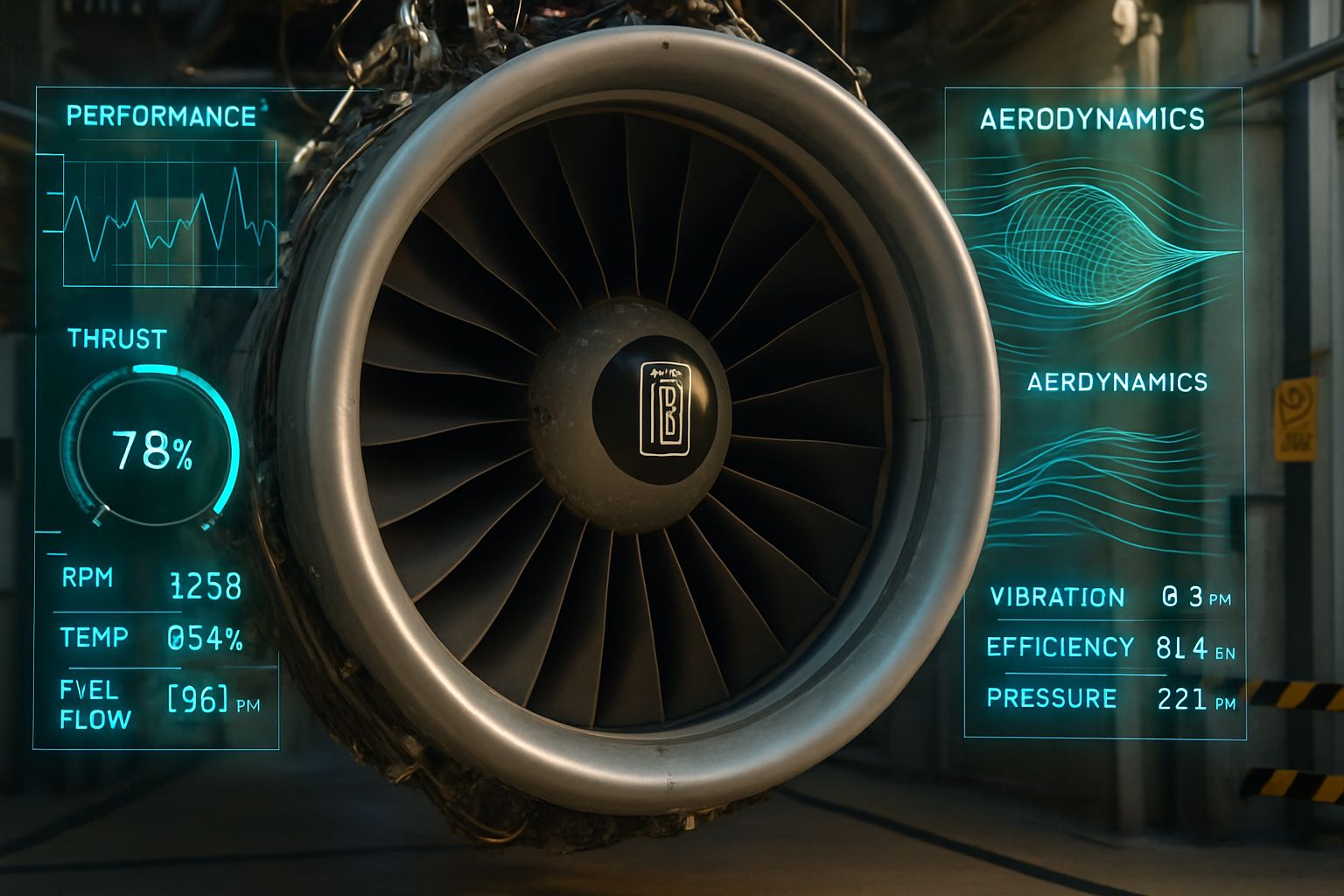
UltraFan relies on gear ratios, composite fan blades, and predictive analytics models. Furthermore, AI Enhanced Jet Engineering underpins those predictive models, optimising blade health in real time. In practice, AI Enhanced Jet Engineering processes thousands of sensor readings per second during testing. Consequently, engineers can adjust parameters immediately, shortening costly test cycles.
Moreover, AI Enhanced Jet Engineering helps simulate extreme conditions before hardware exists. These digital insights cut risk and capital expenditure for each physical prototype. Additionally, AI Enhanced Jet Engineering supports autonomous inspection drones inside the massive fan ducts. Therefore, maintenance intervals shrink, lowering lifetime operating costs for airlines.
Subsequently, AI Enhanced Jet Engineering enables digital twins that stress-test supply chain variability. Nevertheless, critics ask whether AI Enhanced Jet Engineering gains justify public money at this stage. Experts can validate these skills via the AI Project Manager™ certification.
Engineers also integrate quantum-inspired optimisation tools to refine turbine cooling passages. Moreover, cloud-based collaboration platforms allow global teams to iterate designs around the clock. These processes compress traditional development timelines by nearly 30%, according to internal projections.
Advanced analytics accelerate development and reduce lifecycle costs. These gains strengthen the strategic case for limited subsidy. Finally, stakeholders must weigh all factors holistically.
Rolls Royce’s UltraFan saga encapsulates the modern industrial dilemma. Strong profits meet fierce global competition and uncertain public appetite for subsidies. However, the underlying analytics and gear technologies could anchor a high-value domestic supply chain. Therefore, ministers will debate conditions, clawbacks, and equity stakes before signing any cheque.
Consequently, shareholders, workers, and taxpayers await clarity over the coming months. In contrast, overseas governments stand ready with chequebooks, intensifying the urgency. Meanwhile, technical leaders should prepare investment cases grounded in measurable societal value. Explore the certification link to stay informed and lead future aerospace programmes with confidence.


