

AI CERTs
1 month ago
Prompt Engineer Oversight: Laws Turn Prompts Into Audit Evidence
Europe's AI Act has turned a niche craft into a compliance hotspot. Consequently, organizations now treat prompts as auditable assets rather than disposable text fragments. This shift fuels a new discipline known as Prompt Engineer Oversight across regulated sectors. Furthermore, regulators demand traceability, logging, and risk evaluation for every interaction with generative models. Meanwhile, standards bodies reinforce the mandates with management frameworks and third-party audits. Developers, lawyers, and product teams must collaborate closely to avoid penalties reaching multimillion-euro levels. In contrast, firms ignoring the rules risk suspended deployments and damaged customer trust. Therefore, understanding the emerging oversight landscape is now a critical executive priority. This article unpacks the laws, standards, tools, costs, and career implications in plain detail. Additionally, it highlights training paths and certifications that prepare professionals for the new reality.
Global Oversight Landscape Evolves
The EU AI Act moved from draft to enforceable law within two years. Subsequently, prohibited uses became illegal on 2 February 2025, with high-risk obligations arriving in 2026. Moreover, the Act compels providers to store logs, document prompts, and monitor post-market performance continuously. Similar guidance from the United Kingdom and Canada mirrors these requirements, creating near-global expectations.
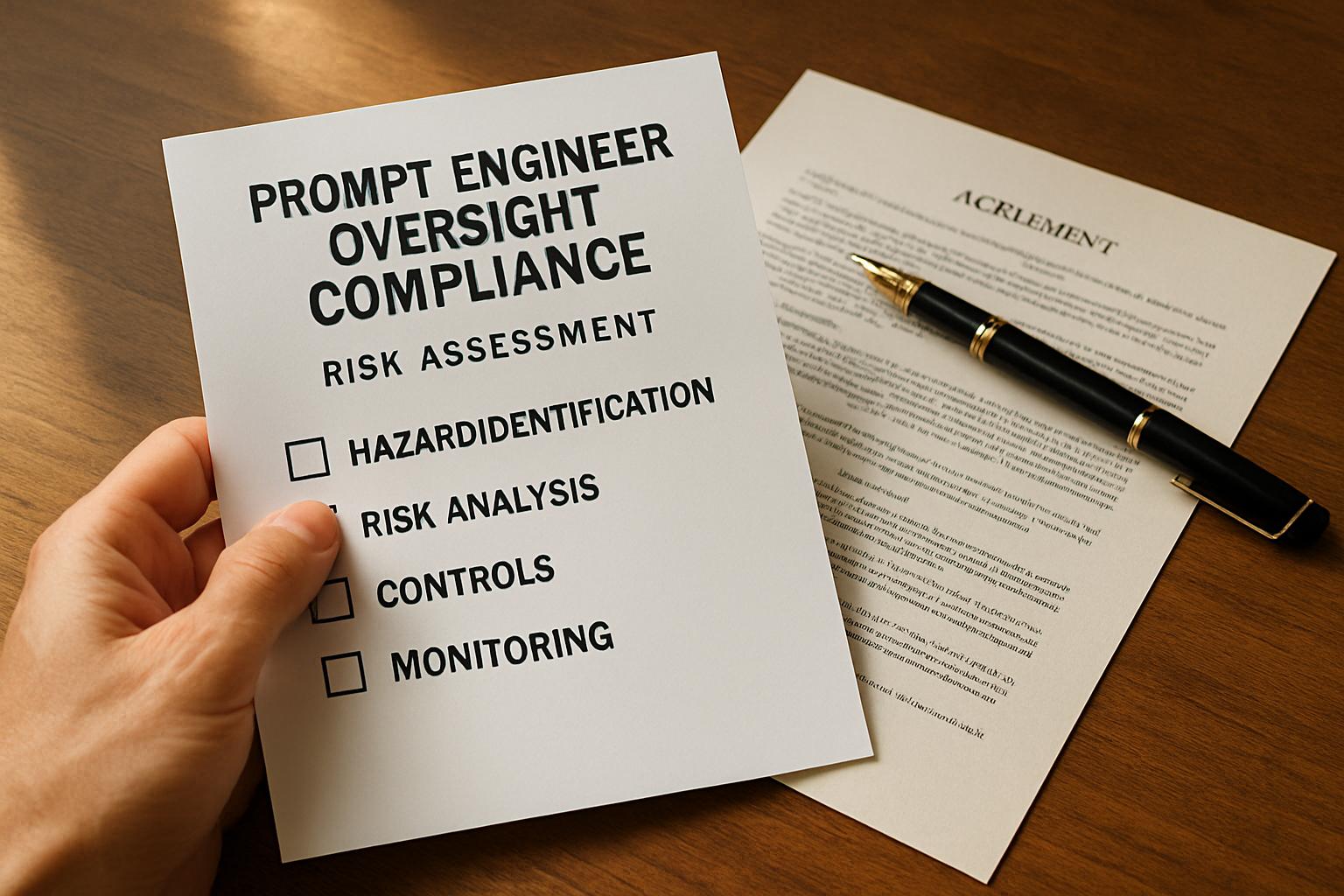
Prompt Engineer Oversight now sits at the heart of compliance evidence packages requested by auditors. Consequently, prompts, templates, and retrieval contexts must exhibit provenance, version history, and approval trails. Auditors also check that Red-teaming protocols detect Jailbreaking attempts before systems reach production. Security teams handle access controls, while risk officers apply impact classifications under the Act’s annexes.
Global rules cement prompt artifacts as regulated data. However, standards bodies now operationalize those rules more concretely.
Standards Cement Prompt Governance
ISO/IEC 42001 launched the first international AI management system standard in late 2023. Therefore, companies adopt it to prove structured governance and continuous improvement processes. The standard references access controls, logging retention, and documented risk registers for every prompt. Furthermore, certification auditors expect Red-teaming evidence demonstrating resilience against Jailbreaking and injection attacks. These controls bolster Safety and Security, satisfying insurance underwriters and procurement teams.
- Version control for system and user prompts.
- Immutable logs retained for at least six months.
- Regular adversarial scenarios covering injection patterns.
- Documented human review for high-risk deployments.
Prompt Engineer Oversight aligns naturally with ISO clauses on change management and monitoring. Consequently, early adopters publicize certifications to signal trustworthy AI practices. Moreover, platforms bundle dashboards that map prompt metrics to each clause, simplifying surveillance.
Standards translate abstract laws into actionable checklists. Next, enterprises build tooling to scale those checklists across teams.
Enterprise Tools And Practices
Vendors such as prompts.ai now market prompt management suites with access control and audit exports. Meanwhile, cloud observability providers archive each prompt-response pair on tamper-evident storage. These products embed Safety classifiers that flag possible Jailbreaking or disallowed content. Furthermore, dashboards label Security severity scores and suggest remediation steps.
Development teams treat prompts like code, pushing changes through pull requests and automated tests. Continuous integration pipelines execute Red-teaming scripts that search for injection vulnerabilities. Consequently, failed scenarios block merges until a human approves adjustments.
Tooling embeds oversight into daily workflows. However, human expertise still governs final deployment decisions.
Red-teaming Becomes More Routine
Adversarial testing matured from sporadic exercises into scheduled, policy-driven operations. Teams craft adversarial prompts to measure model robustness against Jailbreaking, data leakage, and bias. Additionally, findings feed directly into Prompt Engineer Oversight dashboards for executive review. Therefore, oversight becomes measurable through remediation lead times and risk severity metrics.
Routine adversarial testing tightens overall Safety and Security. Consequently, workforce skills must evolve alongside these tactical changes.
Job Market Realignment Begins
Hiring data shows the standalone prompt engineer title plateaued during 2025. In contrast, hybrid roles that pair compliance, product, and Security expertise grew steadily. Moreover, demand intensified for specialists who document Prompt Engineer Oversight evidence for regulators. These roles command premium salaries due to accountability and cross-domain knowledge.
Professionals can validate skills through the AI Government Specialist™ certification. Consequently, the program maps course outcomes to ISO 42001 control objectives and EU AI Act clauses. Additionally, learners drill Safety assessments, Red-teaming planning, and Jailbreaking mitigation. Graduates showcase structured prompt libraries during interviews, proving ready compliance readiness.
Skills And Certifications Matter
Future job postings list Prompt Engineer Oversight familiarity alongside programming languages and cloud platforms. Therefore, generalists must absorb basic risk scoring, log retention rules, and ethical review processes. Nevertheless, high-stakes sectors like healthcare still appoint dedicated oversight leads to maintain Safety guarantees.
Market data confirms governance literacy as a differentiator. Yet, heavy processes carry notable downsides for resource-constrained teams.
Risks, Costs, Tradeoffs Persist
Prompt Engineer Oversight introduces overhead that startups often struggle to fund. Storage fees grow with every logged prompt-response pair, especially under high-traffic workloads. Furthermore, legal responsibility boundaries between model providers and deployers remain contested. Consequently, insurance contracts still exclude some generative risks, raising uncertainty.
Strict controls can also dampen experimentation speed, slowing creative iterations. Nevertheless, proponents argue that upfront discipline prevents costly recalls or public harm incidents. ISO guidance recommends balanced checkpoints that preserve creativity while meeting minimum control thresholds.
Prompt Engineer Oversight requires context-sensitive governance. Finally, we consider overall implications and next steps.
Organizations now recognize that disciplined prompts are as critical as model weights. Consequently, Prompt Engineer Oversight delivers audit trails, adversarial validation, and clear ownership lines across teams. Moreover, ISO 42001 certifications and government guidance provide a structured roadmap for sustained resilience and assurance. Meanwhile, specialists who master governance earn premium salaries and decision-making influence. Nevertheless, small teams must balance oversight costs against product velocity. Prompt Engineer Oversight, applied pragmatically, unlocks trust without extinguishing innovation. Explore certification paths now and future-proof your role in the regulated AI economy. Therefore, adopt measured controls today to build resilient, compliant, and profitable AI products tomorrow.


