

AI CERTS
4 months ago
US Policy Conflict: States, Feds Battle Regulation
Consequently, investors face diverging compliance maps that change weekly. Courts, agencies, and legislatures respond at breakneck speed. Therefore, executives crave concise guidance amid swirling headlines. This briefing meets that need with data-driven analysis. Our analysis unpacks the fault lines, pending lawsuits, and strategic options. Readers will find data, expert views, and certification resources for deeper mastery.
Dueling State Regulation Trends
Blue coastal States are passing aggressive climate, AI, and consumer privacy statutes. In contrast, several southern legislatures promote business-friendly carve-outs and liability shields. Regulation disparity widened after California tightened deepfake disclosures in 2025. Moreover, Nevada and New York added provenance mandates for political ads.
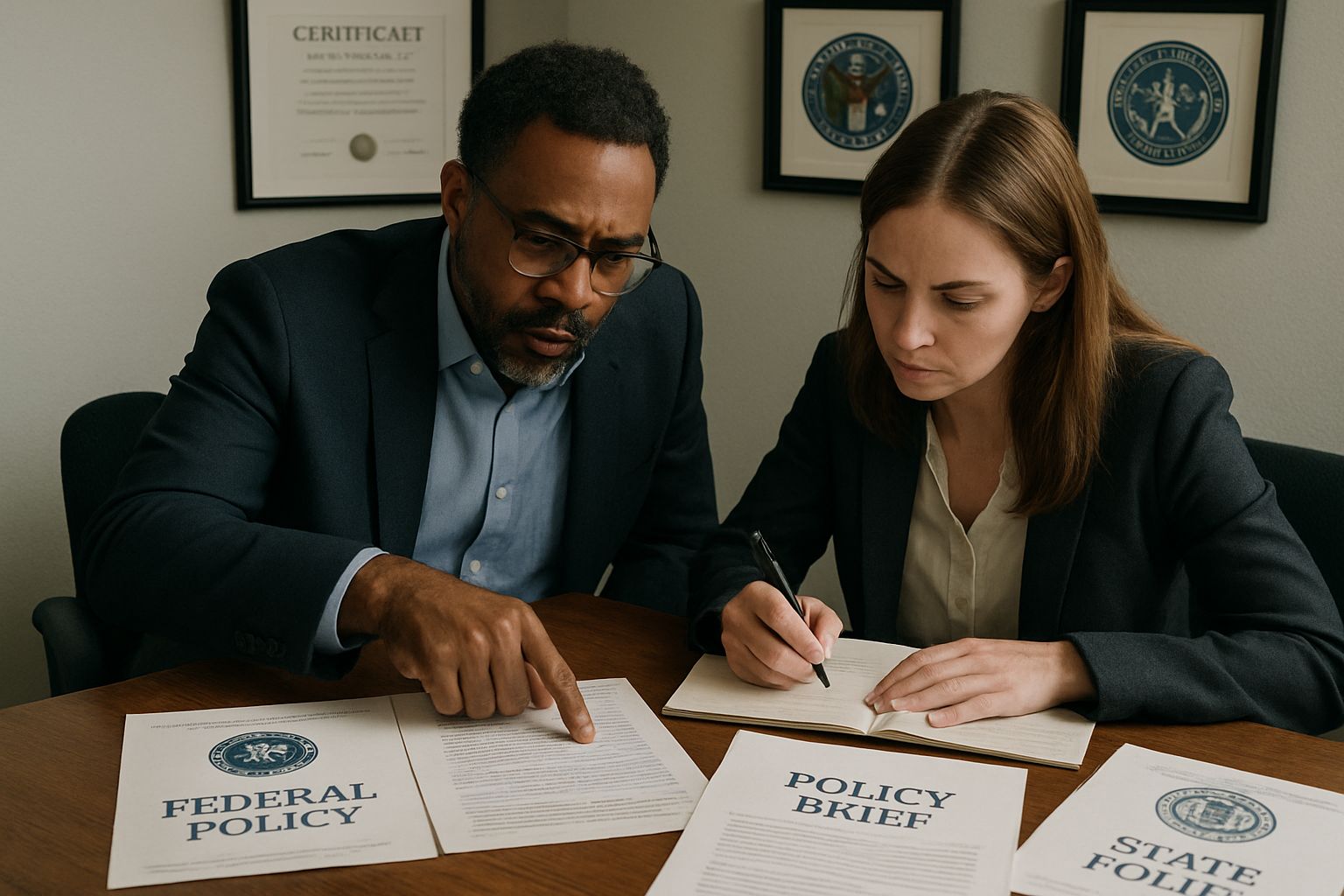
These diverging choices amplify the Policy Conflict and invite cross-border challenges. Consequently, attention shifts to Washington's next moves.
Federal Retrenchment Sparks Litigation
February 12, 2026 saw the EPA rescind the 2009 Endangerment Finding. Therefore, Federal authority over vehicle emissions now hangs on uncertain legal ground. Environmental groups and seventeen States sued within days. Observers called the clash a defining Policy Conflict for climate governance. California's governor labeled the measure the largest anti-climate act in history. Proponents praise $1.3 trillion in estimated savings. Nevertheless, automakers dread a patchwork of divergent tailpipe rules once state litigation matures.
The Policy Conflict now extends from courtrooms to factory floors. Meanwhile, AI rules have triggered their own backlash.
AI Laws Under Fire
Late 2025 reporting revealed a White House directive targeting state AI statutes. The document created an AI Litigation Task-Force inside the Justice Department. However, several attorneys general warned that executive Preemption faces constitutional limits. Industry groups support uniformity, yet civil liberties advocates fear weakened local safeguards. Commentators warned the Policy Conflict could hinder AI investment if uncertainty lingers. Federal lawsuits would test Preemption and Dormant Commerce Clause theories against novel algorithmic risks. Subsequently, lobbyists intensified calls for congressional action before courts decide.
AI disputes deepen the broader Policy Conflict by questioning state sovereignty. Therefore, abortion access battles provide the next instructive case study.
Abortion Shield Law Standoff
Medication abortion now travels across borders through telemedicine networks. Texas and Louisiana prosecutors have pursued extradition of out-of-state prescribers. Consequently, shield-law States pledge noncooperation with such demands. Approximately 22 jurisdictions offer some provider protections, yet only eight cover telehealth explicitly.
Opponents argue that interstate pill shipping evades local Regulation and harms sovereignty. Supporters respond that Preemption principles do not authorize criminalization beyond borders.
This stalemate adds another layer to the mounting Policy Conflict. Moreover, companies must assess practical risks across sectors.
Business Implications And Strategies
Boards cannot ignore the accelerating enforcement landscape. Compliance chiefs now map fifty divergent rulebooks each quarter. Additionally, insurers have started pricing multi-state litigation riders. Investors ask how Federal uncertainty influences plant location and talent deployment.
- EPA rollback promises $1.3 trillion savings but invites decade-long appeals.
- 22 shield-law States shield telehealth providers against extradition risks.
- Over 30 AI bills await Task-Force scrutiny in 2026 sessions.
Professionals enhance readiness through the AI Prompt Engineer™ certification.
Sound planning diminishes exposure amid our evolving Policy Conflict. Subsequently, attention turns to upcoming court calendars.
Looking Ahead Court Timelines
The D.C. Circuit will likely hear EPA arguments by autumn 2026. Consequently, vehicle makers must hedge pending clarity on emissions standards. The DOJ Task-Force could file its first AI case before summer. Meanwhile, extradition fights over abortion telehealth already appear in three appellate circuits. Legal scholars expect Supreme Court petitions in each dispute by 2028.
Timelines suggest the Policy Conflict may persist across business planning cycles. Nevertheless, decision makers still hold proactive options.
Conclusion
Regulatory volatility will remain a boardroom constant. Federal retreats, assertive States, and relentless litigation compose the current Policy Conflict. However, disciplined monitoring, scenario planning, and credible certifications build resilience. Professionals should study evolving Regulation, track Preemption rulings, and follow the DOJ Task-Force. Therefore, explore our resources and pursue the AI Prompt Engineer™ certification to stay competitive. Action today reduces tomorrow's compliance surprises.
Disclaimer: Some content may be AI-generated or assisted and is provided ‘as is’ for informational purposes only, without warranties of accuracy or completeness, and does not imply endorsement or affiliation.


