

AI CERTs
5 hours ago
CES Trade Show: Nvidia Earnings Power Rubin Reveal
Robotics demos hummed at Las Vegas while investors watched spreadsheets. The CES Trade Show gave Nvidia a global microphone. Consequently, chief executive Jensen Huang framed 2026 as the year computing meets the physical world. Moreover, he unveiled the Rubin platform, a six-chip stack promising 10× lower token costs. Financial context amplified the spectacle. Nvidia reported $57 billion for Q3 fiscal 2026 and guided $65 billion for Q4. Meanwhile, analysts called the period a blowout. The phrase Nvidia Earnings Stock Market Lift echoed across brokerage notes. Therefore, observers linked soaring demand with the new products onstage. This article dissects the announcements, financial numbers, and risks shaping the outlook.
Rubin Platform Headlines CES
First, the Rubin GPU joined Vera CPUs, ConnectX-9 networking, and BlueField-4 DPUs in a tightly co-designed rack. Additionally, Nvidia claimed the platform cuts cost per token tenfold versus Blackwell in large language inference. The claim, presented during the CES Trade Show keynote, awaits independent benchmarks.
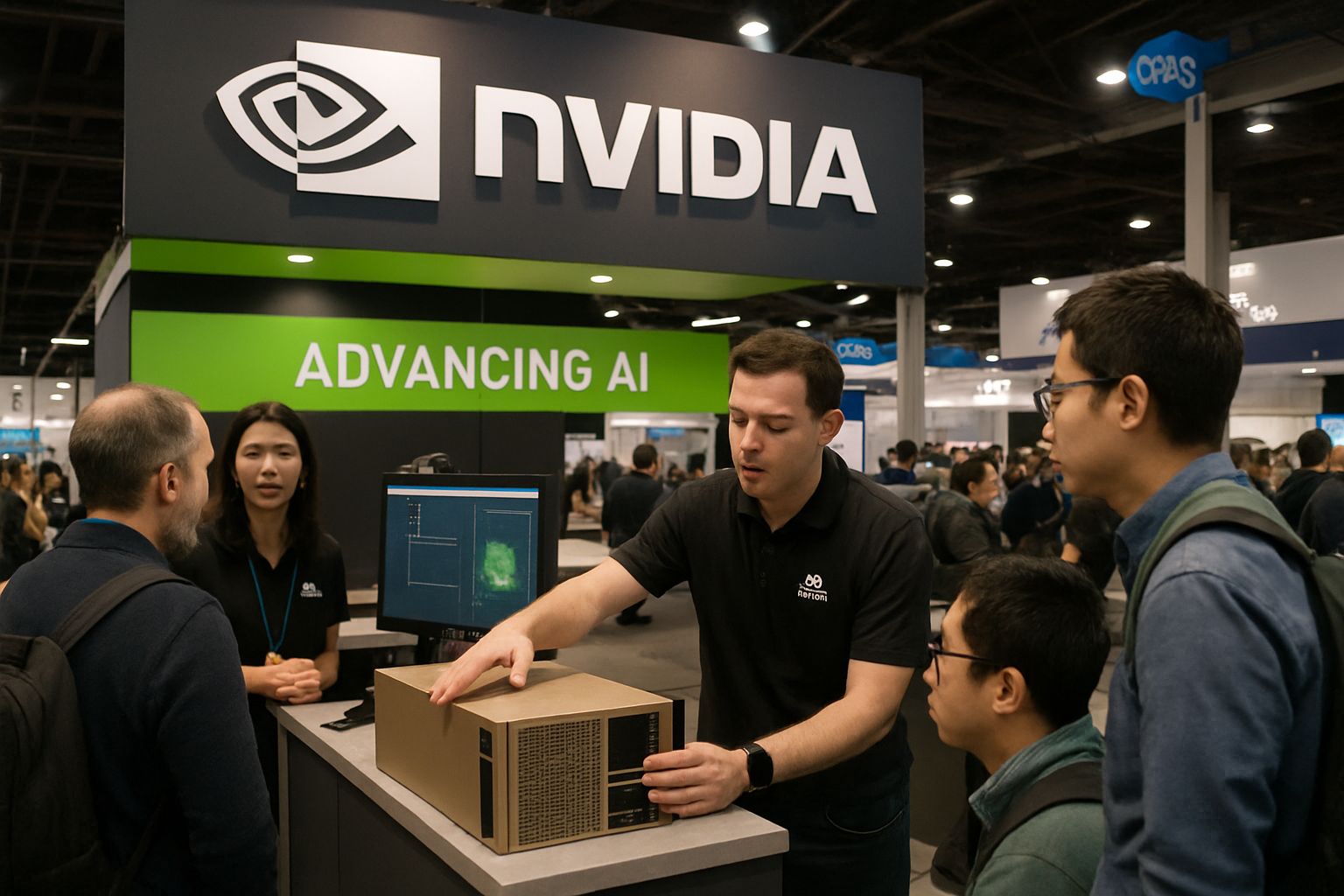
Moreover, Huang declared Rubin “in full production” and highlighted early racks at CoreWeave labs. Reuters later confirmed partners were testing units but not yet shipping to end customers. Consequently, real-world availability remains a mid-2026 question.
These technical promises excite developers. However, confirmation will rely on third-party tests scheduled after volume shipments. Consequently, the next section explores how physical AI could expand demand.
Physical AI Market Impact
Robots, autonomous vehicles, and industrial cobots formed the heart of Nvidia's “physical AI” narrative at the CES Trade Show. Furthermore, new foundation models—Alpamayo, Cosmos, and GR00T—were released as open checkpoints to accelerate adoption. In contrast, skeptics warned that running robots at scale demands edge inference efficiencies still unproven.
Nevertheless, several marquee partners stepped onstage. Mercedes-Benz discussed digital twins, while Siemens highlighted factory simulation pilots. Meanwhile, Boston Dynamics teased a GR00T-trained humanoid dancing with sub-millisecond latency.
These demonstrations suggest real appetite for end-to-end stacks. However, supply of HBM3e memory could constrain volume deployments. Therefore, balance between ambition and logistics remains fragile.
The physical AI push links silicon demand with robotics dreams. Nevertheless, investors anchor sentiment on numbers, not demos. Subsequently, we examine the finances powering the optimism.
Financial Momentum Drives Confidence
Numbers told a louder story than any demo on the Vegas floor. Q3 fiscal 2026 delivered $57 billion in revenue and 74% gross margins. Furthermore, data-center sales represented 90% of the total, underscoring hyperscaler reliance.
Management guided Q4 revenue toward $65 billion, leaving Wall Street scrambling to model capacity. Consequently, Citi, RBC, and others boosted targets. The phrase Nvidia Earnings Stock Market Lift surfaced again in client notes.
Analyst Reactions Post Show
- Q3 revenue rose 62% year over year.
- Data-center segment climbed 66% year over year.
- GAAP diluted EPS reached $1.30.
- Full-year FY2025 revenue hit $130.5 billion.
Moreover, these metrics illustrate scale rarely seen in semiconductor history. Nevertheless, several caveats remain, explored in the next section.
Risks Temper Bullish Outlook
Export controls, memory shortages, and rival silicon teams could dent growth. In contrast, management argues demand exceeds every possible headwind. However, analysts continue watching each risk closely.
Geopolitical noise already delayed some H20 shipments into China. Nevertheless, the phrase Nvidia Earnings Stock Market Lift kept reappearing because investors see policy shifts as transient. Moreover, concern about efficient LLM algorithms looms.
Supply of HBM3e remains tight, raising pricing pressure for cloud builders. Subsequently, any prolonged squeeze could defer Rubin adoption. Therefore, February earnings will offer clarity.
Risks neither negate momentum nor guarantee success. Consequently, stakeholders must monitor catalysts outlined next.
Next Catalysts To Watch
February 25 will reveal final Q4 numbers and fresh guidance. Additionally, first independent Rubin benchmarks should surface mid-year. Consequently, customer deployment timelines will test Nvidia's production claims.
Professionals can broaden insight via the AI Prompt Engineer™ certification. Moreover, knowledge from that course can contextualize future CES Trade Show breakthroughs.
CES Trade Show headlines often fade quickly, yet this cycle feels different. The CES Trade Show platform narrative now aligns with unprecedented revenue. Consequently, investors linking CES Trade Show reveals to Nvidia Earnings Stock Market Lift may gain validation after February results. Nevertheless, the CES Trade Show promises must survive benchmark scrutiny. In summary, Rubin's efficiency claims, physical AI ambitions, and blowout financials create an enticing, but not risk-free, horizon. Therefore, engage with emerging certifications, follow the webcast, and reassess positions as data arrives.


