

AI CERTS
4 hours ago
Scientific Innovation Breakthrough: IAIFI AI Fuels Physics Finds
Moreover, automated pipelines flagged an unusual supernova months before its explosive climax. Early alerts enabled telescopes to capture critical spectra that revealed a possible black-hole and star collision. Meanwhile, institute engineers crafted algorithms that sharpen neutrino telescope images without extra hardware cost. These parallel advances illustrate AI's expanding role across astronomy and particle physics. Furthermore, policy experts see the program as a template for responsible, reproducible scientific computing. The following report unpacks the breakthrough technologies, institutional dynamics, and future training opportunities.
IAIFI Accelerates Cosmic Insights
IAIFI is anchored at MIT and links five regional universities. Consequently, the institute pools talent spanning detector engineering, theoretical modeling, and machine learning. The past year delivered another Scientific Innovation Breakthrough as researchers harmonized domain insight with scalable algorithms. Moreover, cross-disciplinary teams met weekly to exchange failure cases and refine data curation strategies.
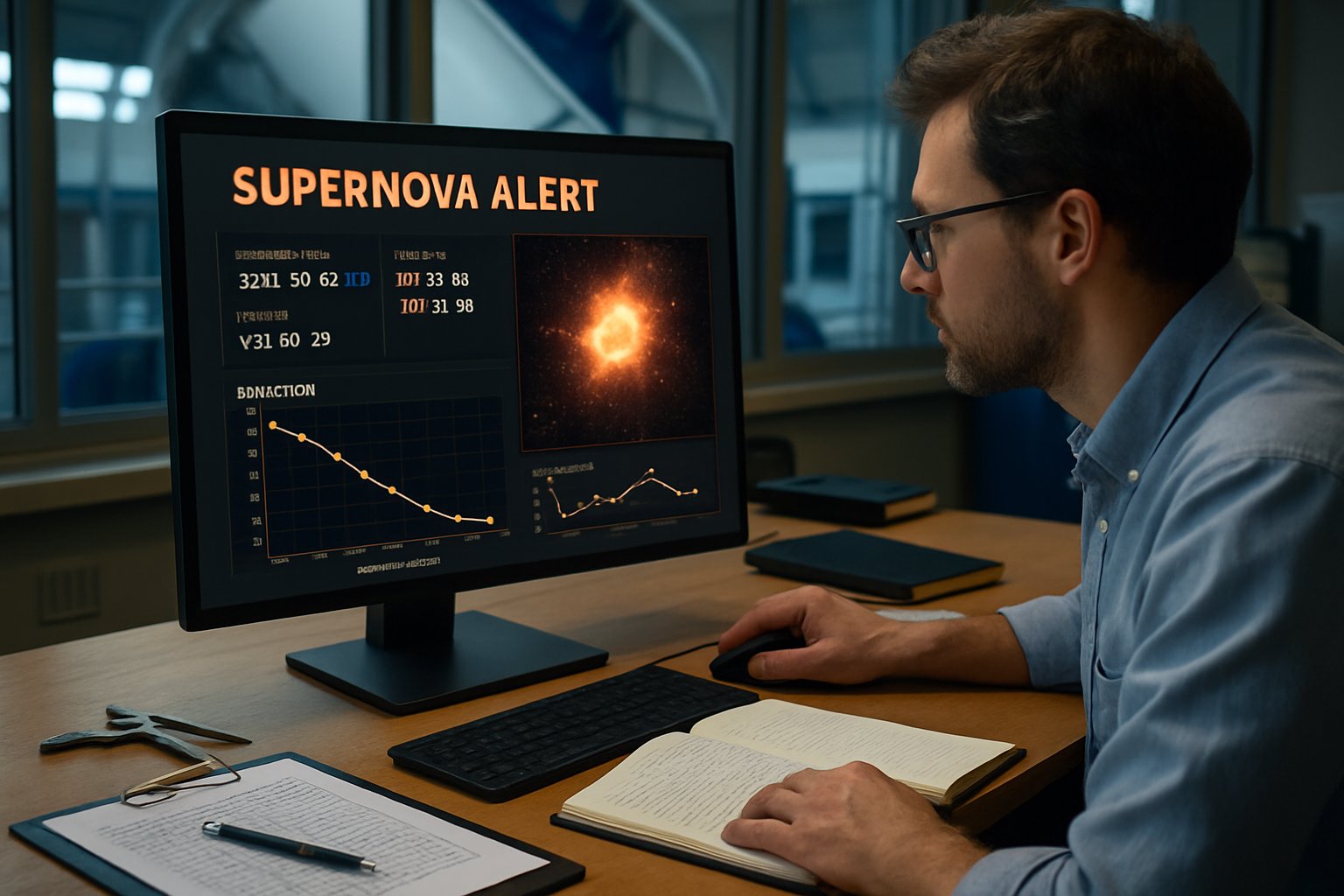
Alex Gagliano explained that the similarity engine flagged SN 2023zkd long before its curious double peak. Therefore, observers captured precursor flashes lasting four years, something no manual survey would notice. Scientists hailed this finding as a tangible Scientific Innovation Breakthrough that validated the alert pipeline. Consequently, the program now integrates the engine with Rubin Observatory brokers to scale toward ten million nightly alerts.
IAIFI's culture and tooling accelerate discovery of rare phenomena across vast datasets. In contrast, focused packages like reLAISS push that speed to front-line observers.
ReLAISS Enables Rapid Discovery
ReLAISS packages thousands of curated features into a pip-installable Python library. Additionally, the tool offers nearest-neighbor searches that surface analogs and anomalies within seconds. Developers designed the software for Rubin volumes, anticipating ten million alerts every clear night.
The package contributed directly to the Scientific Innovation Breakthrough surrounding SN 2023zkd by ranking it an extreme outlier. Consequently, astronomers booked scarce spectroscopy time before the supernova brightened again.
- 20,000 curated features enable flexible similarity searches.
- Python package installs with one command: pip install relais.
- Scales to Rubin's projected one million yearly supernovae.
Moreover, reLAISS documents uncertainty estimates, encouraging transparent ranking rather than opaque scoring. This transparency supports peer review and reproducible discovery claims. Therefore, domain scientists trust the outputs and integrate them into automated follow-up chains.
ReLAISS transforms raw alerts into prioritized targets with traceable reasoning. Meanwhile, particle experiments benefit from comparable AI precision gains.
Neutrino Detectors Gain Precision
IceCube analysts struggle with sparse sensor geometry that limits angular resolution. However, institute researchers introduced superresolution networks that imagine hits on virtual optical modules. The model improved muon track reconstruction in simulated ice by several percent across energy ranges.
Subsequently, teams deployed self-supervised transformers that learn directly from real detector noise. Consequently, reliance on imperfect Monte Carlo dropped, reducing systematic bias. These developments together formed another Scientific Innovation Breakthrough acknowledged by the neutrino community.
Furthermore, reconstruction code remains experiment agnostic, enabling adoption by future under-ice and radio arrays. Developers anticipate open benchmarking releases later this year.
Neutrino pipelines now rival optical analyses in resolution thanks to AI. Nevertheless, embedding physical laws within models remains vital for trust. Next, we examine those physics priors.
Embedding Physics Into Algorithms
Physics-informed layers constrain networks to respect symmetries and conservation laws. In contrast, generic architectures can hallucinate unphysical patterns that mislead interpretations. Therefore, the team integrates group-equivariant convolutions and energy-conserving loss terms.
This methodological groundwork underpins each Scientific Innovation Breakthrough reported above. Moreover, the approach boosts generalization when surveys change exposure times or detectors age. External reviewers appreciate the interpretability gains because scientists can trace outputs to recognizable formulas.
Physics priors raise model reliability across domains. Consequently, community trust grows yet risks persist.
Risks And Validation Standards
Automated alerts can produce overwhelming false positives when thresholds drift. Nevertheless, IAIFI mandates cross-checks with independent instruments before publishing claims. The institute also shares code and notebooks for external reproduction on public clouds.
Furthermore, simulation biases remain a concern despite improved self-supervision. Consequently, reviewers now demand uncertainty estimates alongside every Scientific Innovation Breakthrough announcement. Policy panels advocate benchmark suites that stress-test models against adversarial synthetic data.
Robust validation practices safeguard credibility and minimize hype. Subsequently, training initiatives aim to embed those habits early.
Future Roadmap And Training
IAIFI plans expanded summer schools that couple coding labs with instrument shifts. Moreover, leadership at MIT will launch a graduate minor focused on AI for fundamental physics. The curriculum will dissect each prior Scientific Innovation Breakthrough to teach reproducible workflows.
Professionals can enhance their expertise with the AI Ethical Hacker™ certification. Consequently, graduates master both algorithm security and domain science responsibility.
MIT career services anticipate rising demand for hybrid researchers who unite AI fluency with physics intuition. Therefore, the inclusive mentorship program targets early-career scientists from underserved institutions.
Training investments aim to democratize participation in big-data discovery. Meanwhile, the roadmap lists several upcoming releases that promise another Scientific Innovation Breakthrough soon.
IAIFI's past year shows how disciplined AI accelerates frontier physics. Supernova alerts, neutrino precision, and interpretable models emerged from one coordinated ecosystem. Consequently, the community recorded a cumulative Scientific Innovation Breakthrough that influences multiple experiments. Nevertheless, rigorous validation and equitable compute access remain essential guardrails. Furthermore, upcoming institute curricula and certifications will prepare professionals to lead responsible innovation. Explore the linked credential to strengthen your security mindset while advancing scientific AI careers. Join the conversation and help design the next wave of discovery tools.


