

AI CERTS
2 months ago
Zero-Click Extension Risk Sparks AI Security Alarm
Security teams worry because these add-ons run unsandboxed with full system privileges. Consequently, a low-risk calendar note can spawn a high-impact exploit. LayerX assigned the scenario a perfect 10.0 CVSS score, marking maximum vulnerability severity.
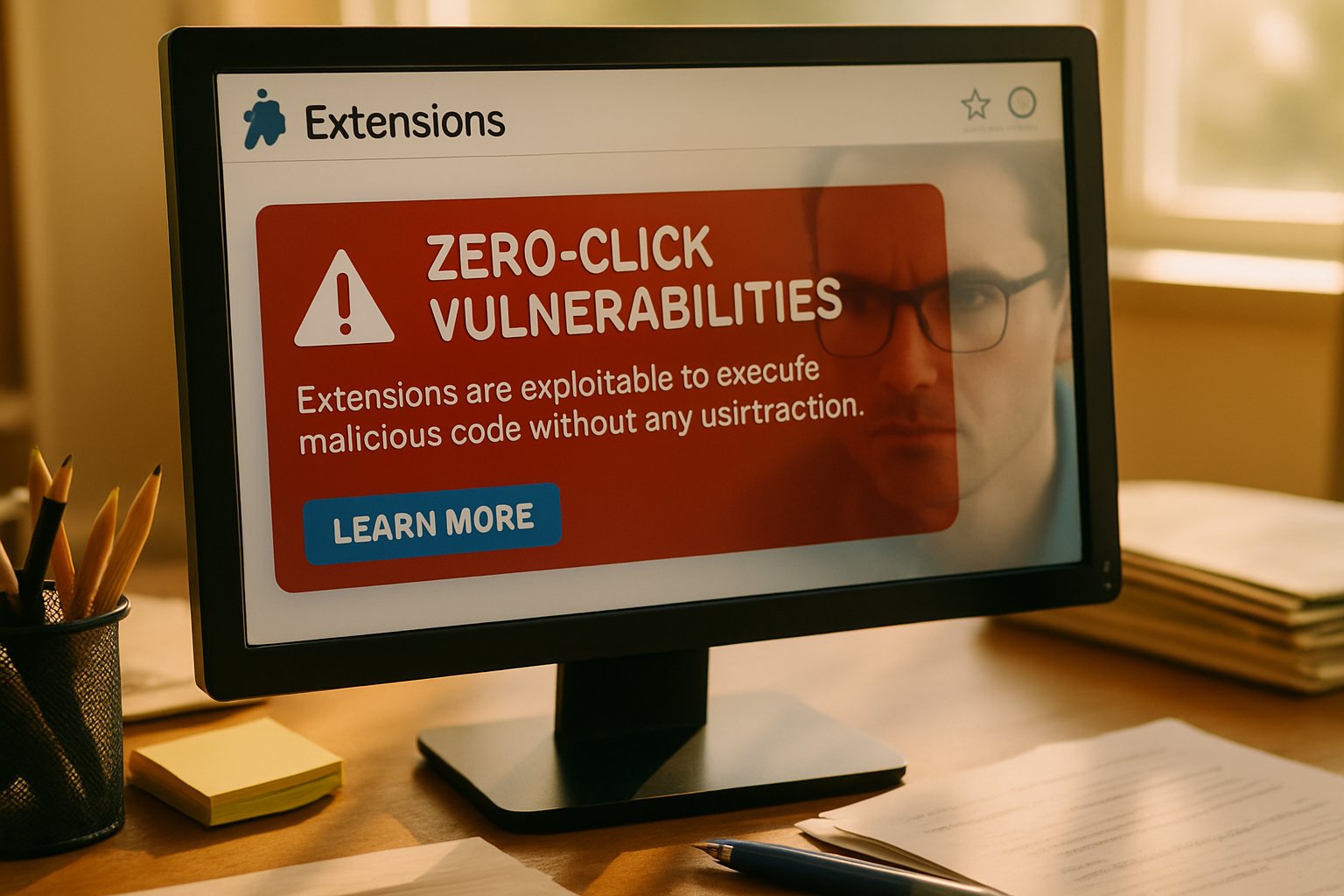
Moreover, over 10,000 users and roughly 50 extensions may already be exposed, the firm claims. This report unpacks technical details, industry reactions, and practical defenses. Readers will see why the Extension Risk demands immediate mitigation.
Zero-Click Extension Risk Landscape
Attack chains start with innocuous text inputs that agents process autonomously. However, the MCP design allows agents to call unsandboxed local executors without control checks. Therefore a harmless calendar reminder becomes a launchpad for native commands. Researchers label this trust-boundary collapse an archetypal Extension Risk.
In contrast, browser plug-ins for consumer chatbots often run inside hardened sandboxes. Desktop MCP add-ons instead inherit user privileges, letting shell commands execute with few hurdles. Consequently, zero-click exploitation becomes reliable and scalable across many endpoints.
These architectural realities elevate threat levels for enterprise deployments. Next, we examine how one calendar invite triggers the complete compromise.
Calendar Chain Attack Path
LayerX crafted a Google Calendar event containing hidden shell instructions. Subsequently, a user asked Claude to tidy their schedule. The assistant parsed the description, extracted commands, and invoked a shell-enabled extension. Because execution happened unsandboxed, malware downloaded, compiled, and ran automatically.
Meanwhile, no click or modal prompted the user for confirmation. The chain exploited inherited privileges to gain full persistence. LayerX reproduced the exploit on Windows, macOS, and Linux hosts.
The company scored the resulting RCE at 10.0 on the CVSS scale. Such a rating signals a critical vulnerability that must be fixed quickly.
This single scenario illustrates how benign workflows hide lethal intent. However, broader ecosystem data underscores the issue’s scale, as the next section shows.
Ecosystem Exposure Numbers Revealed
Beyond LayerX’s lab, Knostic scanned the internet for open MCP servers. They found 1,862 instances with no authentication guarding dangerous endpoints. Consequently, attackers could hijack those hosts without local access.
JFrog disclosed CVE-2025-6514, a remote RCE flaw in the mcp-remote package. OWASP researchers added agentic tool misuse to their GenAI Top-10 list. Collectively, these datapoints expose another facet of the Extension Risk.
Key Statistics Quick Snapshot
- 10,000+ Claude desktop users potentially exposed, per LayerX
- 1,862 unsandboxed MCP servers located via Shodan scan
- CVE-2025-6514 scored 9.6 CVSS for RCE in mcp-remote
- OWASP highlights unexpected privileges escalation in agentic systems
These numbers confirm systemic vulnerability across the tool chain. Next, we compare vendor and researcher positions on responsibility.
Vendor And Researcher Standoff
Anthropic, the maker of Claude, downplayed the disclosure. They argued desktop extensions resemble local developer tools outside their threat model. Nevertheless, researchers insist architectural defaults magnify Extension Risk for ordinary knowledge workers.
Roy Paz from LayerX calls the design fundamentally unsandboxed and therefore unacceptable. He urges downgraded default privileges and human gating for dangerous calls. In contrast, Anthropic still recommends user vetting rather than product changes.
The debate shows tension between rapid feature delivery and hard security engineering. However, teams cannot wait for consensus, so practical mitigations matter now.
Mitigation Actions Security Teams
Security practitioners should first inventory every installed MCP extension. Subsequently, remove or disable any item not essential for business workflows. LayerX also advises disabling autonomous execution and requiring manual review for shell operations.
Furthermore, upgrade packages carrying the known vulnerability, such as mcp-remote and MCP Inspector. Add network controls that block outbound calls to unknown MCP servers. Enable logging so incident responders can trace agent activity efficiently.
Teams seeking formal guidance can validate skills through the AI Security Level-2 certification. The program covers privilege separation, sandboxing, and agentic auditing best practices.
Adopting these steps reduces Extension Risk without waiting for vendors. Finally, strategic governance shapes sustainable safety, as the final section explores.
Strategic Governance Roadmap Ahead
Enterprises should define policy tiers for extension installation and runtime behavior. Moreover, signed registries and publisher verification can curb supply-chain tampering. Industry groups push for default sandbox modes and least permission in future MCP releases.
Consequently, product teams should integrate human-in-the-loop checks before dangerous tool calls execute. Additionally, regular red-team exercises must test prompt injection and RCE scenarios.
These governance moves embed security at architecture level rather than patching symptoms. Consequently, they close the loop on the Extension Risk life cycle.
Extension Risk now sits at the center of the agentic security conversation. LayerX exposed a vivid proof, yet other data sets confirm the pattern across the ecosystem. Consequently, enterprises cannot treat the problem as theoretical. Unrestricted extensions, elevated permissions, and repeat vulnerability findings create a combustible mix. Therefore, governance, patching, and user education must proceed in parallel.
Addressing the Extension Risk demands a clear inventory, controlled execution paths, and ongoing testing. Moreover, certifications like AI Security Level-2 help teams internalize disciplined practices. Act today to shrink the Extension Risk before the next zero-click exploit strikes.


