

AI CERTS
3 hours ago
Enrollment Pivot: Why AI Majors Outpace CS Programs
Moreover, many students associate specialized AI tracks with clearer job prospects after several years of high-profile layoffs. In contrast, seasoned researchers insist core CS degrees remain vital for problem-solving breadth. By mapping enrollment swings to labor-market signals, this article clarifies whether the shift marks a fad or a structural reallocation. Therefore, we begin with forces redirecting student demand.
Why Interest Is Shifting
Firstly, job market anxiety tops the list of motivators. Recent entry-level hiring freezes at major software firms rattled students tracking offer trends. Consequently, many undergraduates pursue applied AI pathways they view as future-proof.
Meanwhile, media stories celebrating prompt-engineers and data scientists reinforce the Enrollment Pivot narrative. Furthermore, campus marketing departments amplify those stories by launching glossy AI majors with interdisciplinary branding. Nevertheless, faculty leaders argue that breadth still matters. Subsequently, high school counselors report earlier requests for AI program brochures.
These challenges highlight critical gaps. However, emerging statistics will clarify the national picture.
National Enrollment Data Snapshot
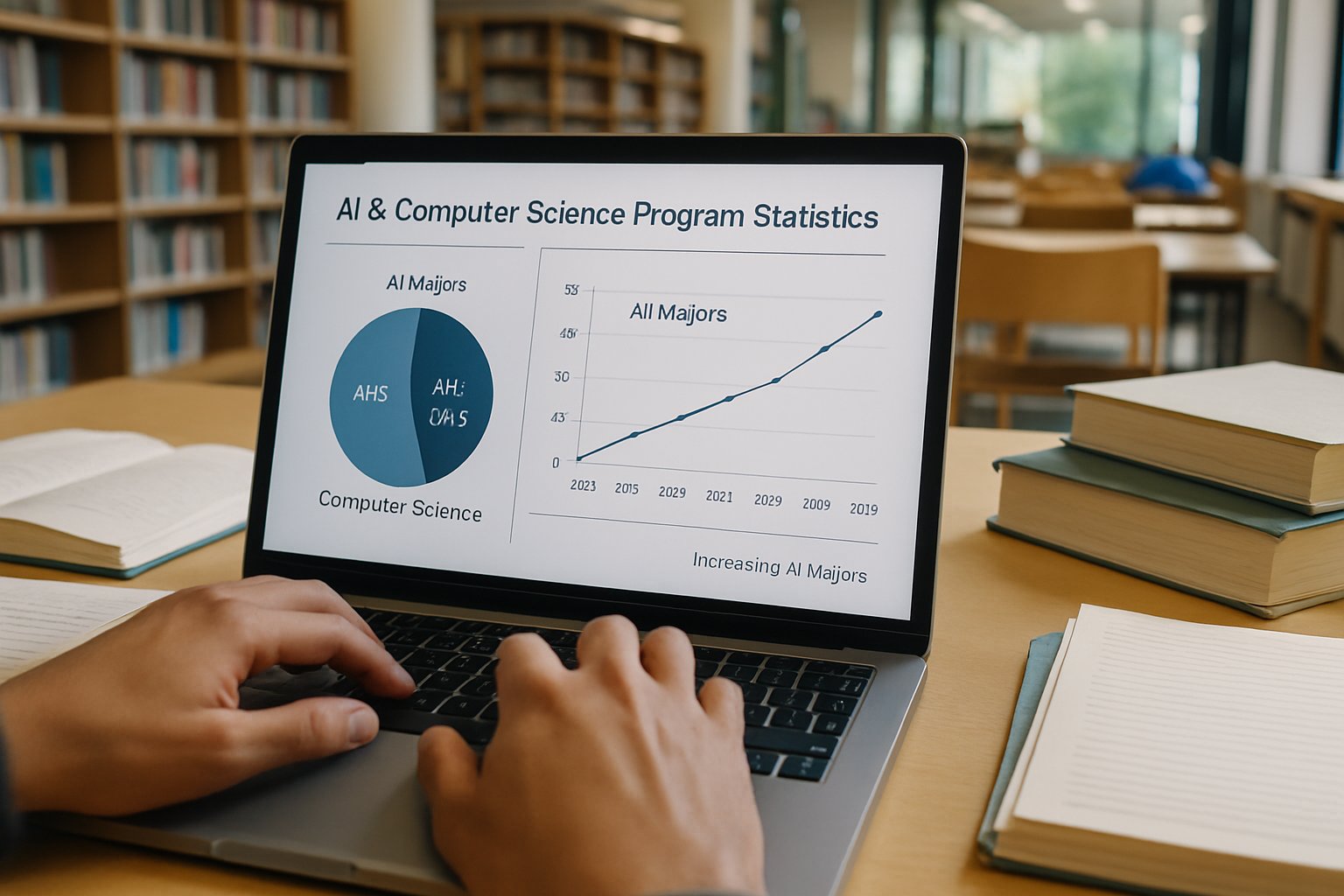
Hard numbers confirm the direction of change. The National Student Clearinghouse logged an 8.1% drop in four-year computer science enrollment for Fall 2025. Graduate counts plunged 14.0% during the same period. Moreover, the Clearinghouse notes overall postsecondary enrollment held steady at 19.4 million. Therefore, the Enrollment Pivot reflects a disciplinary, not systemic, contraction.
- Undergraduate CIS headcount: 606,000 (−8.1%)
- Graduate CIS headcount: 190,000 (−14.0%)
- 62% of computing units report fewer new majors
In contrast, several universities reported double-digit growth in AI, data science, and cybersecurity programs. These statistics reinforce administrators' perception that demand has not vanished but migrated. Subsequently, budget committees shift faculty lines toward the hottest niches. Meanwhile, data science registrations rose 12% according to the same dataset.
Numbers confirm widening specialization. Consequently, campus stories illustrate how institutions respond.
Campus Level Case Studies
Concrete examples make the trend tangible. The UC system recorded a 6% year-over-year decline in CS majors across its campuses. However, UC San Diego grew by enrolling 150 first-years into its new AI major.
Similarly, MIT's Artificial Intelligence and Decision Making program became its second-largest major within two years. Additionally, the University of South Florida attracted more than 3,000 students to a freshly minted AI and cybersecurity college. SUNY Buffalo built an 'A.I. and Society' department enrolling 400 first-year scholars. Consequently, local press framed each case as proof of a nationwide Enrollment Pivot.
These campus snapshots reveal suppliers reacting quickly to student demand. Therefore, we next explore how experts interpret the surge.
Expert Voices Clearly Diverge
Not all leaders agree on long-term implications. Geoffrey Hinton argues core CS skills remain irreplaceable even as tooling automates routine coding. Meanwhile, Bret Taylor differentiates computer science study from simple coding bootcamps, stressing systems thinking. Moreover, Tracy Camp of the CRA describes a sector moving toward specialized, stackable degrees rather than broad survey programs. Nevertheless, several deans foresee eventual equilibrium as supply and reputation stabilize.
Matthew Holsapple from the Clearinghouse notes that technology students still flood campuses, only under different banners. Nevertheless, his commentary underscores the Enrollment Pivot as diversification, not desertion.
Experts therefore encourage balanced messaging to incoming cohorts. Next, we assess possible curricular pitfalls.
Curriculum Design Risks Ahead
Rapidly launching flashy programs carries academic danger. Administrators may underinvest in math foundations while overemphasizing trendy toolchains. Consequently, graduates could emerge without the depth employers expect from rigorous computer science training.
In contrast, well-structured AI majors pair linear algebra, probability, and ethics with project studios. Moreover, accreditation bodies now scrutinize new degrees for learning outcomes and assessment plans. Professionals can enhance expertise with the AI Educator™ certification. Therefore, faculty gain structured guidance on aligning AI pedagogy with foundational education standards. Subsequently, watchdogs warn against "AI-washing" that dilutes academic rigor for marketing appeal.
Solid design mitigates reputational and workforce risks. Subsequently, attention turns to employer demand.
Implications For Future Employers
Hiring managers view the shift through a talent pipeline lens. Moreover, specialized majors promise graduates possessing immediate machine-learning fluency. However, systems engineering teams still require generalists comfortable with distributed architectures and low-level debugging.
Consequently, companies may stratify entry paths: AI specialists, cybersecurity analysts, and classic computer science engineers. In contrast, a reduced supply of broad CS degrees could inflate salaries for those remaining. Therefore, understanding the Enrollment Pivot helps recruiters forecast skill shortages accurately. Additionally, vendors of AI tooling plan sponsorships that shape university research agendas.
Employer strategies shape academic planning cycles. Finally, we propose actions for decision makers.
Strategies For Decision Makers
University boards should ground choices in transparent metrics. Firstly, benchmark local Enrollment Pivot figures against national Clearinghouse data each semester. Secondly, survey prospective students to clarify career perceptions and curriculum needs.
- Create cross-listed gateway courses blending CS and AI fundamentals.
- Invest in faculty development via industry sabbaticals and certification programs.
- Maintain advisory boards that include employers, alumni, and ethicists.
Additionally, partner with the UC system and peer universities to share resource-intensive GPU clusters. Moreover, expand co-op models so degrees embed real production experience. Consequently, the Enrollment Pivot becomes an opportunity for agile institutions rather than a crisis. Meanwhile, regional consortia negotiate shared micro-credential frameworks to avoid duplicated effort.
These strategic moves foster resilient education ecosystems. Next, we close with overarching insights.
The evidence shows the Enrollment Pivot is real, measurable, and diversifying technology pipelines. Nevertheless, fundamentals still matter, as leaders from MIT to the UC system continuously emphasize. Therefore, balanced curricula that anchor AI skills on strong theory will best serve learners and employers.
Consequently, institutions and hiring teams should track Enrollment Pivot metrics, refine messaging, and invest in ongoing faculty development. Moreover, aspirants can future-proof their impact through stackable credentials. The AI Educator™ certification offers a structured path to ethical, industry-aligned instruction. Act now to translate shifting demand into strategic advantage.


