

AI CERTs
2 months ago
China’s Shipbuilding Surge Fuels Maritime Competition
China is building warships faster than any power since World War II. Consequently, Washington now frames Asia as a contest of shipyards, steel, and strategy. This article examines how Beijing's naval surge intensifies Maritime Competition and challenges long-standing U.S. sea dominance. It relies on recent Department of Defense, Congressional Research Service, and CSIS data. Moreover, industry professionals will find detailed statistics, strategic debates, and emerging technology signals inside. Meanwhile, allies adjust force posture and accelerate undersea investments to restore deterrence. Nevertheless, numbers alone do not guarantee wartime effectiveness; training, sustainment, and doctrine remain decisive. Therefore, decision makers must parse headline figures, industrial capacity, and qualitative gaps in tandem. The following sections unpack industrial advantages, blue-water ambitions, submarine trajectories, gray-zone pressure, and allied responses. Finally, readers seeking deeper policy insight can enhance expertise with the linked certification. Consequently, the report equips naval architects, defense planners, and investors with actionable context for upcoming budget cycles. In contrast, sensational headlines often ignore definitional caveats that shape true capability assessments.
Industrial Power Advantage
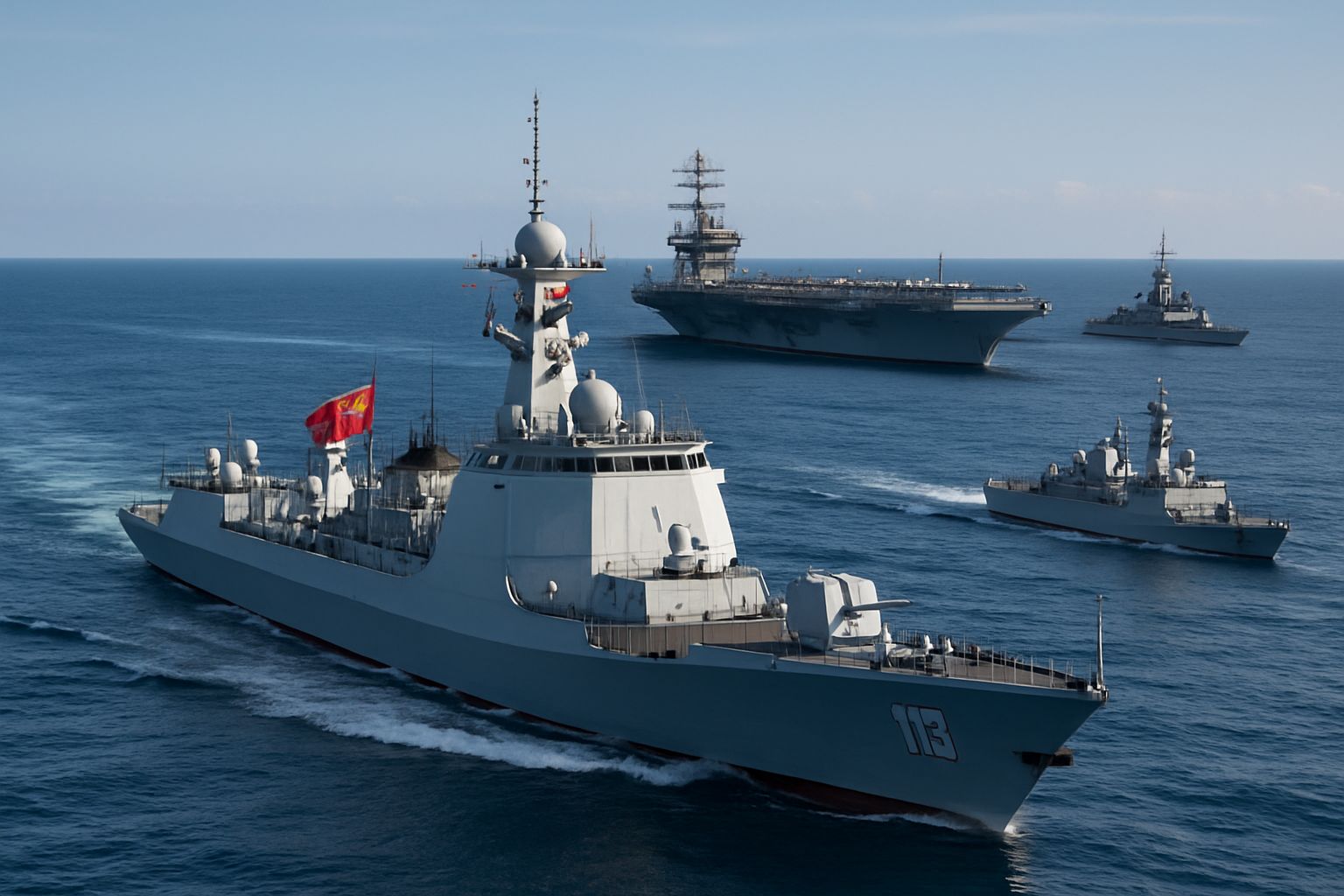
China’s commercial shipyards underpin its strategic momentum. Moreover, Jiangnan Shipyard alone now outproduces all U.S. yards combined. Analysts therefore call the industrial base the decisive enabler of Maritime Competition. CSIS notes that economies of scale let Beijing iterate designs swiftly and incorporate new VLS cells without lengthy yard periods. Consequently, hull counts grow while capability per hull improves.
- PLAN battle-force ships: 370+ in 2025, 435 projected by 2030.
- Submarines: 60–80 boats today, with nuclear share rising.
- Average militia presence: 232 vessels daily around key reefs in 2024.
- Military spending: roughly $300–330 billion in 2024 budgets.
However, counting rules vary across institutions, so comparisons demand caution. Nevertheless, the industrial advantage compresses timelines for cruisers, carriers, and support craft. These realities reinforce Beijing’s capacity to sustain long Maritime Competition. These data points illustrate Beijing’s material edge. Consequently, the next section explores how the fleet employs this mass.
Blue-Water Ambitions Rise
Fujian, China’s first electromagnetic-catapult carrier, began sea trials in 2025. Additionally, the Type-076 amphibious platform tests drones alongside crewed aircraft, signaling deeper integration of Unmanned Systems. Analysts argue such steps mark a transition from regional defense to global presence. Furthermore, new destroyers field 112 VLS cells, narrowing the missile-salvo gap with the U.S. Navy.
PLAN task groups now routinely operate beyond the First Island Chain, reaching the Indian Ocean and Mediterranean. Consequently, allied planners track logistics nodes from Djibouti to potential Atlantic footholds. Nevertheless, Beijing still lacks the replenishment network that underwrites U.S. carrier strike routines worldwide. These operations demonstrate expanding reach. However, the submarine domain presents a different trajectory.
Submarine Force Trajectory Ahead
Pentagon projections warn that China could match U.S. attack-sub numbers by 2035. Moreover, quieting advances and new air-independent propulsion complicate detection. In contrast, the U.S. still enjoys superior nuclear experience and continuous-at-sea deterrence. Analysts also highlight rapid VLS adoption on latest boats, enabling land-attack options previously limited to surface ships.
Meanwhile, training cycles and acoustic benchmarking remain opaque, raising uncertainty for U.S. anti-submarine warfare doctrine. Nevertheless, Maritime Competition under the waves will hinge on sensors, data fusion, and Unmanned Systems such as extra-large autonomous vehicles. These factors shape risk calculations for Taiwan contingencies. Consequently, gray-zone tactics continue to blur peacetime and conflict boundaries.
Gray-Zone Pressure Toolkit Expands
CSIS satellite imagery reveals growing maritime militia concentrations at Mischief and Second Thomas Shoal. Furthermore, the China Coast Guard often escorts clusters, amplifying coercive effect without overt combat. Analysts therefore describe a three-layer model: militia, coast guard, and Navy warships lurking over the horizon.
Additionally, small Unmanned Systems support surveillance, extending visual confirmation of Philippine or Vietnamese moves. Nevertheless, legal ambiguity complicates decisive responses, offering Beijing incremental gains. These tactics intensify Maritime Competition daily, eroding norms through constant presence. Consequently, allies are responding with fresh initiatives and new technology investments.
Allied Countermeasures Evolve Rapidly
AUKUS partners announced rotational nuclear-powered submarines in Western Australia. Moreover, Japan finances additional destroyers with expanded VLS loadouts to maintain salvo parity. Meanwhile, NATO navies share lessons on Arctic bastion defense, anticipating wider theaters of Maritime Competition.
Furthermore, Australia and the United Kingdom test Unmanned Systems for mine countermeasures and persistent ISR. Professionals can enhance their expertise with the AI for Government™ certification. Consequently, regional exercises now combine surface, undersea, and cyber scenarios, mirroring China’s integrated approach. Nevertheless, industrial constraints limit rapid U.S. fleet expansion, elevating the importance of quality considerations.
Balancing Quantity Versus Quality
U.S. officers argue that combat experience, joint doctrine, and resilient logistics networks offset numerical gaps. Additionally, carrier aviation proficiency accrues from decades of high-tempo operations. In contrast, China’s Navy has not fought major wars since 1979.
Moreover, analysts warn that integrating large crews, complex VLS magazines, and advanced Unmanned Systems demands rigorous training. Consequently, mishaps during recent carrier flight trials underscore steep learning curves. Nevertheless, quantity provides redundancy and overwhelms missile defenses in some scenarios, sustaining Maritime Competition momentum. Therefore, balanced modernization remains essential.
These trade-offs define strategic calculations. Subsequently, leaders must weigh deterrence credibility against fiscal realities. The final section synthesizes risks and opportunities ahead.
Strategic Outlook And Risks
Defense planners expect ship counts to favor Beijing through 2030. However, supply-chain vulnerabilities and economic headwinds could slow output. Additionally, autonomous swarming tactics may disrupt traditional dominance assumptions.
Moreover, transparency gaps complicate escalation management during crises. Nevertheless, ongoing dialogue forums and confidence-building measures could moderate miscalculation. Maritime Competition will thus persist as the defining security variable for the Indo-Pacific.
Consequently, firms investing in sensors, cyber resilience, and Unmanned Systems may see expanding demand. These trends demand continuous monitoring. Therefore, professionals should leverage authoritative sources and targeted certifications to maintain strategic literacy.
Conclusion
China’s industrial surge has tilted the naval balance in hull numbers, missiles, and geographic reach. However, qualitative gaps in experience, logistics, and joint command still constrain full power projection. Additionally, allied innovation in Unmanned Systems and advanced VLS platforms narrows capability gaps. Consequently, Maritime Competition remains dynamic, demanding agile analysis and sustained investment. Professionals should, therefore, review latest data, engage in policy debates, and pursue specialized learning. Explore the cited certification to deepen expertise and inform decisive action.


