

AI CERTs
6 months ago
Samsung vs Pixel: Hardware Privacy Features Compared
Mobile privacy debates now hinge on concrete features, not marketing slogans.
Consequently, Samsung and Google are racing to embed deeper protections inside flagship phones.
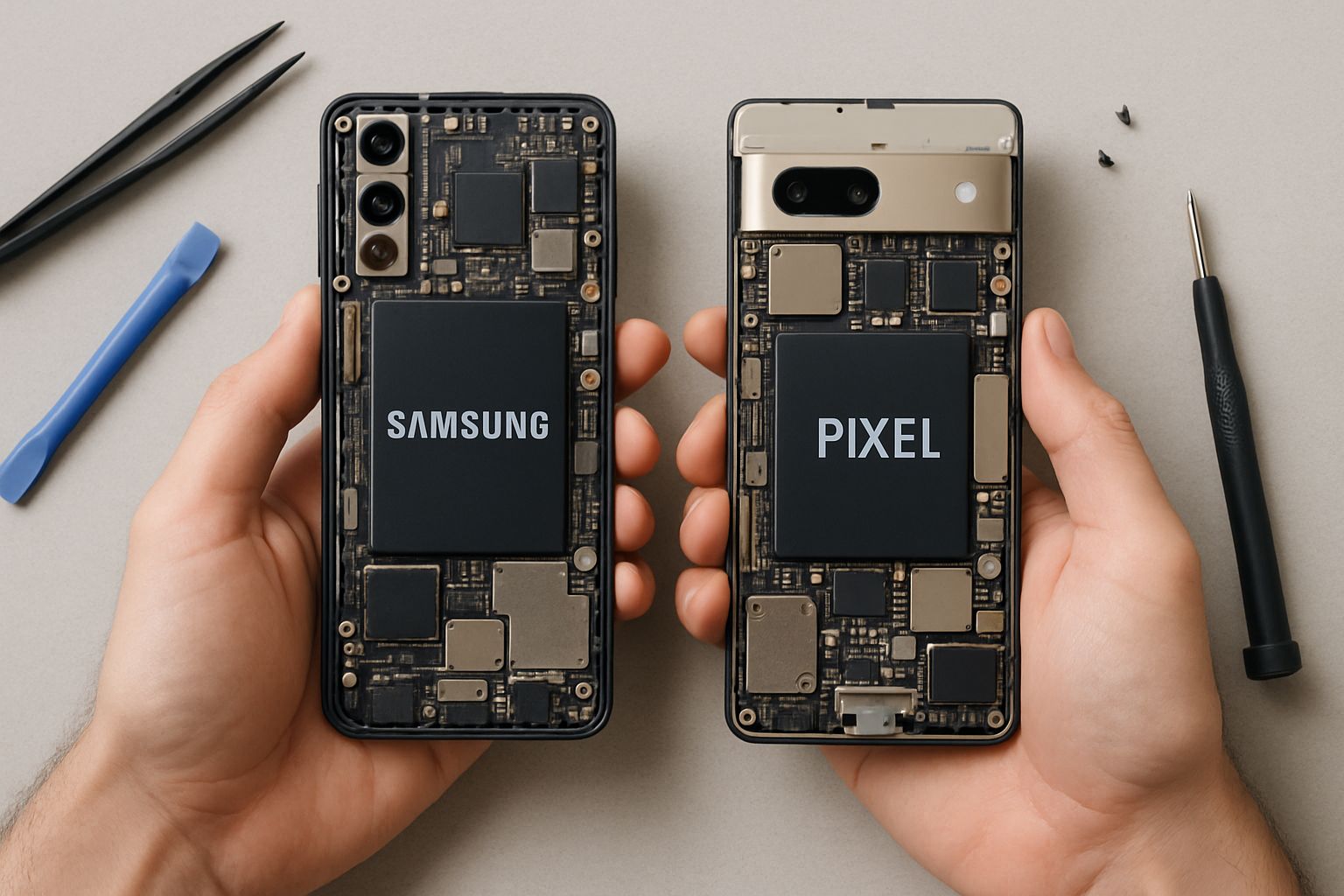
This article dissects their latest moves, focusing on Hardware backed safeguards and AI data containment.
We examine July 2025 One UI 8 advances, Pixel Private Compute milestones, and extended patch promises.
Additionally, market share context and enterprise adoption pressures provide essential perspective.
Technical professionals will find balanced analysis, actionable test advice, and links to deepen expertise.
Meanwhile, professionals can validate emerging skills with the AI Developer™ certification.
The discussion spans Galaxy S26 rumors, quantum-resistant Wi-Fi, and real-world Display privacy indicators.
Every claim derives from primary vendor documentation or independent testing, ensuring factual integrity.
Therefore, let us dive into the specifics and compare strategic approaches.
Galaxy Privacy Feature Surge
Samsung's July 2025 announcement introduced KEEP, Knox Matrix, and post-quantum Secure Wi-Fi.
KEEP isolates AI data inside app-specific encrypted stores, leveraging Knox Vault silicon.
Moreover, the approach limits cross-app movement, reducing attack surface without harming performance.
Knox Matrix extends protection across tablets, watches, and forthcoming S26 phones, automatically revoking compromised credentials.
Consequently, enterprises gain fleet-wide response capabilities previously reserved for desktop ecosystems.
Post-quantum protocols now defend Secure Wi-Fi handshakes against harvest-now-decrypt-later threats.
Samsung claims Common Criteria certification for Knox Vault, reinforcing Hardware trust anchors.
Samsung's recent stack marries Hardware roots with novel AI isolation.
However, practical benefits depend on regional rollouts and user awareness, leading us to Google's answer.
Pixel Stack Comparative View
Google counters with Tensor security cores, Titan M2 chips, and the Private Compute Core sandbox.
Additionally, live threat detection now scans apps on-device, inside the same trusted enclave.
Private Compute Core processes scam call detection, live captions, and personal suggestions without cloud data leakage.
In contrast, Google emphasizes transparency dashboards that Display real-time microphone and camera access.
Pixel devices also bundle Google One VPN options, although many enterprises prefer third-party tunnels.
Moreover, Pixel owners receive first Android patches monthly, sustaining five to seven years of cover.
While Samsung targets ecosystem breadth, Google locks optimizations tightly around bespoke Hardware and integrated software stacks.
Google's layered model highlights software agility supported by dedicated Hardware silicon.
Next, update commitments clarify long-term risk exposure for both camps.
Enterprise Update Commitments Explained
Patching cadence remains central for incident containment.
Samsung now pledges seven years of OS and Security updates for Galaxy S24 onward.
Furthermore, industry analysts view the promise as parity with Pixel, barring carrier delays.
Pixel owners enjoy similar spans, with Google listing exact end-of-support dates per model.
Consequently, risk officers can confidently budget longer device life cycles, reducing total cost of ownership.
- Samsung S24-S26: seven years patches, quarterly firmware drops.
- Pixel 8-9 series: seven years patches, monthly feature drops.
- Average Android vendor: three years patches, irregular cadence.
Nevertheless, enterprises must verify regional firmware timetables because some carriers stagger releases.
Extended schedules narrow practical gaps between vendors.
However, market influence still shapes deployment speed, so share metrics matter next.
Quantifying Market Share Context
IDC numbers place Samsung near 19 percent global shipments during 2024.
Meanwhile, Pixel hovers around four percent in the United States and lower globally.
Consequently, Google wields software influence disproportionate to Hardware volume, because Android releases flow through Pixel first.
Samsung leverages scale to pressure component suppliers, including future Display Security modules for S26.
Moreover, analysts note that widescale adoption tests Knox Matrix resilience under diverse attack scenarios.
Share figures contextualize each roadmap's real-world impact.
Therefore, weighing strengths and weaknesses becomes easier.
Let's examine those now.
Pros Cons Balanced Outlook
Reviewers praise Samsung for enterprise controls, Hardware isolation, and quantum-resistant Wi-Fi measures.
However, critics warn that cloud AI partnerships expand data exposure vectors.
Google earns marks for rigorous on-device ML and clear Privacy dashboards that Display permissions instantly.
In contrast, skeptics question Google's telemetry business incentives despite solid Security architecture.
Subsequently, purchasing teams weigh management tools, brand familiarity, and internal app dependencies.
Each platform delivers strong baselines yet diverges on data routing philosophy.
Next, practical testing guidance empowers informed decisions.
Practical Feature Testing Guide
Hands-on validation uncovers configuration gaps quickly.
Firstly, enable network logging while exercising Galaxy AI features like Smart Gallery search.
Secondly, toggle Advanced Intelligence settings to observe whether packets leave the phone.
Moreover, replicate tests on Pixel Live Threat Detection inside airplane mode to confirm offline operation.
Capture timing of update downloads for S26 beta firmware and compare against Pixel monthly channel.
Professionals can deepen competence through the AI Developer™ certification, gaining structured threat-modeling experience.
Compile findings in a matrix, highlighting Hardware roots, Security apps, and observed Display prompts.
Field tests translate vendor claims into actionable risk metrics.
Consequently, teams can craft policy baselines aligned with evidence.
Finally, consolidate insights below.
Key Takeaway Summary Points
- Hardware roots like Knox Vault and Titan M2 remain the first defense layer.
- KEEP and Private Compute Core isolate AI data locally.
- Seven-year update pledges reduce long-term vulnerability windows.
- Market share shapes patch propagation and ecosystem testing.
Nevertheless, execution details such as carrier delays and cloud toggles decide daily protection.
Therefore, ongoing audits and skill development remain essential.
Modern mobile privacy hinges on tangible engineering, not slogans.
Samsung and Google both anchor strategies in robust Hardware yet pursue divergent data paths.
The company couples KEEP and Knox Matrix with quantum-ready Wi-Fi, aiming at ecosystem breadth.
Google stresses on-device ML within Private Compute Core, supported by Titan silicon and relentless patches.
Additionally, seven-year updates shrink lifecycle risk for both camps.
Nevertheless, carrier schedules, regional availability, and user settings still influence realised Security levels.
Elevate practice by testing devices and earning the AI Developer™ certification today.
Disclaimer: Some content may be AI-generated or assisted and is provided ‘as is’ for informational purposes only, without warranties of accuracy or completeness, and does not imply endorsement or affiliation.


