

AI CERTs
4 hours ago
NP Digital Report Exposes Costly AI Marketing Errors
Generative AI now drafts blogs, builds ads, and writes code at record speed. However, accuracy remains the ticking time bomb beneath these miracles. NP Digital's fresh study, released 4 February 2026, takes direct aim at this problem. The report audits real marketing workflows to reveal how often AI Marketing Errors slip past editors. Furthermore, researchers surveyed 565 U.S. marketers and graded 600 prompts across six leading models. Their findings expose costly hallucinations, hidden labor, and rising brand risk. Consequently, teams spend hours each week on manual fact-check routines that blunt promised efficiency gains. This article unpacks the numbers, explores root causes, and outlines practical safeguards for enterprise content teams. Additionally, readers will discover certification pathways to strengthen governance and career prospects.
NP Report Reveals Scale
The research draws on two complementary data sources. Firstly, NP Digital surveyed 565 practitioners across agencies, SaaS firms, and in-house departments. Secondly, analysts ran 600 standardized prompts through six large language models under controlled conditions. Together, these methods paint a granular picture of accuracy gaps in day-to-day marketing production.
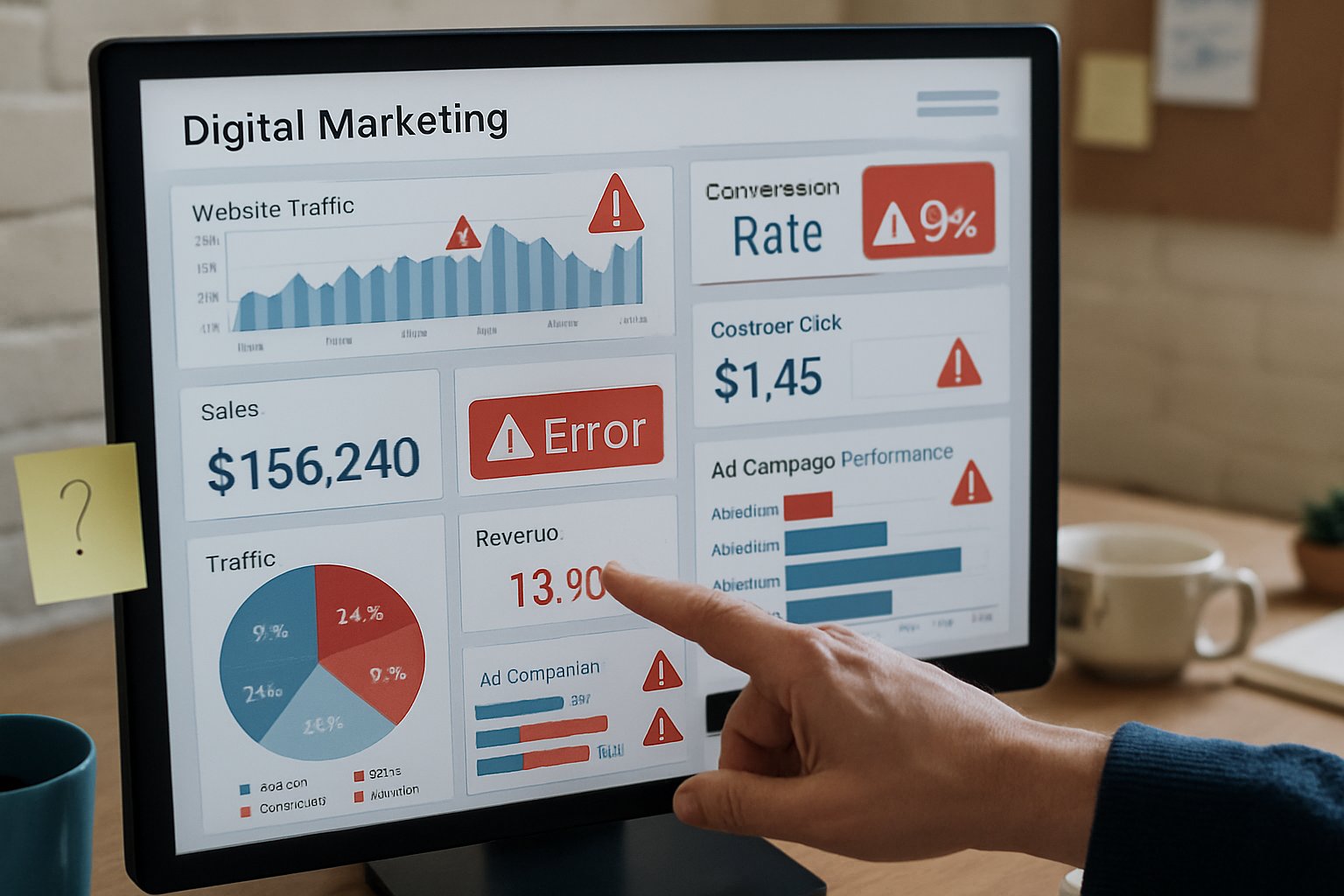
Results show 47.1% of respondents encounter inaccuracies several times each week. Meanwhile, 36.5% admit erroneous output reached the public, while 39.8% report near misses. These figures confirm that AI Marketing Errors are not hypothetical edge cases. Moreover, more than 70% dedicate one to five hours weekly to verify machine-generated material.
The raw statistics expose a pervasive, time-consuming accuracy crisis. Financial and reputational costs already hit many teams. Next, the report dissects where hallucinations emerge most frequently.
Key Error Hotspots Identified
NP Digital categorized mistakes by workflow stage. Full content drafting produced a 42.7% daily error rate. In contrast, HTML and schema generation fared even worse at 46.2%. Reporting and analytics tasks followed at 34.2%, while brainstorming remained relatively safer. These AI Marketing Errors cluster around precision-demanding tasks.
Omission, fabrication, and misclassification accounted for most failures. Fabrication dominates long-form narratives, creating fictional data or fake citations that jeopardize brand trust. Nevertheless, omission often slips unnoticed, distorting campaign measurement and strategic decisions. Because each error type behaves differently, mitigation requires tailored controls, not blanket bans.
Task analysis reveals precise choke points inside marketing pipelines. Teams must prioritize safeguards where error likelihood spikes. Understanding model performance becomes the logical next step.
Comparing Model Accuracy Rankings
NP Digital evaluated ChatGPT, Claude, Gemini, Copilot, Perplexity, and Grok side by side. ChatGPT delivered the highest fully correct rate at 59.7% across the prompt set. However, Claude recorded the lowest overall error rate at 6.2%, despite slightly fewer perfect answers. Grok trailed badly, producing the most AI Marketing Errors among tested platforms.
- ChatGPT: 59.7% fully correct; balanced speed and quality.
- Claude: 55.1% fully correct; smallest error share at 6.2%.
- Gemini: 51.3% fully correct; weaker on multi-step reasoning.
- Perplexity: 12.2% incorrect; excels with fresh news retrieval.
- Copilot: mid-pack accuracy; benefits from Microsoft integration.
- Grok: highest error burden at 21.8% incorrect.
Consequently, vendor choice should align with task demands and acceptable risk tolerance. Model drift and version changes will also shift safety profiles over time.
Comparative testing clarifies that no single model eliminates AI Marketing Errors. Each platform offers different strengths and weaknesses. Operational responses therefore deserve closer examination.
Operational Risk Mitigation Steps
NP Digital outlines several immediate safeguards. Firstly, embed mandatory human review layers before AI Marketing Errors reach production. Secondly, lock trusted data sources through retrieval-augmented prompts or proprietary knowledge bases. Furthermore, track every detected error in an internal incident register to surface recurring patterns.
Dedicated fact-check specialists now appear in many mature content teams. These reviewers rapidly correct AI Marketing Errors while preserving production velocity. In contrast, smaller firms sometimes rotate peer reviewers, which dilutes accountability. Moreover, structured prompt templates reduce ambiguity within HTML, schema, and analytics tasks.
Process controls cut recurrence and shorten audit cycles. They also restore stakeholder confidence in generated assets. Guidance becomes actionable through clear recommendations.
Practical Recommendations For Teams
The report condenses lessons into a concise playbook. Prioritize high-risk tasks for double review and add automated fact-check scripts where possible. Invest in staff training focused on prompt engineering and rapid validation techniques. Professionals can validate skills through the AI Marketing certification.
Additionally, maintain a living style guide that flags prohibited claims and outdated statistics. Schedule quarterly fire drills that simulate public AI Marketing Errors to stress-test response plans. Nevertheless, celebrate productivity wins to sustain executive sponsorship and morale.
Structured playbooks create repeatable, defensible governance. Certification and training reinforce adherence over time. Stakeholders still demand deeper evidence and transparency.
Critical Future Research Needs
Significant knowledge gaps remain despite NP Digital's contribution. Researchers need access to the complete prompt list and grading rubric for replication. Moreover, version disclosure for each tested model would clarify longevity of the accuracy snapshot. Independent labs should repeat experiments quarterly to capture drift and emerging AI Marketing Errors.
Academic literature already documents fabricated citations and legal sanctions linked to AI blunders. Therefore, marketing research must integrate legal, ethical, and brand safety perspectives. Collaboration between vendors, agencies, and universities can accelerate progress.
Transparent data sharing will sharpen peer review. Continuous benchmarking keeps controls aligned with reality. Finally, the conversation circles back to accuracy’s business impact.
NP Digital's findings confirm that speed without scrutiny invites costly reputational damage. Hallucinations persist across workflows, yet disciplined governance can tame the threat. Furthermore, consistent fact-check practices and locked data sources reduce exposure drastically. Comparative model testing shows every tool requires vigilance regardless of marketing maturity. Teams that invest in training and certifications strengthen brand safety while preserving efficiency gains. Consequently, organizations must treat AI Marketing Errors as a measurable, manageable operational risk. Act now: review your workflows, deploy guardrails, and pursue advanced learning to stay competitive. The market will reward brands that pair innovation with precision.


